Questions

[5 Mark Question Answer]

🎯

Test yourself on this topic

8 questions · timed · auto-graded

Question 15 Marks
Can sound travel through a vacuum ? Describe an experiment to explain your answer.
Answer
Experiment — Arrange an electric bell, a glass bell jar, a vacuum pump, a battery and a switch as shown in the figure. When the circuit is closed by pressing the switch, the bell starts ringing and sound can be heard. Now remove the air from the jar with the help of vacuum pump. The loudness of the sound gradually decreases and a stage comes when no sound is heard. Sound requires a medium to travel but cannot travel in vacuum.
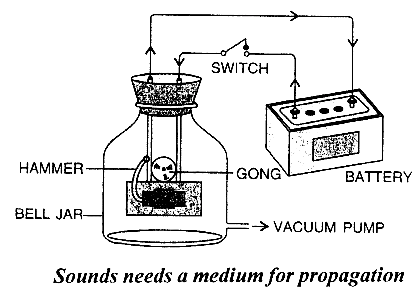
Connect the bell to a battery through a switch. On pressing the switch, the bell starts ringing and a sound is heard. The sound reaches us through the air in the jar.
Now start the vacuum pump. It withdraws the air from the jar. You will notice that as the jar is evacuated, the sound becomes feeble and feeble. After some time when no air is left within the jar, no sound is heard. However, the hammer of the electric bell can be still seen striking the gong. The reason is that when no air is left in the jar, the sound does not reach us, although the bell is still ringing (or vibrating).
Thus, sound cannot travel through a vacuum.
View full question & answer
Question 25 Marks
How do we produce sound ?
Answer
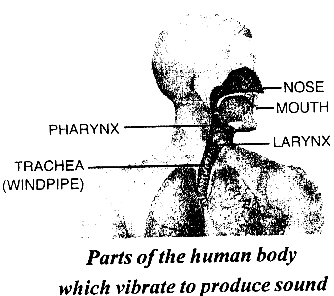
Our throat has a larynx. The voice is produced in the larynx. Larynx is also called the voice box. It is designed to produce voice. It is a box like structure with walls of tough tissues. Inside two folds of the tissue, there is a gap. They are the vocal cords. When we breathe, the vocal cords become loose and the gap between them increases. When we talk, shout or sing, the cords become tight and hence they vibrate, thus produce sound. Given figure shows the part of the body which vibrates to produce sound.
View full question & answer
Question 35 Marks
List the measures that you will take when designing a sound-proof room.
Answer
In order to design such a sound proof room we take the following measures
(1) The roof of the enclosure must be covered by plaster of paris after putting the sheets of thermocol.
(2) The walls of the enclosure should be covered by the wooden strips.
(3) The floor must be laid down by thick carpets.
(4) The machine parts of all the electrical equipments such as fan, air conditioner etc. must be placed outside the enclosure.
(5) Thick curtains should be used to cover the doors and keep them closed.
(6) Thick stripping must be used to cover the openings of doors and windows.
View full question & answer
Question 45 Marks
Describe an experiment to show that each source of sound is a vibrating body.
Answer
Sound is produced when a body vibrates. In other words, each source of sound is a vibrating body. This can be demonstrated by the following experiment.
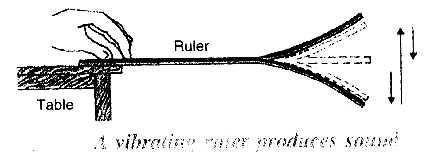
Take a ruler. Press its one end on the table with the left hand as shown in figure. Pull down the other end of the ruler with the right hand and then leave it.
You will notice that the ruler vibrates i.e., the ruler moves to and fro and a humming sound is heard.
After some time, the ruler stops vibrating. No sound is then heard.

This shows that humming sound is produced only because of the vibration of the ruler.
View full question & answer
Question 55 Marks
Describe an experiment to estimate the speed of sound in air.
Answer
To estimate the speed of sound in air suppose we choose two hills A and B about a kilometer apart. A person at the hill A fires a gun. Another person at the hill B starts a stopwatch as he sees the flash of the fire and stops it on hearing the sound. Thus, he measures the time interval between the seeing of flash and hearing of the sound. Let it bet second. Then measure the distance between the hills A and B. Let it be S meter. The speed of sound V
$
\begin{aligned}
& =\frac{\text { Distance }(\mathrm{S})}{\text { Time }(\mathrm{t})} \\
& =\frac{\mathrm{S}}{\mathrm{t}} \mathrm{ms}^{-1}
\end{aligned}
$
Experimentally, it is found that the speed of sound in air is nearly $330 \mathrm{~ms}^{-1}$
View full question & answer
Question 65 Marks
How does the loudness of sound produced depend on the vibrating area of the body ?
Answer
The loudness of sound also depends on the area of the vibrating body. Greater the area of the vibrating body, louder is the sound produced.
If you take two drums, one small and the other big, and beat both of them to produce vibrations in them, We will notice that the sound produced from the big drum is louder than that produced from the small drum. In temples, you must have noticed that the bell with a big case produces a louder sound than that with a small case.
View full question & answer
Question 75 Marks
Describe an experiment to show that sound can travel in a solid.
Answer
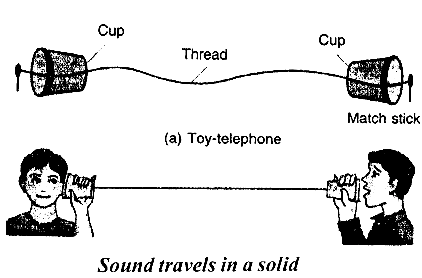
Take two empty ice-cream cups. Make a small hole at the bottom of each cup and pass a long thread (about 20 m long) through them. Tie a knot or match-stick at each end of the thread so that the thread does not slip out through the holes. This makes a toy – telephone

Now use the toy-telephone as shown in figure and talk to your friend. You will be able to hear the sound of your friend. This shows that sound travels through the thread and reaches your ear. Thus, sound can travel through a solid.
View full question & answer
Question 85 Marks
Column A Column B
(a) Vibrations cause (1) absorb sound
(b) A shriller sound is (2) second
(c) Unit of frequency (3) sound
(d) Unit of time period (4) of high pitch
(e) Curtains (5) hertz
Answer
Column A Column B
(a) Vibrations cause (3) sound
(b) A shriller sound is (4) of high pitch
(c) Unit of frequency (5) hertz
(d) Unit of time period (2) second
(e) Curtains (1) absorb sound
View full question & answer
[5 Mark Question Answer] - PHYSICS STD 7 Questions - Vidyadip