Question 15 Marks
(a) State the law of conservation of energy.
(b) By giving an example explain law of conservation of energy.
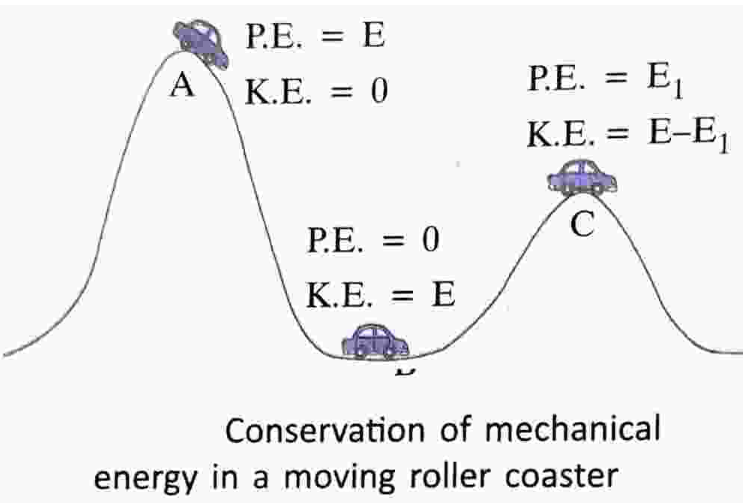
(c) Show that the sum of potential energy and kinetic energy remains the same by giving the example of roller coaster car.
(b) By giving an example explain law of conservation of energy.
(c) Show that the sum of potential energy and kinetic energy remains the same by giving the example of roller coaster car.
Answer
View full question & answer→(a) The law of conservation of energy states that the amount of energy is neither created nor destroyed. For example, when you roll a toy car down a ramp and it hits a wall, the energy is transferred from kinetic energy to potential energy.
(b) Energy can neither be created nor destroyed. It can only be transformed from one to another is the law of conservation of energy. For example , object falling from certain height converts its potential energy to kinetic energy and at all instant total mechanical energy remains constant.
(c) A roller coaster operates on the law of conservation of energy. Initially, some work is done to put the roller coaster car at the top position. This work done is stored in the roller coaster car in the form of potential energy. But it’s kinetic energy is zero due to its stationary position.
(b) Energy can neither be created nor destroyed. It can only be transformed from one to another is the law of conservation of energy. For example , object falling from certain height converts its potential energy to kinetic energy and at all instant total mechanical energy remains constant.
(c) A roller coaster operates on the law of conservation of energy. Initially, some work is done to put the roller coaster car at the top position. This work done is stored in the roller coaster car in the form of potential energy. But it’s kinetic energy is zero due to its stationary position.