Questions

[3 Mark Question Answer]

🎯

Test yourself on this topic

3 questions · timed · auto-graded

Question 13 Marks
How can you say expansion of gases is very large as compared to the solids of the liquids?
Answer
Experiment to prove expansion in gases is very large as compared to solids or liquids:
1. Take a clean empty bottle and fill it with hydrogen gas.
2. Fix a deflated rubber balloon over the mouth of the bottle.
3. Place the bottle in a trough of hot water for a few minutes.
Observations:
1. After a few minutes, we can observe that the balloon gets inflated.
2. Hence we can conclude that the expansion in gases is very large as compared to solids or liquids.
View full question & answer
Question 23 Marks
Define thermal expansion of gases.
Answer
Gases are having large interparticle space and weak interparticle force of attraction. When the gas is heated, its molecules will start moving faster and they collide with each other more violently. The violent collision of faster-moving molecules makes them away from each other and it causes the volume to increase. This increase in the volume of gas when heated is the thermal expansion of gases. The thermal expansion happening in gas is cubical expansion.
View full question & answer
Question 33 Marks
What conclusion do you get from Gravesande’s Ring and Ball experiment? Explain briefly.
Answer
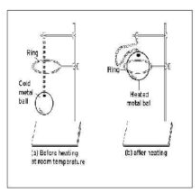
The apparatus used in the experiment consists of a metal ball suspended by a metal chain and a ring connected to the stand. The inner diameter of the ring is the same as the outer diameter of the ball, so that ball can easily pass through the ring.
Image
If we heated the ball on a Bunsen flame for two minutes and try to pass the ball through the ring, we can see that ball does not pass through the ring.
Conclusion:-
1.The ball is not able to pass through the ring because it got expanded on heating.
2.Gravesande’s ring and ball experiment conclude that solids will expand on heating.


View full question & answer
[3 Mark Question Answer] - PHYSICS STD 7 Questions - Vidyadip