Questions

[3 Mark Question Answer]

🎯

Test yourself on this topic

3 questions · timed · auto-graded

Question 13 Marks
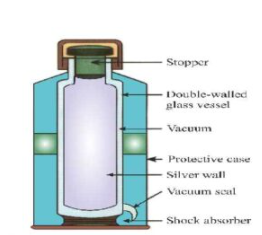
Draw a neat diagram of a vacuum flask. Explain carefully how the heat losses due to conduction, convection and radiation are minimized?
Answer
Heat loss due to conduction is prevented by placing the calorimeter box in a well lagged vessel using wool or cork material. Heat loss due to convection is prevented by placing a lid on the box. Heat loss due to radiation is minimized by polishing the box in order to smoothen it.
Image
View full question & answer
Question 23 Marks
Describe an experiment to prove (a) convection currents in liquids, (b) convection currents in gases.
Answer
(a) Aim: To show convection in liquid.
Materials required: Round bottomed flask, water, a burner and mustard seeds.
Procedure: Fill a round-bottomed flask three-fourths with water. Heat it up using a burner. Drop a few mustard seeds into the flask. Observe the movement of the mustard seeds inside the flask, as the water gets heated and starts boiling.
Observation and conclusion: The pattern of the rise and fall of the mustard seeds is actually the pattern of the convection currents of water molecule.
View full question & answer
Question 33 Marks
Describe an experiment to prove that water is a bad conductor of heat energy.
Answer
Experiment to prove that water is a bad conductor of heat energy:
1.Take a hard glass test tube and drop a piece of ice wrapped up in copper wire gauze.
2.Fill 3/4th of the test tube with ice-cold water and clamp it in an iron stand.
3.Heat the test tube near its mouth with the help of a burner.
4.After a few moments, we can observe that water near the top starts boiling and steam is given off freely.
5.The ice placed at the bottom does not melt because the heat supplied to the water is unable to melt the ice.
6.This shows that water is a bad conductor of heat.

View full question & answer
[3 Mark Question Answer] - PHYSICS STD 7 Questions - Vidyadip