Question 14 Marks
What are endocrine glands ?
Answer
View full question & answer→The specialised tissues that release, chemical substances that is hormones in trace amounts are called endocrine glands.$-$ The endocrine glands do not have ducts, so they are called ductless glands. These glands put their secrefrous directly into the blood. Hormones are the chemical messengers which help to control and
coordinate various activities in the body. The various endocrine glands are.
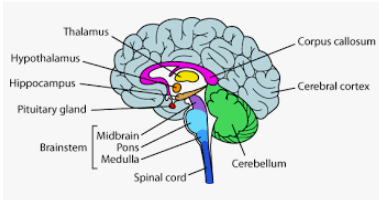
$(a)$ Pituitary gland : It is called the master gland as it secretes many hormones and some of these hormones control other endocrine glands. It is present at the base of the brain. It releases the growth hormone which controls the growth of the body.
$(b)$ Thyroid gland : It is present in the throat region. It produces thyroxine hormone which controls the speed of cellular metabolism especially, the rate at which oxygen is consumed and. energy is produced.
$(c)$ Parathyroid glands : Parathyroid glands are four small glands attached to the thyroid gland. It releases parathyroxine or parathormone. This hormone controls the amount of calcium and phosphorus in the body, which plays an important role in muscle contraction.
$(d)$ Pancreas : Pancreas is both exocrine as well as endocrine gland. It has a duct w’hich secretes pancreatic juice which helps in digestion. Pancreas also contains an endocrine tissue called Islets of Langerhans which produce insulin. Insulin controls the amount of glucose in the blood.
$(e)$ Adrenal glands : One adrenal gland is present above each of the two kidneys. Adrenal glands produce the hormone adrenalin. Adrenalin is released when person is under stress or involved in intensive exercise. It makes the heart beat faster, increases the flow of blood to the brain and helps to cope with stress.
$(f)$ Ovaries and testes : Ovaries produces female hormones progesterones and oestrogen. Testes produces male hormone testosterone. These hormones control growth, development and reproductive behaviour. These hormones are related to appearance of secondary sexual- character in both males and females.
coordinate various activities in the body. The various endocrine glands are.
$(a)$ Pituitary gland : It is called the master gland as it secretes many hormones and some of these hormones control other endocrine glands. It is present at the base of the brain. It releases the growth hormone which controls the growth of the body.
$(b)$ Thyroid gland : It is present in the throat region. It produces thyroxine hormone which controls the speed of cellular metabolism especially, the rate at which oxygen is consumed and. energy is produced.
$(c)$ Parathyroid glands : Parathyroid glands are four small glands attached to the thyroid gland. It releases parathyroxine or parathormone. This hormone controls the amount of calcium and phosphorus in the body, which plays an important role in muscle contraction.
$(d)$ Pancreas : Pancreas is both exocrine as well as endocrine gland. It has a duct w’hich secretes pancreatic juice which helps in digestion. Pancreas also contains an endocrine tissue called Islets of Langerhans which produce insulin. Insulin controls the amount of glucose in the blood.
$(e)$ Adrenal glands : One adrenal gland is present above each of the two kidneys. Adrenal glands produce the hormone adrenalin. Adrenalin is released when person is under stress or involved in intensive exercise. It makes the heart beat faster, increases the flow of blood to the brain and helps to cope with stress.
$(f)$ Ovaries and testes : Ovaries produces female hormones progesterones and oestrogen. Testes produces male hormone testosterone. These hormones control growth, development and reproductive behaviour. These hormones are related to appearance of secondary sexual- character in both males and females.
| Gland | Location | Main Hormone secreted by it | Functions |
| pituitary | at the base of the brain |
growth hormone |
regulates growth |
| thyroid | throat region | thyroxine | regulates rate of growth and metabolism |
| parathyroid | throat region | parathormone | Regulates calcium and phosphorus level |
| pancreas | abdomen $($near the small intenstine$)$ |
insulin in blood |
regulates amount of glucose in blood |
| adrenal | above kidneys | Adrenalin | helps a person to cope with an emergency |
| Ovaries $($females$)$ | lower abdomen |
Oestrogen. progesterone |
Control reproductive growth and development, and reproductive behavior. |
| Testes $($males$)$ | scrotum | testosterone | Controls reproductive growth and development, and reproductive behaviour |