Questions

[3 marks Question Answer]

🎯

Test yourself on this topic

6 questions · timed · auto-graded

Question 13 Marks
List the uses of bacteria in the food industry.
Answer
The bacterial action is involved in the following industrial processes.
$1.$ In the manufacture of vinegar, butter and cheese.
$2.$ The process of tanning hides in leather making and preparing sponges.
$3.$ The separation of flax and hemp fibres which are used for making linen cloth and ropes.
$4.$ Fermentation of green plants for the production of ensilage for animal food.
$5.$ Bacteria are used for forming lactic acid, vinegar, citric acid, and vitamins.
$6.$ For formation of antibiotics, serums and vaccines, vitamin B complex.
View full question & answer
Question 23 Marks
Differentiate between food crops and cash crops and give two examples of each.
Answer
Differences:
Food crops
$1.$These are crops which are grown for food such as cereals: wheat, rice, maize, pulses, oil seeds.
$2.$These grow in the plains generally.
$3.$These are annuals and complete their cycle in one season as in case of wheat, rice maize, gram, beans, peas.
Cash crops
$1.$These are crops which are cultivated for commercial purposes such as tea, coffee, rubber, coconut, spices.
$2.$These grow in the hilly areas on the slopes as water of rain should not stand in the roots as in case of tea.
$3.$These plants are perennials. These plants live for more than two years. Tea, coffee require pruning before winter.
View full question & answer
Question 33 Marks
Name any two exotic breeds of fowl in India, and mention their usefulness.
Answer
Exotic breeds of fowl in India are as:
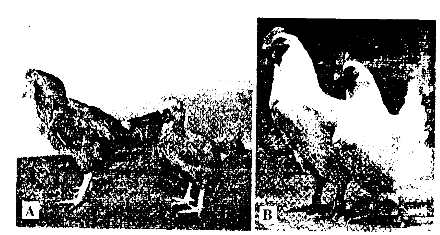
$1.$ White leghorn: Its size is small and needs less feed for maintenance. So to raise it is economical. It lays oval white eggs.
$2.$ Rhode island red: It serves both the purposes as it is a good egg layer and also provide enough of meat. It was raised on a farm in Rhode island of $\text{U.S.A}$. So it is named as Rhode island red.
View full question & answer
Question 43 Marks
Differentiate between an egger and a broiler.
Answer
Following are the differences between the egger and the broiler:
Egger
$1.$ Egg laying chickens are called eggers or egg layers.
$2.$ The chicks are given calcium $($bones, seeds$)$ and are reared to produce eggs.
$3.$ Eggers should give large number of eggs as white leghorns give many eggs. Rhode island red breeds like $HH-260$, $\text{IBL}-80, B-77.$

Broiler

$1.$ Chickens which give us meat are called broilers.
$2.$ Those chicks are reared on a diet of fats so that they gain flesh on their body and these are used as broilers.
$3.$ Broilers should give flesh. Indigenous variety Aseel give high yield of meat and less number of eggs.
View full question & answer
Question 53 Marks
List out the benefits of "White revolution" in our country.
Answer
The benefits of “White Revolution” in our country:
$1.$ The purpose of this programme was to link the rural producer $($dairy farmer$)$ with the urban consumer.
$2.$ Rural farmer co$-$operatives were organized at the village level and connected to the urban consumer.
$3.$ It ensured that the dairy farmer got a major share of the price of milk which consumers pay.
The “Operation flood” ensured thre objectives:
$1.$ increased milk production
$2.$ strengthened the dairy farmer’s income.
$3.$ easy availability of milk at a fair price to all.
View full question & answer
Question 63 Marks
Mention the benefits of "Green revolution" in our country.
Answer
Green revolution : Knowledge of science has brought about manifold increase in the production of grains, pulses and other crops and led to green revolution. Factors leading to it are:
$1.$ development of high $–$ yielding varities.
$2.$ development of early $–$ maturing varities.
$3.$ disease $–$ resistant varities.
$4.$ using of fertilizers and pesticides.
$5.$ development of drought $–$ resistant and dwarf varities.
Dr. M.S. Swaminathan is known as the father of green revolution in India which has led to manifold increase in the production of wheat and rice using hybrid varities $($wheat $–$ Kalyan Sona and Sonalika, Rice$ – IR – 8$ Padma, Jaya and Pusa $215$, Maize $–$ Ganga $101$ and Rankit$)$.
View full question & answer
[3 marks Question Answer] - BIOLOGY STD 8 Questions - Vidyadip