State the electronic configuration for each of the following : Calcium $[p = 20]$
View full solution →Question types
Atomic Structure question types
30 questions across 5 question groups — pick any mix to generate a CHEMISTRY paper with step-by-step answer keys.
30
Questions
5
Question groups
5
Question types
01
[1 Mark Question Answer]
10 Q→02[2 Mark Question Answer]
8 Q→03[5 Mark Question Answer]
6 Q→04Fill in the blanks.
5 Q→05Match The Following.
1 Q→Sample Questions
Atomic Structure questions
One sample from each question group in this chapter. Select any group above to see the full set with answer keys.
State the electronic configuration for each of the following : Potassium $[p = 19]$
View full solution →State the electronic configuration for each of the following : Argon $[p = 18]$
View full solution →State the electronic configuration for each of the following : Sulphur $[p = 16]$
View full solution →State the electronic configuration for each of the following : Aluminium $[p = 13]$
View full solution →Draw the structure of the following atoms showing the nucleus containing $-$ protons, neutrons and the orbits with the respective electrons: Isotopes of hydrogen $\ce{[^1_1H, ^2_1H, ^3_1H]}$
View full solution →Draw the structure of the following atoms showing the nucleus containing $–$ protons, neutrons and the orbits with the respective electrons : Sodium $[$At. no. $= 11$, Mass no. $= 23]$
View full solution →Draw the structure of the following atoms showing the nucleus containing $–$ protons, neutrons and the orbits with the respective electrons : Silicon $[$At. no. $= 14$, Mass no. $= 28]$
View full solution →Draw the structure of the following atoms showing the nucleus containing $–$ protons, neutrons and the orbits with the respective electrons : Carbon $[$At. no. $= 6$, Mass no. $= 12]$
View full solution →Draw the structure of the following atoms showing the nucleus containing $–$ protons, neutrons and the orbits with the respective electrons : Lithium $[$At. no. $= 3,$ Mass no. $= 7]$
View full solution →The diagram represents an isotope of hydrogen $[H],$ Answer the following:
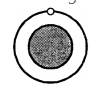
At. no.$ = 1$
Mass no. $= 1$
$1.$ Are isotopes atoms of the same element or different elements.
$2.$ Do isotopes have the same atomic number or the same mass number.
$3.$ If an isotope of $‘H’$ has mass no.$ = 2$, how many electrons does it have.
$4.$ If an isotope of ‘$H’$ has mass no. $= 3$, how many neutrons does it have.
$5.$ Which sub$-$atomic particles in the $3$ isotopes of $‘H’ $ are the same.
View full solution →At. no.$ = 1$
Mass no. $= 1$
$1.$ Are isotopes atoms of the same element or different elements.
$2.$ Do isotopes have the same atomic number or the same mass number.
$3.$ If an isotope of $‘H’$ has mass no.$ = 2$, how many electrons does it have.
$4.$ If an isotope of ‘$H’$ has mass no. $= 3$, how many neutrons does it have.
$5.$ Which sub$-$atomic particles in the $3$ isotopes of $‘H’ $ are the same.
Valency is also the number of electrons $-$ donated or accepted by an atom so as to achieve stable electronic configuration of the nearest noble gas'. With reference to this definition $-$
$a.$ State what is meant by 'stable electronic configuration'.
$b.$ State why the valency of $-$
$i.$ sodium, magnesium $\& $ aluminium is : $+1,+2 \&+3$ respectively.
$ii.$ chlorine, oxygen $\&$ nitrogen is : $-1,-2 \&-3$ respectively.
View full solution →$a.$ State what is meant by 'stable electronic configuration'.
$b.$ State why the valency of $-$
$i.$ sodium, magnesium $\& $ aluminium is : $+1,+2 \&+3$ respectively.
$ii.$ chlorine, oxygen $\&$ nitrogen is : $-1,-2 \&-3$ respectively.
Draw the atomic diagrams of the following elements showing the distribution of $-$ protons, neutrons the electrons in the various shells of the atoms.
$a$. Carbon $-{ }^{12} C$
$b$. Oxygen $-{ }_8^{16} O$
$c$. Phosphorus $-{ }^{31}{ }_{15} P$
$d$. Argon $-{ }^{40}{ }_{18} Ar$
$e$. Calcium $-{ }_{20}^{40} Ca$
$[$The upper number represents the $-$ mass number $\ $ the lower number the $ -$ atomic number e.g. calcium $-$ mass number $=40$, atomic number $=20]$
View full solution →$a$. Carbon $-{ }^{12} C$
$b$. Oxygen $-{ }_8^{16} O$
$c$. Phosphorus $-{ }^{31}{ }_{15} P$
$d$. Argon $-{ }^{40}{ }_{18} Ar$
$e$. Calcium $-{ }_{20}^{40} Ca$
$[$The upper number represents the $-$ mass number $\ $ the lower number the $ -$ atomic number e.g. calcium $-$ mass number $=40$, atomic number $=20]$
Explain in brief $–$ Goldstein’s experiment which led to the discovery of the proton and $–$ Lod Rutherford’s experiment which led to the discovery of the atomic nucleus.
View full solution →With reference to the discovery of the structure of an atom, explain in brief $-$ William Crookes experiment for the discovery of cathode rays, followed by $-$ J.J. Thomsons experiment pertaining to the constituents of the cathode rays. State which sub$-$atomic particle was discovered from his experiment.
View full solution →Magnesium atom with electronic configuration $2, 8, 2$ achieves stable electronic configuration by losing two electrons, thereby achieving stable electronic configuration of the nearest noble gas $………… [$neon$/$argon$]$.
View full solution →An element $Z$ with zero valency is a $………… [$metal$/$noble gas$/$non$-$metal$]$.
View full solution →A $………… [$proton$/$neutron$]$ is a sub$-$atomic particle with no charge and unit mass.
View full solution →An element $‘Y’$ has electronic configuration $2, 8, 6$. The element ‘$Y’$ is a $………… [$metal$/$non$-$metal$/$noble gas$].$
View full solution →An element $‘X$ has six electrons in its outer or valence shell. Its valency is $………… [+2l – 2l – 1].$
View full solution →Match the statements in List $I$ with the correct answer from List $II$.
View full solution →| List $-I$ | List $-II$ |
| $1.$ Mass number of an atom is the number of protons and | $A:$ Electron |
| $2.$ The sub$-$atomic particle with a negligible mass. | $B:$ Argon |
| $3.$ An atom having stable electronic configuration. | $C:$ Nitrogen |
| $4.$ A molecule formed by sharing of electrons $[$covalency$]$.. | $D:$ Sodium |
| $E:$ Neutrons |
Generate a Atomic Structure paper free
Pick question groups from the list above, set marks and difficulty, and export a branded PDF with step-by-step answer keys. First 3 chapters free — no signup.