Questions

[2 Mark Question Answer]

🎯

Test yourself on this topic

14 questions · timed · auto-graded

Question 12 Marks
A metallic oxide to calcium carbonate.
Answer
A metallic oxide to calcium carbonate
Step $i:$
$\ce{CaO} + \ce{H_2O \longrightarrow Ca[OH ]_2}$
Step $ii.$ 
$\ce{Ca[OH ]_2}+ \ce{CO_2} \longrightarrow \underset{\text { [Cal. carbonate] }}{ } \ce{CaCO_3}+ \ce{H_2O}$

View full question & answer
Question 22 Marks
Carbon dioxide to carbon.
Answer
$\ce{CO_2}$ to carbon On burning magnesium in $\ce{CO_2}$
$\ce{2Mg} + \ce{CO_2} \rightarrow \ce{2Mgo} + C \text { (Carbon) }$
View full question & answer
Question 32 Marks
Lime water $[$soln. of calcium hydroxide$]$ to calcium bicarbonate.
Answer
Lime water to calcium bicarbonate When $\ce{CO_2}$ is passed it turns milky.
Step $I:$
$\ce{Ca[OH]_2}+ \ce{CO_2} \longrightarrow \underset{\substack{\text { Cal. carbonate } \\ \text { (insoluble) }}}{ \ce{CaCO_3 }\downarrow}+ H _2 O$
Step $II :$ On passing excess of $\ce{CO_2}$, soluble $\ce{HCO_3}$ is formed and miliness disappears.
$\ce{CaCO_3}+ \ce{H_2O} + \ce{CO_2} \rightarrow \ce{Ca[HCO_3]_2}$
View full question & answer
Question 42 Marks
Calcium bicarbonate to calcium nitrate using a dilute acid.
Answer
Calcium bicarbonate to calcium nitrate
Image
View full question & answer
Question 52 Marks
Coke to water gas.
Answer
Steam is passed over white hot coke at $1000^{\circ} C + \ce{H_2O}\ 1000^{\circ} C$ )
$\underset{\text { [Coke] }}{ C }+\underset{\text { Steam }}{ H _2 O } \xrightarrow{1000^{\circ} C } \underset{\text { Water gas }}{\left[ CO + H_2\right]-\Delta}$
$\text{STEP} \ce{II :}$
Reduction of steam to hydrogen $–$ by $CO$
$\ce{[CO + H_2] + H_2O} \xrightarrow[ Fe_2O_3]{450^{\circ} C } \ce{CO_2+2 H_2+\Delta}$
Water Gas $[$Excess Steam$]$
View full question & answer
Question 62 Marks
Explain the term ‘dry ice’. State its application. Give three reasons why carbon dioxide finds application in Are extinguishers.
Answer
Dry ice : Solid carbon dioxide is called dry ice.
Applications : Diy ice is used as refrigerant for preservation of foods as it freezes faster and lasts longer than ordinary ice.
View full question & answer
Question 72 Marks
‘When carbon dioxide is bubbled into lime water, the lime water turns milky and when bubbled in excess the milkiness disappears’. Give balanced equations to support the statement.
Answer
$\underset{\text { Lime water }}{ Ca[OH ]_2}+ CO_2 \longrightarrow \underset{\text { (Insoluble) milky }}{ CaCO_3 \downarrow+ H_2O }$
When $CO_2$ is passed in excess, milkiness disappears due to formation of bicarbonate which is soluble in water.
$\ce{CaCO _3}+ \ce{H _2O} + \ce{CO_2} \rightarrow\ce{Ca\left[ HCO_3\right]_2}$
View full question & answer
Question 82 Marks
How would you prove experimentally that $(a)$ Carbon dioxide does not support combustion $(b)$ Is slightly acidic in nature.
Answer
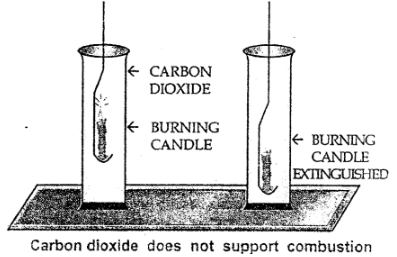
$(a)$ Carbon dioxide does not support combustion.
Image
Experiment : Bring a burning candle in a gas jar full of $\ce{CO_2}$ gas. The candle is extinguished. This shows that $\ce{CO_2}$ is non$-$supporter of combustion.
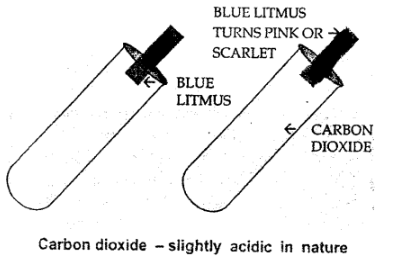
$(b)\ \ce{CO_2}$ gas is acidic in nature. Bring a moist blue litmus paper in the mouth of gas jar full of $\ce{CO_2}$ gas. The blue colour of filter paper changes red. This shows that $\ce{CO_2}$ gas is acidic in nature.
Image
View full question & answer
Question 92 Marks
Carbon dioxide occurs both in the free state and in the combined state. State three methods how carbon dioxide is added to the atmosphere.
Answer
Carbon dioxide is added to the atmosphere by $–$
Burning of carbon compounds $–$ wood petroleum.
Death and decay of organic matter.
Respiration in living organisms.
View full question & answer
Question 102 Marks
‘Wood charcoal $–$ an amorphous allotrope of carbon reduces heated metallic oxides to metals.’ Give a balanced equation to support the statement.
Answer
Wood charcoal reduces $\ce{ZnO , Fe_2O_3}$ to metal.
$\ce{ZnO} + C \longrightarrow \underset{\text { Zinc metal }}{ Zn }+ CO$
$\ce{Fe_2O_3}+3C \longrightarrow \underset{\text { Metal iron }}{2 Fe }+\ce{3CO}$
View full question & answer
Question 112 Marks
Name two crystalline and four amorphous allotropes of carbon.
Answer
Allotropes of carbon:
Crystalline $–$
$(i)$ diamond
$(ii)$ graphite.
Amorphous $–$
$(i)$ coal
$(ii)$ coke
$(iii)$ lampblack
$(iv)$ wood charcoal.
View full question & answer
Question 122 Marks
Define the term ‘allotropy’. Give a reason why carbon exhibits allotropy.
Answer
Allotropy : “The phenomenon of occuring of an element in two or more forms having same chemical properties but different physical properties.” Carbon shows allotropy as a result of $–$ difference in atomic arrangement in the crystal structure.
View full question & answer
Question 132 Marks
State how carbon occurs in the free state and in the combined state.
Answer
Occurence of carbon : In free state $-$ diamond, graphite, in impure form as coal. In combind state: $\ce{CO_2}$ in atmosphere, hydro$-$carbon as natural gas, petroleum, cellulose in wood and limestone $\ce{CaCO_3}$
View full question & answer
Question 142 Marks
Differentiate between the two branches of chemistry $–$ organic chemistry $\&$ inorganic chemistry with suitable examples.
Answer
Organic chemistry: "A branch of science that deals with the study of specific compounds $($of carbon$)$ hydrogen and oxygen." e.g. methane $\ce{CH_4}$, ethane $\ce{C_2H_6,CH_3 COOH,CH_3OH}$ methyl alcohol. Inorganic chemsitry: "A branch of science that deals with the study of $-$ oxides of carbon, carbonates, metallic carbides etc." e.g. $\ce{H_2CO_3}$ - carbonic acid, $\ce{CO_2, CaCO_3}$ calcium carbonate.
View full question & answer
[2 Mark Question Answer] - CHEMISTRY STD 8 Questions - Vidyadip