Differentiate between $–$
$(a)$ Direct combination reaction $\&$ a decomposition reaction
$(b)$ Displacement reaction $\&$ a neutralization reaction.
Answer
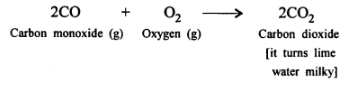
$(a)$ Direct combination: "Is a reaction in which two elements ' or compound combine to give one new compound."
$C + \ce{O_2 \rightarrow CO_2}$
Decomposition reaction: "A chemical compound $($breaks up$)$ decomposes into two or more simpler substances."
Copper carbonate $\rightarrow$ Copper oxide + carbon dioxide
$\ce{CuCO_3 \rightarrow CuO}+\ce{CO_2}$
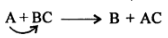
$(b)$ Displacement reaction : “A chemical reaction in which an element displaces the element from a solution of its compound.”
In a activitiy series of metals, an element placed higher displaces the element placed below it.
Here $Zn$ is placed above $Cu$ in activity series of metal and is more reactive than copper has displaced $Cu$ from copper sulphate.
Neutralization reaction :
“A reaction between an acid and a base to form salt and water is called neutralization reaction.”
State why a direct combination reaction is called a $–$ ‘synthesis reaction’.
Answer
When two or more substances $[$element with element or element with compound or compound with another compound$]$ combine to form a new compound with new properties. Hence direct combination is called ‘synthesis reaction’.
Example :
Hydrogen $($a gas$) +$ Oxygen $($a gas$)$ combines to form water $($liquid$)$.
$\ce{2H_2}+ \ce{O_2 \rightarrow 2H_2O}$