Question types

Elements, Compounds and Mixtures question types

29 questions across 6 question groups — pick any mix to generate a CHEMISTRY paper with step-by-step answer keys.

29
Questions
6
Question groups
5
Question types
Sample Questions

Elements, Compounds and Mixtures questions

One sample from each question group in this chapter. Select any group above to see the full set with answer keys.
Compare the properties of iron $\ce{[II]}$ sulphide with iron $-$ sulphur mixture, considering iron $\ce{[II]}$ sulphide as a compound particles of iron sulphur mixed together as an example of a mixture.
View full solution
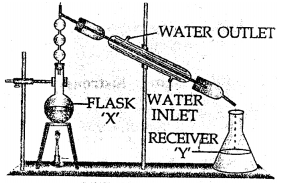
The diagram represents fractional distillation for separation mixtures. Answer the following
Image
$1.$ Can two immiscible liquids be separated by this process.
$2.$ Separation of liquids by this process is based on which physical property?
$3.$ If methyl alcohol $\&$ water are to be separated, which liquid would remain in flask ‘$X$’ after condensation.
$4.$ Give a reason for the above answer.
$5.$ State the purpose of the fractionating column in the apparatus.
View full solution
Explain with diagrams the process used to $-$ separate the following substances from the given mixtures.
$(a)$ Ammonium chloride from a mixture of $-$ ammonium chloride $\&$  potassium chloride.
$(b)$ Iron from a mixture of $-$ iron $\&$ copper
$(c)$ Sulphur from a mixture of $-$ sulphur $\&$ copper.
$(d)$ Potassium nitrate from a mixture of $-$ potassium nitrate $\&$ potassium chlorate.
$(e)$ Lead carbonate [insoluble] from a mixture of $-$ lead carbonate $\&$ water.
$(f)$ Lead nitrate [soluble] from a mixture of $-$ lead nitrate $\&$ water Le. lead nitrate solution.
$(g)$ Carbon tetrachloride from a mixture of $-$ carbon tetrachloride $[$heavier component$]\  \&$ water.
$(h)$ Benzene from a mixture of $-$ benezene $\left[\right. b.p. \left.80^{\circ} C \right]$ toluene $\left[ b . p . \ 110^{\circ} CJ\right.]$.
$(i)$ Different dyes $-$ in their liquid constituent ink.
View full solution
State any one method $–$ to separate the following mixtures$-$
$(a)$ Two solid mixtures one of which $–$ directly changes into vapour on heating.
$(b)$ Two solid mixtures one of which $–$ dissolves in a particular solvent and other does not
$(c)$ A solid-liquid mixture containing $–$ an insoluble solid in the liquid component
$(d)$ A solid-liquid mixture containing $–$ a soluble solid in the liquid component
$(e)$ A liquid-liquid mixture containing $–$ two immiscible liquids having different densities
$(f)$ A liquid-liquid mixture containing $–$ two miscible liquids having different boiling points.
$(g)$ A liquid-gas mixture containing $–$ a gas dissolved in a liquid component.
$(h)$ A gas-gas mixture containing $–$ two gases with different densities.
$(i)$ A mixture of different solid constituents $–$ in a liquid constituent.
View full solution
Explain the term ‘mixture’. Differentiate between homogenous $\&$ heterogenous mixtures. State why brass is considered as a homogenous mixture while a mixture of iron $\&$ sulphur – heterogenous. Give an example of two liquids which form $–$
$(a)$ homogenous
$(b)$ heterogenous $–$ mixtures.
View full solution
List $-I$ List $-II$
$1.$ Naphthalene from naphthalene $\&$ sodium chloride. $A:$ Separating funnel
$2.$ Cream from milk. $B:$ Sublimation
$3.$ Kerosene oil from kerosene $C:$ Boiling oil $\&$ water.
$4.$ Lead nitrate from an aqueous solution of lead nitrate. $D:$ Centrifugation
  $E:$ Distillation
View full solution

Generate a Elements, Compounds and Mixtures paper free

Pick question groups from the list above, set marks and difficulty, and export a branded PDF with step-by-step answer keys. First 3 chapters free — no signup.

Download App