Questions

[2 Mark Question Answer]

🎯

Test yourself on this topic

15 questions · timed · auto-graded

Question 12 Marks
The reaction of chlorine with hydrogen sulphide is deemed a redox reaction.
Answer
Reaction of $\ce{Cl_2}$ with $\ce{H_2S}$ is redox reaction as $\ce{Cl_2}$ gets reduced to $\ce{HCl}$ and $\ce{H_2S}$ is oxidised simultaneously in the reaction. Hence it is redox reaction.
View full question & answer
Question 22 Marks
In Bosch process $–$ the final gaseous products are passed through caustic potash $\ce{[KOH]}$ soln.
Answer
In Bosch process, final products are passed through caustic potash solution to separate hydrogen from the mixture. $\ce{CO_2}$ dissolves in $\ce{KOH}$ leaving behind hydrogen.
View full question & answer
Question 32 Marks
In the laboratory preparation of hydrogen from zinc and dilute hydrochloric acid $–$ the zinc used granulated zinc.
Answer
Granulated zinc contains traces of impurities which act as catalyst and increase the rate of production of hydrogen.
View full question & answer
Question 42 Marks
In the preparation of hydrogen by electrolysis of water $–$ the distilled water used is acidified.
Answer
Pure or distilled water is bad conductor of electricity and does not form ions. To increase the number of $H+$ ions distilled water is acidified and made good conductor of electricity.
View full question & answer
Question 52 Marks
Copper does not displace hydrogen from dilute hydrochloric acid, but zinc does.
Answer
Copper lies below $[H]$ in activity series of metals and cannot displace hydrogen from acid.
$Zn$ lies above $[H]$ in reactivity series of metals and being more reactive can displace hydrogen from dil. acids.
View full question & answer
Question 82 Marks
Water gas to hydrogen $–$ industrially.
Answer
$\underset{\text { Iron(III) Oxide }}{ Fe_2O_3}+3 H_2 \longrightarrow \underset{\text { [iron metal] }}{2 Fe }+3 H _2 O$
$CO_2$ is removed by dissolving the mixture obtained in water under pressure
OR
By passing the mixture through water or $KOH$ [Caustic Potash Solution]
$\ce{2KOH + CO_2 \rightarrow K_2CO_3 + H_2 O}$
Residual gas left is $\text{HYDROGEN.}$
View full question & answer
Question 102 Marks
Zinc to sodium zincate $–$ using an alkali.
Answer
Zinc to sodium zincate.
$Zn +\ce{2NaOH \longrightarrow \underset{\substack{\text { Sodium Zincate }}}{ Na_2ZnO_2}+ H_2}$
View full question & answer
Question 112 Marks
With reference to oxidation $\&$ reduction reaction $–$ complete the statement given by filling in the blanks with only the words $(a)$ Addition $(b)$ Removal. ‘Oxidation is a chemical reaction involving $– .........$ of oxygen to a substance or $.........$ of hydrogen from a substance. Reduction on the other hand involves $.........$ of hydrogen to a substance or $.........$ of oxygen from a substance.
Answer
‘Oxidation is a chemical reaction involving $–$ addition of oxygen to a substance or removal of hydrogen from a substance. Reduction on the other hand involves addition of hydrogen to a substance or removal of oxygen from a substance.
View full question & answer
Question 122 Marks
Give a test to differentiate between two gas jars $–$ one containing pure hydrogen and the other hydrogen-air mixture.
Answer
When a burning splinter is brought near the gas jar containing, pure $H_2$ bums with pale blue flame quietly. $H_2+$ Oxygen mixture bums with explosion.
View full question & answer
Question 132 Marks
State a reason why, when hydrogen is passed over heated copper oxide, the resultant product formed, differs in colour from the original reactant.
Answer
Image
$H_2$ removes oxygen from $\ce{CuO}$ and reduces it to $Cu$ metal $($reddish brown in colour$)$.
View full question & answer
Question 142 Marks
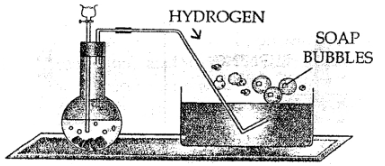
Draw neat labelled diagrams for two different experiments to prove that $–$ hydrogen is lighter than air.
Answer
$(i)$ To show that $H_2$ is lighter than air :
Image
$(ii)$ Air from jar $B$ being heavier runs down in jar $A$ and $H_2$ runs to jar $B$ as it is lighter than air and bums with ‘pop’ sound in jar $B$ if a burning splinter is brought there.
View full question & answer
Question 152 Marks
State how hydrogen occurs in the free state. Name three compounds containing hydrogen in the combined state.
Answer
In free state : In traces in the earth’s crust and atmosphere and in volcanic gases. It is also found in huge amount in the interior of the sun.
In combined state : In organic compounds, plant and animals, in acids, in water.
View full question & answer
[2 Mark Question Answer] - CHEMISTRY STD 8 Questions - Vidyadip