Question 14 Marks
State the ‘law of conservation of mass’. State the main points of Landolt’s experiment for experimental evidence of the law.
Answer
View full question & answer→Law of Conservation of Mass :
"In any chemical reaction, the total mass of the reacting substances is equal to the total mass of the products of the reaction provided masses are measured under similar conditions."
Landolt's experiment :
To illustrate the law of conservation of mass. Two solutions $- \ce{NaCl}$ in limb $A$ and $\ce{AgNO_3}$ sol. in limb $B$ were taken in $U-$shaped tube and weighed
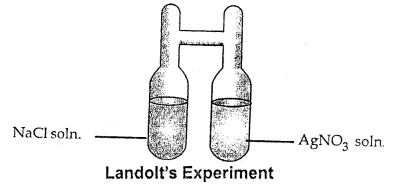
Now tube was tilted so that two solutions get mixed and react with each other to form new products. Tube is weighed again Weight after reaction was found to be same as before reaction.

Total mass of reactants $=$ Total mass of products This verifies the law.
Two other examples are :
$(i)$ We can take two solutions of lead acetate $\ce{Pb \left(CH_3OO\right)_2}$ in limb $A$ and sodium sulphate $\ce{Na_2SO_4}$ in limb $B$ in the $U$-shaped tube.
$\ce{Pb \left(CH_3COO\right)_2 + Na_2SO_4 \rightarrow PbSO _4+2 CH _3 COONa}$
$(ii)$ We can also take two solutions of iron $\ce{[II]}$ sulphate $\ce{FeSO_4}$ in limb $A$ and silver sulphate $\ce{Ag_2SO_4}$; in limb $B$ in $U-$shaped tube still the result is found to be same.
$\ce{2FeSO_4 + Ag_2 SO_4 \rightarrow 2 Ag \downarrow+ Fe_2\left(SO_4\right)_3}$
"In any chemical reaction, the total mass of the reacting substances is equal to the total mass of the products of the reaction provided masses are measured under similar conditions."
Landolt's experiment :
To illustrate the law of conservation of mass. Two solutions $- \ce{NaCl}$ in limb $A$ and $\ce{AgNO_3}$ sol. in limb $B$ were taken in $U-$shaped tube and weighed
Now tube was tilted so that two solutions get mixed and react with each other to form new products. Tube is weighed again Weight after reaction was found to be same as before reaction.
Total mass of reactants $=$ Total mass of products This verifies the law.
Two other examples are :
$(i)$ We can take two solutions of lead acetate $\ce{Pb \left(CH_3OO\right)_2}$ in limb $A$ and sodium sulphate $\ce{Na_2SO_4}$ in limb $B$ in the $U$-shaped tube.
$\ce{Pb \left(CH_3COO\right)_2 + Na_2SO_4 \rightarrow PbSO _4+2 CH _3 COONa}$
$(ii)$ We can also take two solutions of iron $\ce{[II]}$ sulphate $\ce{FeSO_4}$ in limb $A$ and silver sulphate $\ce{Ag_2SO_4}$; in limb $B$ in $U-$shaped tube still the result is found to be same.
$\ce{2FeSO_4 + Ag_2 SO_4 \rightarrow 2 Ag \downarrow+ Fe_2\left(SO_4\right)_3}$