Questions

[4 Mark Question Answer]

🎯

Test yourself on this topic

8 questions · timed · auto-graded

Question 14 Marks
Image
Write two characteristics of this type of settlement.
Answer
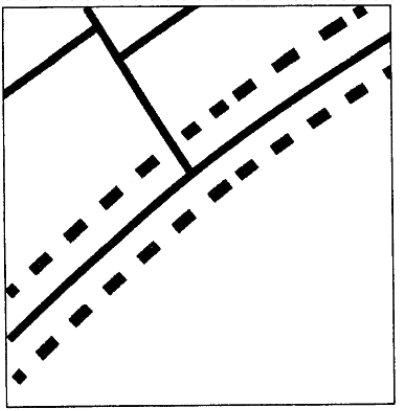
Linear settlements are those settlements that develop in a line. Houses, shops, dhaba’s, petrol pumps and garages develop along the sides of the roads, railway lines or river banks. Gradually, these linear settlements grow in size. These settlements gradually develop into trading centers.
Examples:
  1. If such a settlement is near a railway track, and over a period of time, a need for a railway station is felt, then it becomes a railway stop.
  2. When located on main roads, such settlements become important stops for travellers as dhaba’s, tyre and car repairing shops and petrol pumps open up.
  3. On rivers and coasts, they become places where boats can unload goods and passengers.
Image
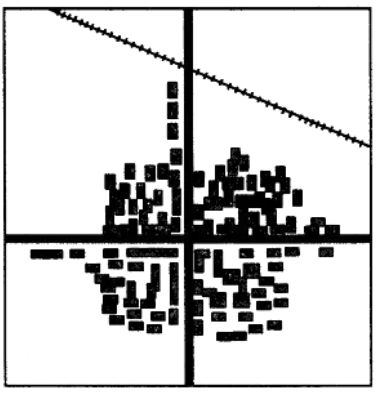
Scattered settlements are also known as dispersed settlements. Houses or huts in this type of settlement are far apart from one another. On map, such settlement is indicated by long distances between houses. Such areas show sparse population and the absence of proper roads. Houses or huts are usually connected by cart tracks or paths. Cattle rearing is common as each household has cattle that is allowed to graze in the open fields. The land is not very fertile to support big populations.
Image
View full question & answer
Question 24 Marks
What are the three main types of settlement patterns on a topo sheet?
Answer
The three main types of settlement patterns on a topo sheet are:
$1.$ Nucleated settlements $-$ In such settlements, buildings and huts are in a compact cluster. They are usually found in plains or valleys. This kind of settlement indicates that the community is living on an area where the land is fertile and good for agriculture. Such settlements generally have a well$-$ knit and large community. Apart from houses, essential facilities like hospitals, police stations, post offices, schools and administrative buildings are found. They are also known as clustered settlements.
Image
$2.$ Linear settlements $-$ Linear settlements are those settlements that develop in a line. Houses, shops, dhaba’s, petrol pumps and garages develop along the sides of the roads, railway lines or river banks. Gradually, these linear settlements grow in size. These settlements gradually develop into trading centres.
Examples :
$(a)$ If such a settlement is near a railway track, and over a period of time, a need for a railway station is felt, then it becomes a railway stop.
$(b)$ When located on main roads, such settlements become important stops for travellers as dhaba’s, tyre and car repairing shops and petrol pumps open up.
$(c)$ On rivers and coasts, they become places where boats can unload goods and passengers.
Image
$3.$ Scattered settlements $-$ They are also known as dispersed settlements. Houses or huts in this type of settlement are far apart from one another. On map, such settlement is indicated by long distances between houses. Such areas show sparse population and the absence of proper roads. Houses or huts are usually connected by cart tracks or paths. Cattle rearing is common as each household has cattle that is allowed to graze in the open fields. The land is not very fertile to support big populations.
Image
View full question & answer
Question 34 Marks
Explain the two types of grid references.
Answer
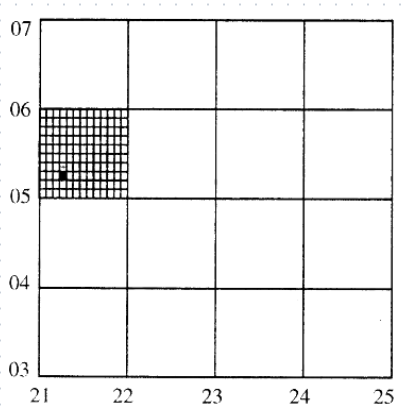
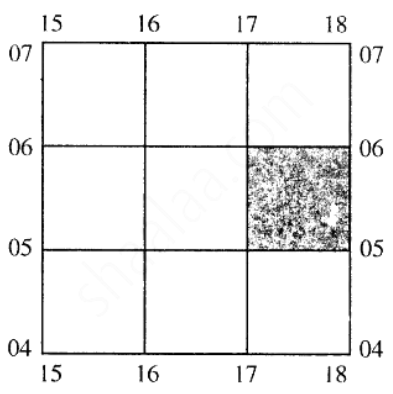
The four$-$figure reference : The four$-$figure reference is used to locate places that fall within the numbered grid square, for example, the grid reference for the shaded square in the diagram below is $1705$.
Image
The six$-$figure grid reference : A church shown with the help of a six$-$figure grid reference The six$-$figure grid reference is used to locate an object such as wells, post offices, milestones or temples within the square with greater accuracy. In the six$-$figure grid reference, the first three figures are the eastings while the last three are the northings. To get the six$-$figure grid reference, we need to divide the grid square on the topo sheet into ten equal parts vertically and horizontally. These figures will give us the third figure for the eastings and the sixth figure for the northings, for example, the grid reference for the church in the diagram is $213052.$
Image
View full question & answer
Question 44 Marks
Mention features of a grid system of a topo sheet.
Answer
  1. The lines that run vertically are called eastings and those that run horizontally are called northings.
  2. Eastings and northings cross each other to form a square called as a grid square.
  3. The starting point or the reference point is the exteme south$-$west grid or the one at the bottom left corner.
  4. The numerical value of eastings increases eastwards beginning from the south$-$west corner. Similarly, the numerical value of northings increases northwards.
  5. Eastings and northings are always given in two digit numbers. Even $0$ is read as $00. ($For example,$ 01, 02, 03, 98, 99.)$
  6. When referring to a grid, eastings are always stated first.
  7. Eastings and northings on a topo sheet drawn on a scale of $1 : 50,000 $are always $2 \ cm$ apart, which means they represent a distance of $1 \ km$ on the ground. So, the area of $2\ cm \times 2\ cm$ on the map represents $1 \ km \times 1 \ km$ on the ground.
  8. There are two types of grid references, the four$-$figure reference and the six$-$figure reference.
View full question & answer
Question 54 Marks
List the aspects that you should keep in mind while studying a topographical map.
Answer
Some of the elements of a topo sheet are:
  1. Sheet number $—$ This number refers to a specific geographical area. It is written on the top of the sheet.
  2. Scale $—$ The scale is not the same for all maps. It can be $1 : 10,00,000 1 \ cm : 10 \ km], 1 : 250,000 [$i.e. ; $1 \ cm = 2.5 \ km]$ or $1 : 50,000 [$i.e. $2 \ cm = 1 \ km]$ It is written at the bottom of the sheet.
  3. Grid $—$ The sheets have grid lines in red called eastings and northings which help in locating places easily.
  4. Direction on map sheet $—$ The top half of a topographical map is always the north and the bottom half is the south. The right hand is the east and left hand is the west. The eastings and northings are read from the southwest corner.
  5. The eastings and northings $—$ Their numbers should be remembered before reading a map.
  6. Four$-$figure grid reference and six$-$figure grid reference squares $—$ The four$-$figure grid reference will have four digits and six$-$figure grid reference will have six digits.
  7. Legend and keys $—$ Legends contain conventional signs and symbols in the form of keys. They provide the vital information to interpret the map correctly.
  8. Contour interval $— ($Vertical interval$)$ It is the vertical distance between two consecutive contour lines. It remains same for a given scale of topo sheets.
  9. Spot heights $—$ These indicate the actual elevation of a spot above mean sea level.
  10. Triangulated stations $—$ These also indicate the height on maps. They are indicated on the map with a small triangle followed by the number.
  11. Contour index $—$ Every fifth contour line is bolder than the other lines for easy identification of contour lines.
  12. Places marked with letters $DEP ($depression$)$ indicate land at a lower level than the surrounding area.
  13. Dry and wet streams $—$ On the map, black streams are dry and blue streams have water.
  14. Contour features $—$ Like saddle, hill, pass, gentle and steep slope, ridge, etc can be seen on topo maps.
  15. Colours $—$ Green coloured area contains vegetation and forests, yellow coloured area is cultivated land and white portion is barren land.
View full question & answer
Question 64 Marks
Compare Nucleated settlement and scattered settlement.
Answer
  Nucleated settlement Scattered settlement
$1$ The buildings and huts are in compact cluster. The houses and huts are far apart from one another.
$2$ These are mostly found in plains or river valleys. These are mostly found in hilly areas, thick forests and regions of extreme climate.
$3$ These are also called as clustered settlements. These are also called as dispersed settlements.
$4$ The land is fertile and good for agriculture. The land is not very fertile.
$5$ The generally have a well$-$ knit and large community. They don’t have a very close$-$knit large community.
$6$ They have dense population. They have sparse population.
$7$ Essential facilities like hospitals, schools, police stations, post offices, etc are found Essential facilities like school hospital, police station, etc. are not found.
$8$ Proper communication lines such as roads and railways lines are present. Proper roads are absent houses are connected by cart tracks or paths.
View full question & answer
Question 74 Marks
How can transport and communication of an area be inferred directly from a topographical sheet?
Answer
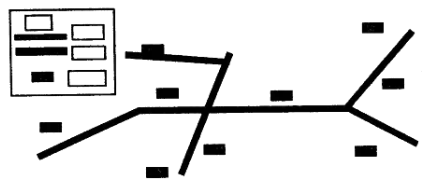
On a topographical map you will notice some black lines that cross the map. These lines are symbols of roadways and railway tracks and indicate the type of communication in the area. They depict the various modes of transport being used in the area.
Communication and transport lines indicate the importance of a place. When many roads and railway lines converge in a village or a town, it indicates the importance of a place. It could be for several reasons such as the economic activity of the region or the region could be a tourist hot spot of it could be because of the presence of industries and factories leading to plenty of job opportunities.
Airports are also an important form of travel and communication but airports are confined to large cities only. The conventional sign of an aeroplane indicates the presence of an airport or an airstrip.
View full question & answer
Question 84 Marks
What are the different factors that determine the location and the type of settlements?
Answer
Many factors determine the location and the type of settlements:
  1. Settlements grow in areas that are flat and where the land is cultivable. Settlements do not grow on steep hillsides or marshy lands.
  2. Settlements grow in places where water is available in plenty for both agricultural and domestic purposes. Settlements, therefore, also grow on the confluence of rivers or the banks of rivers.
  3. Settlements also thrive on a plateau because of the flat surface of the plateau and the availability of land for cultivation.
  4. They develop and grow in places where the climate is suitable or pleasant to live in. Extremely hot, cold, wet or dry places are not attractive settlement sites.
  5. Settlements are formed where there are prospects for employment. Mines and industries in the area are potential sources of employment and encourage growth of settlements. Such places are usually near places of abundant raw materials for the growth of industries.
  6. They develop in places that are easily accessible by various kinds of roads, rivers, and railway lines. Easy access to and from the settlements will allow movement of people and goods from one place to another.
View full question & answer
[4 Mark Question Answer] - Geography STD 8 Questions - Vidyadip