Questions

[5 marks sum]

🎯

Test yourself on this topic

18 questions · timed · auto-graded

Question 15 Marks
The ages of $A$ and $B$ are in the ratio $7 : 5$. Ten years hence, the ratio of their ages will be $9 : 7$. Find their present ages.
Answer
Ratio in the present ages of $A$ and $B = 7 : 5$ Let age of $A = 7x$ years
Let age of $B = 5x$ years
$10$ years hence,
Then age of  $A = 7x + 10$ years
and age of $B = 5x + 10$ years
According to the condition,
By crossing multiplication
$7(7x + 10) = 9(5x + 10)$
$\Rightarrow 49x + 70 = 45x + 90$
$\Rightarrow 49x – 45x = 90 – 70$
$\Rightarrow 4x = 20$
$\Rightarrow x = 5$
Present age of $A = 7x = 7 \times 5 = 35$ years
and present age of $B = 5x = 5 \times 5 = 25$ years
View full question & answer
Question 25 Marks
The sum of two numbers is $405$ and their ratio is $8 : 7$. Find the numbers.
Answer
Let the first number $=x$
and the second number $=7$
According to the question, $x+y=405$
and the numbers are in the ratio $8: 7$
i.e. $\frac{8 x}{7 y}=1$
$\Rightarrow 8 \mathrm{x}=7 \mathrm{y}$
$\Rightarrow \mathrm{x}=\frac{7}{8} \mathrm{y}$
Now, substitute the value of $x$ in equation $(i)$
$\frac{7}{8} y+y=405$
$7 y+8 y=405 \times 8$
$15 y=3240$
$y=\frac{3240}{15}$
$y=216$
Now, put the value of $y$ in equation $(ii)$
$x=\frac{7}{8} \times 216$
$x = 189$
Hence, the numbers are $189$ and $216$
View full question & answer
Question 35 Marks
Solve : $\frac{9 \mathrm{x}+7}{2}-\left(\mathrm{x}-\frac{\mathrm{x}-2}{7}\right)=36$
Answer
$ \frac{9 \mathrm{x}+7}{2}-\left(\mathrm{x}-\frac{\mathrm{x}-2}{7}\right)=36$
$ \Rightarrow \frac{9 \mathrm{x}+7}{2}-\left(\frac{7 \times x-1(\mathrm{x}-2)}{7}\right)=36$
$ \Rightarrow \frac{9 \mathrm{x}+7}{2}-\left(\frac{7 \mathrm{x}-\mathrm{x}-2}{7}\right)=36$
$ \Rightarrow \frac{9 \mathrm{x}+7}{2}-\left(\frac{6 \mathrm{x}-2}{7}\right)=36$
$ \Rightarrow \frac{7(9 \mathrm{x}+7)+2(-6 \mathrm{x}+2)}{14}=36$
$ \Rightarrow \frac{63 \mathrm{x}+49-12 \mathrm{x}+4}{14}=36$
$ \Rightarrow \frac{51 \mathrm{x}+53}{14}=36$
$ \Rightarrow 51 \mathrm{x}+53=14 \times 36$
$ \Rightarrow 51 \mathrm{x}=504-53$
$ \Rightarrow 51 \mathrm{x}=451$
$ \mathrm{x}=\frac{451}{51}$
$\therefore x = 8.8$  i.e., $x = 9$
View full question & answer
Question 45 Marks
Solve: $\frac{x+2}{6}-\left(\frac{11-x}{3}-\frac{1}{4}\right)=\frac{3 x-4}{12}$
Answer
$x+\frac{2}{6}-11-\frac{x}{3}-\frac{1}{4}=3 x-\frac{4}{12} $
$\Rightarrow \frac{x+2}{6}-\frac{4(11-x)-1 \times 3}{12}=\frac{3 x-4}{12} $
$ \Rightarrow \frac{x+2}{6}-\frac{44+4 x+3}{12}=\frac{3 x-4}{12} $
$ \Rightarrow \frac{2(x+2)-41+4 x}{12}=\frac{3 x-4}{12}$
$ \Rightarrow \frac{2 x+4-41+4 x}{12}=\frac{3 x-4}{12} $
$\Rightarrow \frac{6 x-37}{12}=\frac{3 x-4}{12}$
$\Rightarrow 12(6x - 37) = 12(3x - 4)$
$\Rightarrow 72x - 444 = 36x - 48$
$\Rightarrow 72x - 36x = -48 + 444$
$\Rightarrow 36x = 396$
$\Rightarrow x=\frac{396}{36}=11$
$\therefore x = 11$
View full question & answer
Question 55 Marks
Solve : $\frac{3 x-2}{4}-\frac{2 x+3}{3}=\frac{2}{3}-x$
Answer
$\frac{3 \mathrm{x}-2}{4}-\frac{2 \mathrm{x}+3}{3}=\frac{2}{3}-\mathrm{x}$
$ =\frac{3 \mathrm{x}-2}{4}-\frac{2 \mathrm{x}+3}{3}=\frac{2}{3}-\frac{\mathrm{x}}{1}$
$ =\frac{3(3 \mathrm{x}-2)-4(2 \mathrm{x}+3)}{12}=\frac{2 \times 1}{3 \times 1}-\frac{\mathrm{x} \times 3}{1 \times 3}$
$=\frac{9 x-6-8 x-12}{12}=\frac{2-3 x}{3}$
$ =\frac{x-18}{12}=\frac{2-3 x}{3}$
$ =3(x-18)=12(2-3 x)$
$ =3 x-54=24-36 x$
$ =3 x+36 x=24+54$
$ =39 x=78$
$\mathrm{x}=\frac{78}{39}=2$
$\therefore x=2$
View full question & answer
Question 65 Marks
Solve : $\frac{2 x}{3}-\frac{3 x}{8}=\frac{7}{12}$
Answer
$\frac{2 x}{3}-\frac{3 x}{8}=\frac{7}{12}$

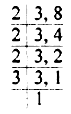
$\text{L.C.M}$. of $3$ and $8=2 \times 2 \times 2 \times 3=24$
$\therefore \frac{2 \mathrm{x} \times 8}{3 \times 8}-\frac{3 \mathrm{x} \times 3}{8 \times 3}=\frac{7}{12}$
$=\frac{16 \mathrm{x}}{24}-\frac{9 \mathrm{x}}{24}=\frac{7}{12}$
$=\frac{16 x}{24}-\frac{9 x}{24}=\frac{7}{12}$
$=\frac{16 x-9 x}{24}=\frac{7}{12}$
$=\frac{7 \mathrm{x}}{24}=\frac{7}{12}$
$=\mathrm{x}=\frac{7 \times 24}{12 \times 7}=2$
$\therefore x=2$
View full question & answer
Question 75 Marks
Six more than one$-$fourth of a number is two$-$fifth of the number. Find the number.
Answer
Let the required number $= x\therefore$ One$-$fourth of the number $= `"x"/4`$
Two$-$fifth of the number $= `"2x"/5`$
According to the statement:
$`"2x"/5 = 6 + "x"/4`$
$`=> "2x"/5 - "x"/ = 6/1`$
$`=> "2x"/5 x\times 20 - "x"/4 x\times 20 = 6 x\times 20`$
$....[$Multiplying each term by $20$ because $\text{L.C.M}$. of $5,4$ and $1 = 20]$
$\Rightarrow 8x- 5x = 120$
$\Rightarrow 3x = 120$
$\Rightarrow x = `120/3`$
$x = 40$
Required number $= 40$
View full question & answer
Question 85 Marks
Separate $178$ into two parts so that the first part is $8$ less than twice the second part.
Answer
Let first part $= x$  Second part $= 178 – x$
According to the problem :
First Part $= 8$ less than twice the second part
$x = 2(178 – x) – 8$
$\Rightarrow x = 356 – 2x – 8$
$\Rightarrow x+2x = 356 – 8$
$\Rightarrow 3x = 348$
$\Rightarrow x = 116$
First Part $= 116$
$\Rightarrow$ Second Part $= 178 – x = 178 – 116 = 62$
First Part $= 116$
$\Rightarrow$ Second Part $= 62$
Alternative Method :
Let Second part $= x$
First part $= 2x – 8$
According to the problem :
$x + 2x – 8 = 178$
$\Rightarrow x + 2x = 178 + 8$
$\Rightarrow 3x = 186$
$\Rightarrow x = 62$
First part $= 2x – 8 = 2 \times 62 – 8 = 124 – 8 = 116$
First part $= 116$
Second part $= 62$
View full question & answer
Question 95 Marks
If the same number be added to the numbers $5, 11, 15$ and $31$, the resulting numbers are in proportion. Find the number.
Answer
Let $\mathrm{x}$ be added to each number, then the numbers will be $5+x, 11+x, 15+x$ and $31+x$
According to the condition
$\frac{5+x}{11+x}=\frac{15+x}{31+x}$
By cross multiplication,
$(5+x)(31+x)=(15+x)(11+x)$
$ \Rightarrow 155+5 x+31 x+x^2=165+11 x+15 x+x^2$
$ \Rightarrow 155+36 x+x^2=165+26 x+x^2$
$ \Rightarrow 36 x+x^2-26 x-x^2=165-155$
$ \Rightarrow 10 x=10 $
$\Rightarrow x=\frac{10}{10}=1$
$1$ should be added
View full question & answer
Question 105 Marks
Three consecutive whole numbers are such that if they be divided by $5, 3$ and $4$ respectively; the sum of the quotients is $40$. Find the numbers.
Answer
Let the three consecutive whole numbers be $x, x+1$ and $x+2$
According to the statement:
$\frac{x}{5}+\frac{x+1}{3}+\frac{x+2}{4}=40$
$\Rightarrow \frac{\mathrm{x}}{5} \times 60+\frac{\mathrm{x}+1}{3} \times 60+\frac{\mathrm{x}+2}{4} \times 60=40 \times 60 \ldots [$Multiplying each term by $60$ because $\text{L.C.M}$. of denominators $=60]$
$\Rightarrow 12 x+20(x+1)+15(x+2)=2400$
$\Rightarrow 12 x+20 x+20+15 x+30=2400$
$ \Rightarrow 12 x+20 x+15 x=2400-20-30$
$\Rightarrow 47 x=2350$
$\Rightarrow \mathrm{x}=\frac{2350}{47}$
$x=50$
$x+1=50+1=51$
$x+2=50+2=52$
Three consecutive whole numbers are $50, 51$ and $52$
View full question & answer
Question 115 Marks
Two consecutive natural numbers are such that one$-$fourth of the smaller exceeds one$-$fifth of the greater by $1.$ Find the numbers.
Answer
Let two consecutive natural numbers $=x, x+1$
$\therefore$ One-fourth of the smaller $=\frac{\mathrm{x}}{4}$
one$-$fifth of the greater $=\frac{x+1}{5}$
According to the statement:
$\frac{x}{4}=\frac{x+1}{5}+1$
$ \Rightarrow \frac{x}{4}-\frac{x+1}{5}=1$
$\Rightarrow \frac{5 x-4(x+1)}{20}=1 $
$\Rightarrow \frac{5 x-4 x-4}{20}=1$
$\Rightarrow \frac{x-4}{20}=1$
$\Rightarrow x-4=20 \ldots ($Cross multiplying$)$
$\Rightarrow x=20+4 \Rightarrow x=24$
$\therefore x+1=24+1=25$
Two consecutive numbers are $24$ and $25$
View full question & answer
Question 125 Marks
The difference of two numbers is $3$ and the difference of their squares is $69$. Find the numbers.
Answer
Let one number $=x$
Second number $=x+3 [$Difference of two numbers is $3 ]$
According to the statement :
$(x+3)^2-(x)^2=69$
$\Rightarrow(x)^2+(3)^2+2 \times x \times 3-x^2=69$
$\Rightarrow x^2+9+6 x-x^2=69$
$\Rightarrow 6 x=69-9$
$\Rightarrow 6 \mathrm{x}=60$
$\Rightarrow x=\frac{60}{6}$
$\Rightarrow x=10$
One number $=10$
Second number $=x+3=10+3=13$
View full question & answer
Question 135 Marks
A man completed a trip of $136\  km$ in $8$ hours. Some part of the trip was covered at $15 \ km/hr$ and the remaining at $18 \ km/hr$. Find the part of the trip covered at $18 \ km/hr.$
Answer
Total distance of the trip $=136\  km$
Let part of the trip covered at $18\  km / hr=x\  km$
$\therefore$ Distance of the trip covered at $15\  km / hr=(136-x)\  km$
Time taken by the man to cover $\mathrm{xm}=\frac{\text { Distance }}{\text { speed }}=\frac{x}{18}$ hours
Time taken by the man to cover $(136-x)\  km=\frac{136-x}{15}$ hours
Time taken by the man to cover a trip of $136\  km=8$ hours
$\therefore \frac{x}{18}+\frac{136-x}{15}=8$
$ \Rightarrow \frac{x}{18} \times 90+\frac{136-x}{15} \times 90=8 \times 90....[$Multiplying each term by $90$ becuase $\text{L.C.M}$. of denominatorsn $= 90]$
$\Rightarrow 5 x+6(136-x)=720$
$ \Rightarrow 5 x+816-6 x=720$
$ \Rightarrow 5 x-6 x=720-816$
$ \Rightarrow-x=-96$
$ \Rightarrow x=96$
$\therefore$ Part of the trip covered at $18\  km / hr=96\  km$
View full question & answer
Question 145 Marks
Solve : $\frac{4-3 x}{5}+\frac{7-x}{3}+4 \frac{1}{3}=0$ Hence, find the value of ' $p$ ', if $3 p-2 x+1=0$
Answer
$\Rightarrow \frac{4-3 x}{5}+\frac{7-x}{3}+4 \frac{1}{3}=0$
$ \Rightarrow \frac{4-3 x}{5}+\frac{7-x}{3}+\frac{13}{3}=0$
$ \frac{12-9 x+35-5 x+65=0}{15} \ldots(\text { L.C.M.}$ of  $5,3,3=15)$
$ -14 x+112=0$
$ \Rightarrow-14 x=-112$
$ \Rightarrow x=\frac{-112}{-14}=8$
Hence $x=8$ Now, $3 p-2 x+1=0$
$\Rightarrow 3 p-2 \times 8+1=0$
$ \Rightarrow 3 p-16+1=0$
$ \Rightarrow 3 p-15=0$
$ \Rightarrow 3 p=15$
$ \Rightarrow p=5$
View full question & answer
Question 155 Marks
Solve : $\frac{2 \mathrm{x}}{3}-\frac{\mathrm{x}-1}{6}+\frac{7 \mathrm{x}-1}{4}=2 \frac{1}{6}$ Hence, find the value of $\ 'a\ ',$ if $\frac{1}{\mathrm{a}}+5 \mathrm{x}=8$
Answer
$\frac{2 \mathrm{x}}{3}-\frac{\mathrm{x}-1}{6}+\frac{7 \mathrm{x}-1}{4}=2 \frac{1}{6}$
$ \Rightarrow \frac{2 \mathrm{x}}{3}-\frac{\mathrm{x}-1}{6}+\frac{7 \mathrm{x}-1}{4}=\frac{13}{6}$
$ \frac{8 \mathrm{x}-2 \mathrm{x}+2+21 \mathrm{x}-3=26}{12} \ldots(\text { L.C.M.}$ of  $3,6,4,6=12)$
$ \Rightarrow 27 \mathrm{x}-1=26$
$ \Rightarrow 27 \mathrm{x}=26+1$
$ \Rightarrow x=\frac{27}{27}=1$
Now, $\frac{1}{\mathrm{a}}+5 \mathrm{x}=8$
$\Rightarrow \frac{1}{a}+5 \times 1=8$
$ \Rightarrow \frac{1}{a}+5=8$
$ \Rightarrow \frac{1}{a}=8-5=3$
$ \because 3 a=1$
$ \Rightarrow a=\frac{1}{3}$
$\therefore \mathrm{x}=1$ and $\mathrm{a}=\frac{1}{3}$
View full question & answer
Question 165 Marks
Solve the following equation : $\frac{1}{x-1}+\frac{2}{x-2}=\frac{3}{x-3}$
Answer
$ \frac{1}{x-1}+\frac{2}{x-2}=\frac{3}{x-3}$
$ =\frac{1(x-2)+2(x-1)}{(x-1)(x-2)}=\frac{3}{x-3}$
$ \Rightarrow \frac{x-2+2 x-2}{x^2-2 x-x+2}=\frac{3}{x-3}$
$ \Rightarrow \frac{3 x-4}{x^2-3 x+2}=\frac{3}{x-3}$
$ \Rightarrow(x-3)(3 x-4)=\left(x^2-3 x+2\right)$
$ \Rightarrow 3 x^2-4 x-9 x+12=3 x^2-9 x+6$
$ \Rightarrow 3 x^2-13 x-3 x^2+9 x=6-12$
$ x=\frac{-6}{-4}=\frac{3}{2}=1 \frac{1}{2}$
View full question & answer
Question 175 Marks
Solve the following equation : $\frac{3 x}{x+6}-\frac{x}{x+5}=2$
Answer
$ \frac{3 \mathrm{x}}{\mathrm{x}+6}-\frac{\mathrm{x}}{\mathrm{x}+5}=2$
$ \Rightarrow \frac{3 \mathrm{x}(\mathrm{x}+5)-\mathrm{x}(\mathrm{x}+6)}{(\mathrm{x}+6)(\mathrm{x}+5)}=2$
$ \Rightarrow \frac{3 \mathrm{x}^2+15 \mathrm{x}-\mathrm{x}^2-6 \mathrm{x}}{\mathrm{x}^2+5 \mathrm{x}+6 \mathrm{x}+30}=2$
$ \Rightarrow \frac{2 \mathrm{x}^2+9 \mathrm{x}}{\mathrm{x}^2+11 \mathrm{x}+30}=2$
$ \Rightarrow 2 \mathrm{x}^2+9 \mathrm{x}=2\left(\mathrm{x}^2+11 \mathrm{x}+30\right)$
$ \Rightarrow 2 \mathrm{x}^2+9 \mathrm{x}=2 \mathrm{x}^2+22 \mathrm{x}+60$
$ \Rightarrow 2 \mathrm{x}^2-2 \mathrm{x}^2+9 \mathrm{x}-22 \mathrm{x}=60$
$ \Rightarrow-13 \mathrm{x}=60$
$ \mathrm{x}=-\frac{60}{13}=-4 \frac{8}{13}$
View full question & answer
Question 185 Marks
Solve the following equation : $\frac{2 x-13}{5}-\frac{x-3}{11}=\frac{x-9}{5}+1$
Answer
$\frac{2 x-13}{5}-\frac{x-3}{11}=\frac{x-9}{5}+\frac{1}{1}$
Since, $\text{L.C.M}$. of denominators $5, 11, 5$ and $1=55$
$\therefore \frac{2 x-13}{5} \times 55-\frac{x-3}{11} \times 55=\frac{x-9}{5} \times 55+\frac{1}{1} \times 55$
$ \Rightarrow 11(2 x-13)-5(x-3)=11(x-9)+55$
$ \Rightarrow 22 x-143-5 x+15=11 x-99+55$
$ \Rightarrow 22 x-5 x-11 x=-99+55+143-15$
$ \Rightarrow 6 x=198-114$
$ \Rightarrow 6 x=84$
$ \Rightarrow x=\frac{84}{6}$
$ \Rightarrow x=14$
View full question & answer
[5 marks sum] - MATHS STD 8 Questions - Vidyadip