Questions

[3 marks sum]

🎯

Test yourself on this topic

23 questions · timed · auto-graded

Question 13 Marks
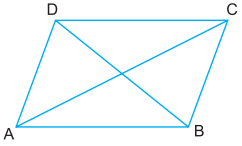
If the diagonals of a parallelogram are equal in length, show that the parallelogram is a rectangle.
Image
Answer
[Hint : Using SSS congruecy, first show that $\triangle A B C \cong \triangle B A D$ $\Rightarrow \angle B=\angle A$
But, $\angle A+\angle B=180^{\circ}$ [Co-interior angles]
View full question & answer
Question 23 Marks
In a square ABCD , if $AB =(3 x-8) cm$ and $BC =(x+6) cm$, find the value of $x$. Also, find the length of each side of the square.
Answer
x = 7, each side = 13 cm
View full question & answer
Question 33 Marks
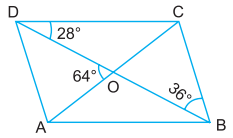
In the adjoining figure, the diagonals AC and BD of parallelogram ABCD intersect at O . If $\angle OBC =36^{\circ}, \angle ODC$ $=28^{\circ}$ and $\angle AOD =64^{\circ}$; find the measure of
(i) $\angle OAD$
(ii) $\angle OCD$.
Image
Answer
(i) $\angle OAD =80^{\circ}$
(ii) $\angle OCD =36^{\circ}$
View full question & answer
Question 43 Marks
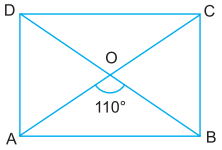
In the adjoining figure, ABCD is a rectangle whose diagonals AC and BD intersect at O . If $\angle AOB =110^{\circ}$, find the measure of : (i) $\angle ODA$ and (ii) $\angle OCD$.
Image
Answer
(i) $\angle ODA =55^{\circ}$
(ii) $\angle OCD =35^{\circ}$
[Hint : $\angle A O D=\left(180^{\circ}-110^{\circ}\right)=70^{\circ}$.
Since $O A=O D$, we have $\angle O A D=\angle O D A$.
$\angle C O D=110^{\circ}($ Why? $)$ and $O C=O D$, so $\angle O C D=\angle O D C$.]
View full question & answer
Question 53 Marks
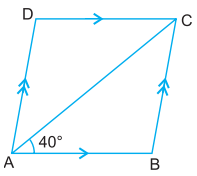
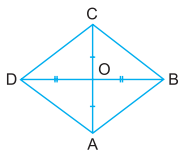
In the adjoining figure, ABCD is a rhombus in which $\angle BAC =40^{\circ}$. Find the measures of :
(i) $\angle ACB$
(ii) $\angle ABC$
(iii) $\angle ADC$
(iv) $\angle ACD$
(v) $\angle CAD$
Image
Answer
(i) $\angle ACB =40^{\circ}$
(ii) $\angle ABC =100^{\circ}$
(iii) $\angle ADC =100^{\circ}$
(iv) $\angle ACD =40^{\circ}$
(v) $\angle CAD =40^{\circ}$
[Hint : Since $A B C D$ is a rhombus, so $A B=B C$ $
\left.\Rightarrow \angle A C B=\angle B A C=40^{\circ}\right]
$
View full question & answer
Question 63 Marks
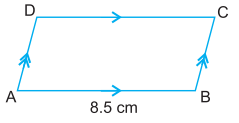
In the given figure, ABCD is a parallelogram in which AB = 8.5 cm and its perimeter is 24 cm . Find the length of each of its remaining sides.
Image
Answer
$BC =3.5 cm, CD =8.5 cm, AD =3.5 cm$
View full question & answer
Question 73 Marks
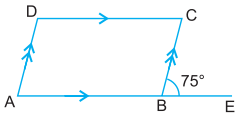
In the adjoining figure, side AB of parallelogram ABCD has been produced to E . If $\angle CBE =75^{\circ}$, find the measure of each angle of the parallelogram.
Image
Answer
$\angle ABC =105^{\circ}, \angle ADC =105^{\circ}, \angle BCD =75^{\circ}, \angle BAD =75^{\circ}$
View full question & answer
Question 83 Marks
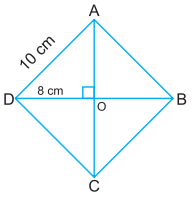
Each side of a rhombus is 10 cm long and one of its diagonals measures 16 cm . Find the length of the other diagonal.
Image
Answer
12 cm
[Hint : The diagonals of a rhombus bisect each other at right angles. Apply Pythagoras theorem in $\triangle A O B$ to get the length AO.]
View full question & answer
Question 93 Marks
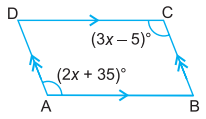
In a parallelogram ABCD , if $\angle A =(2 x+35)^{\circ}$ and $\angle C =(3 x-5)^{\circ}$.
Find: (i) the value of x
(ii) measure of each angle of ABCD .
Image
Answer
(i) $x=40$
(ii) $\angle A =115^{\circ}, \angle C =115^{\circ}, \angle B =65^{\circ}, \angle C =65^{\circ}$
[Hint : $\angle A=\angle C, \angle B=\angle D$ and $\angle A+\angle B+\angle C+\angle D=360^{\circ}$.]
View full question & answer
Question 103 Marks
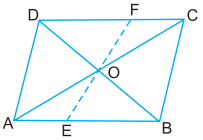
In the adjoining figure, ABCD is a parallelogram whose diagonals intersect at O . A line segment EOF is drawn to meet AB at E and DC at F . Prove that OE = OF.
Image
Answer
[Hint: Prove that $\triangle O A E \cong \triangle O C F$.]
View full question & answer
Question 113 Marks
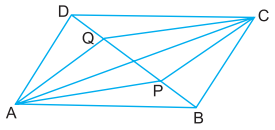
P and Q are points of trisection of the diagonal BD of a parallelogram ABCD . Prove that $CQ \| AP$.
Image
Answer
[Hint : Join CP, AQ and AC. Now, $B P=D Q=\frac{1}{3}(B D)$.]
View full question & answer
Question 123 Marks
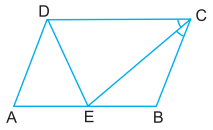
In the adjoining figure, ABCD is a parallelogram, E is the midpoint of AB and CE bisects $\angle BCD$. Prove that :
(i) $AE = AD$
(ii) DE bisects $\angle ADC$
(iii) $\angle DEC =90^{\circ}$.
Image
Answer
$\begin{array}{l}{[\text { Hint }: \angle B E C=\angle E C D=\angle E C B \Rightarrow E B=B C \Rightarrow A E=A D .} \\ \therefore \angle A D E=\angle A E D=\angle E D C . \\ \left.\angle A D C+\angle B C D=180^{\circ} \Rightarrow \frac{1}{2}(\angle A D C)+\frac{1}{2}(\angle B C D)=90^{\circ} \Rightarrow \angle E D C+\angle D C E=90^{\circ}\right]\end{array}$
View full question & answer
Question 133 Marks
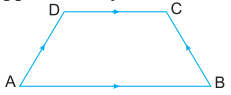
In an isosceles trapezium, prove that the opposite angles are supplementary.
Image
Answer
[Hint: $\angle A=\angle B$ and $\angle C=\angle D$
Also, $\angle A+\angle D=180^{\circ}$
and $\angle B+\angle C=180^{\circ}$ $\quad$ [Co-interior angles]
Now conclude $\angle A \perp \angle C=\angle B+\angle D=180^{\circ}$ ]
View full question & answer
Question 143 Marks
The diagonals AC and BD of a rhombus intersect each other at O . Prove that:
$
AB^2+BC^2+CD^2+DA^2=4\left(OA^2+OB^2\right)
$
Image
Answer
[Hint : The diagonals of a rhombus bisect each other at right angles.]
View full question & answer
Question 153 Marks
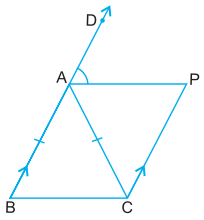
In the adjoining figure, $AB = AC , CP \| BA$ and AP is the bisector of $\angle CAD$.
Prove that:
(i) $\angle PAC =\angle BCA$
(ii) ABCP is a parallelogram.
Image
Answer
$\begin{aligned} {[\text { Hint }:} & \angle C A D=\angle A B C+\angle A C B=2 \angle A C B(\text { Why }) ? \\ & \text { And so, } \angle P A C=\frac{1}{2} \angle C A D=\angle A C B \\ & \therefore A P \| B C]\end{aligned}$
View full question & answer
Question 163 Marks
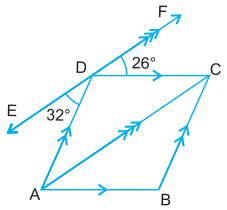
In the adjoining figure, ABCD is a parallelogram and EF is a line segment such that $EF \| AC$.
If $\angle ADE =32^{\circ}$ and $\angle CDF =26^{\circ}$, find the measure of $\angle ABC$.
Image
Answer
$\angle ABC =122^{\circ}$
[Hint : $\angle D C A=\angle C D F($ Why? $)$ and $\angle C A D=\angle A D E($ Why? $)]$ \
View full question & answer
Question 173 Marks
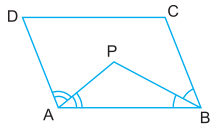
In the adjoining figure, ABCD is a parallelogram and $\angle A =120^{\circ}$. If the bisectors of $\angle A$ and $\angle B$ meet at a point P , show that $\angle APB$ is a right angle.
Image
Answer
$\begin{array}{c}{\left[\text{Hint : Since } \angle A=120^{\circ} \text {, so } \angle B=60^{\circ}(\text { Why? })\right.} \\ \left.\therefore \angle P A B=60^{\circ} \text { and } \angle A B P=30^{\circ}(\text { Why? })\right]\end{array}$
View full question & answer
Question 183 Marks
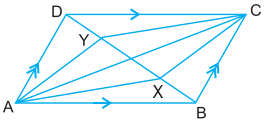
In the adjoining figure, ABCD is a parallelogram and $AX \| CY$. Prove that:
(i) $AX = CY$
(ii) AXCY is a parallelogram.
Image
Answer
[Hint: Using AAS congruence, prove that $\Delta ABX \cong \Delta CDY$.
Also, $AX \| CY$ and $AX = CY$, from (i)
So, AXCY is a parallelogram, as one pair of sides is parallel and equal.]
View full question & answer
Question 193 Marks
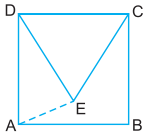
In the adjoining figure, ABCD is a square and CDE is an equilateral triangle. Find
(i) $\angle AED$
(ii) $\angle EAB$
(iii) reflex $\angle AEC$
Image
Answer
(i) $\angle AED =75^{\circ}$
(ii) $\angle EAB =15^{\circ}$
(iii) reflex $\angle AEC =225^{\circ}$
View full question & answer
Question 203 Marks
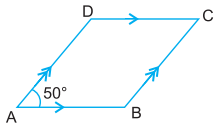
In the adjoining figure, ABCD is a parallelogram in which $\angle A=50^{\circ}$. Find the measure of each of the remaining angles of the parallelogram.
Image
Answer
$\angle B =130^{\circ}, \angle C =50^{\circ}, \angle D =130^{\circ}$
View full question & answer
Question 213 Marks
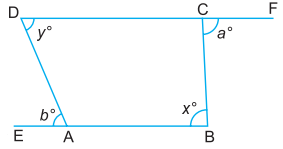
In the adjoining figure, the sides BA and DC of a quadrilateral ABCD have been produced to E and F respectively.
Prove that : $a+b=x+y$.
Image
Answer
$
\begin{array}{l}
{\left[\text { Hint }: b^{\circ}+\angle A=180^{\circ}, a^{\circ}+\angle C=180^{\circ} .\right.} \\
\therefore a^{\circ}+b^{\circ}+\angle A+\angle C=360^{\circ} .
\end{array}
$
But, $x^{\circ}+y^{\circ}+\angle A+\angle C=360^{\circ}$. [Angles of a quadrilateral]]
View full question & answer
Question 223 Marks
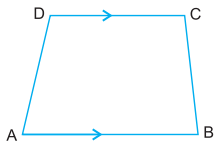
In a quadrilateral ABCD , it is being given that $AB \| DC$.
$\angle A : \angle D =2: 3$ and $\angle B : \angle C =4: 5$.
Find the measure of each angle of quadrilateral ABCD.
Image
Answer
$\angle A =72^{\circ}, \angle D =108^{\circ}, \angle B =80^{\circ}, \angle C =100^{\circ}$
[Hint : $2 x+3 x=180$ and $4 y+5 y=180$.
View full question & answer
Question 233 Marks
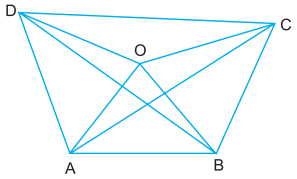
If $O$ is a point within a quadrilateral $A B C D$, prove that: $OA + OB + OC + OD > AC + BD$.
Image
Answer
[Hint: We know that the sum of any two sides of a triangle is greater than the third side.
So, $O A+O C > A C$ and $O B+O D > B D$. ]
View full question & answer
[3 marks sum] - MATHS STD 8 Questions - Vidyadip