Questions

[4 marks sum]

🎯

Test yourself on this topic

29 questions · timed · auto-graded

Question 14 Marks
If $A = \{1, 2, 3, 4, 5\}B = \{2, 4, 6, 8\}$ and $C = \{3, 4, 5, 6\}$ Verify : $A - (B ∩ C) = (A - B) ∪ (A - C)$
Answer
$A = \{1, 2, 3, 4, 5\}$
$B = \{2, 4, 6, 8\}$
$C = \{3, 4, 5, 6\}$
$B ∩ C = \{2, 4, 6, 8\} ∩ \{3, 4, 5, 6\}$
$= \{4,6\}$
$A - (B ∩ C) = \{1, 2, 3, 4, 5\} - \{4,6\}$
$= \{1, 2, 3, 5\}$
$A - B = \{1, 2, 3, 4, 5\} - \{2, 4, 6, 8\}$
$= \{1, 3, 5\}$
$A -C = \{1, 2, 3, 4, 5\} - \{3, 4, 5, 6\}$
$= \{1,2\}$
$(A - B) ∪ (A - C) = {1, 3, 5} ∪ {1,2}$
$= \{1, 2, 3, 5\}$
$\therefore A - (B ∩ C) = (A - B) ∪ (A - C)$
View full question & answer
Question 24 Marks
If$ A = \{1, 2, 3, 4, 5\}B = \{2, 4, 6, 8\}$ and $C = \{3, 4, 5, 6\}$ Verify :$ A - (B ∪ C) = (A - B) ∩ (A - C)$
Answer
$A = \{1, 2, 3, 4, 5\}$
$B = \{2, 4, 6, 8\}$
$C = \{3, 4, 5, 6\}$
$B ∪ C = \{2, 4, 6, 8\} ∪ \{3, 4, 5, 6\}$
$= \{2, 3, 4, 5, 6, 8\}$
$A - (B ∪ C) = \{1, 2, 3, 4, 5\} - \{2, 3, 4, 5, 6, 8\}$
$= \{1\}$
$A - B = \{1, 2, 3, 4, 5\} - \{2, 4, 6, 8\}$
$= \{1, 3, 5\}$
$A - C = \{1, 2, 3, 4, 5\} - \{3, 4, 6, 8\}$
$=\{1,2\}$
$∴ (A - B) ∩ (A - C) = \{1, 3, 5\} - \{1,2\}$
$= \{1\}$
$∴ A - (B ∪ C) = (A - B) ∩ (A - C)$
View full question & answer
Question 34 Marks
If $A = \{5, 6, 7, 8, 9\}, B = \{x : 3 < x < 8$ and $x \in W\}$ and $C = \{x : x \leq 5$ and $x \in N\}$. Find: $B ∩ C$ and $A ∩ (B ∩ C)$ Is $(A ∪ B) ∪ C = A ∪ (B ∪ C)$? Is $(A ∩ B) ∩ C = A ∩ (B ∩ C)$?
Answer
$A = (5, 6, 7, 8, 9)$
$B = (4, 5. 6, 7)$
$C = (1, 2, 3, 4, 5)$
$B ∩ C = (4, 5)$
$A ∩ (B ∩ C) = (5)$
$(A ∪ B) ∪ C = (1, 2, 3, 4, 5, 6, 7, 8, 9)$
$A ∪ (B ∪ C) = (1, 2, 3, 4, 5, 6, 7, 8, 9)$
Yes, these are equal.
$A ∩ B) ∩ C = {5}$
$A ∩ (B ∩ C) = {5}$
Yes, these are equal.
View full question & answer
Question 44 Marks
Given the universal set $=\{x : x \in N$ and $x < 20\}$, find: $B = \{y : y = 2n + 3, n \in N\}$
Answer
$U = \{1, 2, 3, 4, 5, 6, 7, 8, 9, 10, 11, 12, 13, 14, 15, 16, 17, 18, 19\}$
$\therefore B = \{y : y = 2n + 3, n \in N\}$
$y = 2n + 3$
$\therefore n = 1 \Rightarrow 2(1) + 3 = 2 + 3 = 5$
$\therefore n = 2 \Rightarrow 2(2) + 3 = 4 + 3 = 7$
$\therefore n = 3 \Rightarrow 2(3) + 3 = 6 + 3 = 9$
$\therefore n = 4 \Rightarrow 2(4) + 3 = 8 + 3 = 11$
$\therefore n = 5 \Rightarrow 2(5) + 3 = 10 + 3 = 13$
$\therefore n = 6 \Rightarrow 2(6) + 3 = 12 + 3 = 15$
$\therefore n = 7 \Rightarrow 2(7) + 3 = 14 + 3 = 17$
$\therefore n = 8 \Rightarrow 2(8) + 3 = 16 + 3 = 19$
$\therefore B = \{5, 7, 9, 11, 13, 15, 17, 19\}$
View full question & answer
Question 54 Marks
State, if the following pair of a set is equal or not : $A =\{x : x \in N, x < 3\}$ and $B =\{y : y^2 - 3y + 2 = 0\}$
Answer
$A = \{x : x \in N, x < 3\}$
$=\{1, 2\}$
$B = \{y : y^2 - 3y + 2 = 0\}$
$y2 - 3y + 2 = 0$
$\Rightarrow y^2 - 2y - y + 2 = 0$
$\Rightarrow y(y - 2) -1(y - 2) = 0$
$\Rightarrow (y - 2)(y - 1) = 0$
$\therefore$ Either $y - 2 = 0$
$\Rightarrow y = 2$
Or
$y - 1 = 0$
$\Rightarrow y = 1$
$\therefore B = \{1, 2\}$
Now we see that elements of sets $A$ and $B$ are the same $($identical$)$.
$\therefore $ Sets $A$ and $B$ are equal.
View full question & answer
Question 64 Marks
State, if the following pair of a set is equal or not : $A =\{2, 4, 6, 8\}$ and $B = \{2n : n \in N$ and $n < 5\}$
Answer
$A = \{2, 4, 6, 8\}$ and
$B = \{2n : n \in N$ and $n < 5\}$
When $n = 1, 2n = 2 \times 1= 2$
When $n = 2, 2n = 2 \times 2= 4$
When $n = 3, 2n = 2 \times 3= 6$
When $n = 4, 2n = 2 \times 4= 8$
$\therefore B = \{2, 4, 6, 8\}$
Now we see that elements of sets $A$ and $B$ are the same $($identical$)$
$\therefore$ Sets $A$ and $B$ are equal.
View full question & answer
Question 74 Marks
State the following sets are finite or infinite: $P = \{y : y = 3x -2, x \in N x > 5\}$
Answer
$P = \{y : y = 3x -2, x \in N x > 5\}$
$y = 3x -2$
When $x = 6,$
$y = 3 x 6 - 2$
$= 18 - 2$
$= 16$
When $x = 7,$
$y = 3 x 7 - 2$
$= 21 - 2$
$= 19$
When $x =8$,
$y = 3 x 8 - 2$
$= 24 - 2$
$= 22$
When $x = 9$,
$y = 3 x 9 - 2$
$= 27 - 2$
$= 25$
$\therefore P = \{16, 19, 22, 25,....\}$
$\therefore$ It is an infinite set.
View full question & answer
Question 84 Marks
List the elements of the following sets $:\{x : 4 – 2x > -6, x \in Z\}$
Answer
$\{x: 4-2 x>-6, x \in Z\}$
$4-2 x>-6$
$-4+4-2 x>-6-4$
$($Subtracting $4$ from both sides$)$
$-2 x>-10$
$ -2 x+2 x+10>-10+2 x+10$
$[$Adding $2 x+10$ to both sides$]$
$+10>2 x$
$\frac{10}{2}>x$
$ 5 > x$
$\therefore$ Elements of the given set $\{x: 4-2 x>-6, x \in Z\}$ are $4,3,2,1,0,-1$.
View full question & answer
Question 94 Marks
Write the following sets in Roster form:$ C = \{x : x$ is composite number and $5 \leq x \leq 21\}$
Answer
$C = \{x : x$ is composite number and $5 < x < 21\}$
$5 \leq x \leq 21$ means $x = 5, 6, 7, 8, 9, 10 ......, 21$
But we are given that $x$ is a complete number
$\therefore x = 6, 8, 9, 10, 12, 14, 15, 16, 18, 20, 21$
$\therefore$ Roster form of the given set $C = \{6, 8, 9, 10, 12, 14, 15, 16, 18, 20, 21\}$
Note: Composite numbers : The natural numbers $($greater than $1),$ which are not prime, are called composite numbers.
View full question & answer
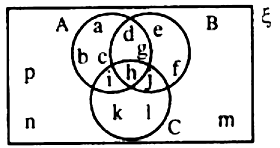
Question 104 Marks
Use the given diagram to find: $(i) A ∪ (B ∩ C)\ (ii) \ B - (A - C)\ (iii) \ A - B\ (iv) \ A ∩ B' $ Is $A ∩ B' = A - B$?
Answer
$(i) B ∩ C = \{d, e, f, g, h\} ∩ \{h, i, k, l\}$
$= \{h, j\}$
$∴ A ∪ (B ∩ C) = \{a, b, c, d, g, h, i, j\} ∪ \{h, j\}$
$= \{a, b, c, d, g, h, i, j\}$
$(ii) A - C = \{a, b, c, d, g, h, i\} - \{h, i, j, k, l\}$
$= \{a, b, c, d, g\}$
$∴ B - (A - C) = \{d, e, f, g, h, j\} - \{a, b, c, d, g\}$
$= \{e, f, h, j\}$
$(iii) A - B = \{a, b, c, d, g, h, i\} - \{d, e, f, g ,h, i\}$
$⇒ A - B = \{a, b, c, i\} ...(I)$
$(iv) B' = \{a, b, c ,i, k, l, m, n, p\}$
$A ∩ B' = \{a, b, c, d, g, h, i\} ∩ \{a, b, c, i, k, l, m, n, p\}$
$⇒ A ∩ B' = \{a, b, i\} ...(II)$
From $I$ and $II$ we can conclude $A ∩ B' = A - B$
View full question & answer
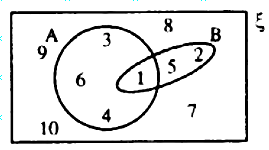
Question 114 Marks
From the given diagram, find : $ (i)\  A’\ (ii) \ B’\ (iii) \ A' ∪ B'\ (iv)\  (A ∩ B)'\ $

Is $A' ∪ B' = (A ∩ B)' $?
Also, verify if $A' ∪ B' = (A ∩ B)'.$
Answer
$(i) A = \{1, 3, 4, 6\}$
$A' = \{2, 5, 7, 8, 9, 10\}$
$(ii) B = {1, 2, 5}$
$\therefore B' = \{3, 4, 6, 7, 8, 9, 10\}$
$(iii) A' ∪ B' = \{2, 5, 7, 8, 9, 10\} ∪ \{3, 4, 6, 7, 8, 9, 10\}$
$= \{2, 3, 4, 5, 6, 7, 8, 9, 10\}$
$(iv) A ∩ B = \{1, 3, 4, 6\} ∩ \{1, 2, 5\}$
$= \{1\}$
$\therefore (A ∩ B)' = \{2, 3, 4, 5, 6, 7, 8, 9, 10\}$
From Part $(iii)$ and Part $(iv)$ we conclude
$A' ∪ B' = (A ∩ B)'$
Now $A ∩ B = \{2, 5, 7, 8, 9, 10\} ∩ \{3, 4, 6, 7, 8, 9, 10\}$
$\Rightarrow A' ∪ B' = \{7, 8, 9, 10\} ...(I)$
Now $A ∪ B = \{1, 3, 4, 6\} ∪ \{1, 2, 5\}$
$= \{1, 2, 3, 4, 5, 6\}$
$\therefore (A ∩ B)' = \{7, 8, 9, 10\} ...(II)$
From $I$ and $II$ we conclude
$A' ∪ B' = (A ∩ B)$
View full question & answer
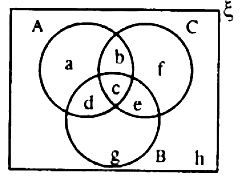
Question 124 Marks
From the given diagram, find : $(i)\  (A ∪ B) - C\ (ii)\  B - (A ∩ C)\ (iii)\  (B ∩ C) ∪ A\ $ Verify : $A -(B ∩ C) = (A - B) ∪ (A - C)$
Answer
$(i) A ∪ B = \{a, b, c, d\} ∪ \{c, d, e, g\}$
$= \{a, b, c, d, e, g\}$
$\therefore (A ∪ B) - C = \{a, b, c, d, e, g\} - \{b, c, e, f\}$
$= \{a, d, g\}$
$(ii) (A ∩ C) = \{a, b, c, d\} ∩ \{b, c, e, f\}$
$= {b, c}$
$\therefore B - (A ∩ C) = \{c, d, e, g\} - \{b, c\}$
$= \{d, e, g\}$
$(iii) B ∩ C = \{c, e, d, g\} ∩ \{b, c, e, f\}$
$= \{c, e\}$
$\therefore A - (B ∩ C) = (A - B) ∪ (A - C) $
$\Rightarrow (B ∩ C) = \{c, e\}$
So, $A − (B ∩ C) = \{a, b, d\} .....(1)$
Now, $A − B = \{a, b\}$
And $A − C = \{a, d\}$
The union of two sets has the elements of both sets.
So,$ (A − B) ∪ (A − C) = \{a, b, d\} .....(2)$
From $(1)$ and $(2)$, we have $>$
$A − (B ∩ C) = (A − B) ∪ (A − C)$
The relation holds True.
View full question & answer
Question 134 Marks
Given $A = \{x : ∈ N :< 6\}, B = \{3, 6, 9\}$ and $C \{x ∈ N : 2x - 5 ≤ 8\}$. show that : $A ∩ (B ∪ C) = (A ∩  B)∪ (A ∩ C)$
Answer
$A = \{x : \in N :< 6\}$
$B = \{3, 6, 9\}$
$C = \{x \in N : 2x - 5 \leq 8\}$
$2x - 5 \leq 8$
$\Rightarrow 2x \leq 8+5$
$\Rightarrow 2x \leq 13$
$\Rightarrow x \leq `13/2`$
$\Rightarrow x \leq 6.5$
$\therefore C = \{1, 2, 3, 4, 5, 6\}$
$B ∪ C = \{3, 6, 9\} ∪ \{1, 2, 3, 4, 5, 6\}$
$= \{1, 2, 3, 4, 5, 6, 9\}$
$A ∩ (B ∪ C) =\{1, 2, 3, 4, 5\} ∩ \{1, 2, 3, 4, 5, 6, 9\}$
$= \{1, 2, 3, 4, 5\}$
Now $A ∩ C = \{1, 2, 3, 4, 5\} ∩ \{1, 2, 3, 4, 5, 6\}$
$= \{1, 2, 3, 4, 5\}$
$A ∩ B = \{1, 2, 3, 4, 5\} ∩ \{3, 6, 9\}$
$= \{3\}$
$\therefore (A ∩ B) ∪ (A ∩ C) = \{3\} ∪ \{1, 2, 3, 4, 5\}$
$= \{1, 2, 3, 4, 5\}$
$\therefore A ∩ (B ∪ C) = (A ∩ B) ∪ (A ∩ C)$
View full question & answer
Question 144 Marks
Given $A = \{x : \in N :< 6\}, B = \{3, 6, 9\}$ and $C = \{x \in N : 2x - 5 \leq 8\}$. show that : $A ∪ (B ∩ C) = (A ∪ B) ∩ (A ∪ C)$
Answer
$A = \{x : \in N :< 6\}$
$B = \{3, 6, 9\}$
$C = \{x \in N : 2x - 5 \leq 8\}$
$2x - 5 \leq 8$
$\Rightarrow 2x \leq 8+5$
$\Rightarrow 2x \leq 13$
$\Rightarrow x \leq `13/2`$
$\Rightarrow x \leq 6.5$
$\therefore C = \{1, 2, 3, 4, 5, 6\}$
$B ∩ C = \{3, 6, 9\} ∩ \{1, 2, 3, 4, 5, 6\}$
$= \{3,6\}$
$\therefore A ∪ (B ∩ C) = \{1, 2, 3, 4, 5\} ∪ \{3,6\}$
$= \{1, 2, 3, 4, 5, 6\}$
$A ∪ B = \{1, 2, 3, 4, 5\} ∪ \{3, 6, 9\}$
$= \{1, 2, 3, 4, 5, 6, 9\}$
$A ∪ C = \{1, 2, 3, 4, 5\} ∪ \{1, 2, 3, 4, 5, 6\}$
$= \{1, 2, 3, 4, 5, 6\}$
$\therefore (A ∪ B) ∩ (A ∪ C)$
$= \{1, 2, 3, 4, 5, 6, 9\} ∩ \{1, 2, 3, 4, 5, 6\}$
$= \{1, 2, 3, 4, 5, 6\}$
$\therefore A ∪ (B ∩ C) = (A ∪ B) ∩ (A ∪ C)$
View full question & answer
Question 154 Marks
If $P = \{$factors of $36\}$ and $Q = \{$factors of $48\}$; Find : $P' ∩ Q.$
Answer
$1 \times 36 = 36$
$2 \times 18 = 36$
$3 \times 12 = 36$
$4 \times 9 = 36$
$6 \times 6 = 36$
$1 \times 48 = 48$
$2 \times 24 = 48$
$3 \times 16 = 48$
$4 \times 12 = 48$
$6 \times 8 = 48$
$\therefore$ Factors of $36 = 1, 2, 3, 4, 6, 9, 12, 18, 36$
Factors of $48 = 1, 2, 3, 4, 6, 8, 12, 16, 24, 48$
$P = \{$factors of $36\}$
$= \{1, 2, 3, 4, 6, 8, 12, 18, 36\}$
$Q = \{$factors of $48\}$
$= \{1, 2, 3, 4, 6, 8, 12, 16, 24, 48\}$
$P' ∩ Q =$ Only $Q$
$= Q - P$
$= \{1, 2, 3, 4, 6, 8, 12, 16, 24, 48\} - \{1, 2, 3, 4, 6, 9, 12, 18, 36\}$
$= \{8, 16, 24, 48\}$
View full question & answer
Question 164 Marks
If $P = \{$factors of $36\}$ and $Q = \{$factors of $48\};$ Find : $Q - P.$
Answer
$1 \times 36 = 36$
$2 \times 18 = 36$
$3 \times 12 = 36$
$4 \times 9 = 36$
$6 \times 6 = 36$
$1 \times 48 = 48$
$2 \times 24 = 48$
$3 \times 16 = 48$
$4 \times 12 = 48$
$6 \times 8 = 48$
$\therefore$ Factors of $36 = 1, 2, 3, 4, 6, 9, 12, 18, 36$
Factors of $48 = 1, 2, 3, 4, 6, 8, 12, 16, 24, 48$
$P = \{$factors of $36\}$
$= \{1, 2, 3, 4, 6, 8, 12, 18, 36\}$
$Q = \{$factors of $48\}$
$= \{1, 2, 3, 4, 6, 8, 12, 16, 24, 48\}$
$Q - P = \{1, 2, 3, 4, 6, 8, 12, 16, 24, 48\} - \{1, 2, 3, 4, 6, 9, 12, 18, 36\}$
$= \{8, 16, 24, 48\}$
View full question & answer
Question 174 Marks
If $P = \{$factors of $36\}$ and $Q = \{$factors of $48\}$; Find : $P ∩ Q$
Answer
$1 \times 36 = 36$
$2 \times 18 = 36$
$3 \times 12 = 36$
$4 \times 9 = 36$
$6 \times 6 = 36$
$1 \times 48 = 48$
$2 \times 24 = 48$
$3 \times 16 = 48$
$4 \times 12 = 48$
$6 \times 8 = 48$
$\therefore$ Factors of $36 = 1, 2, 3, 4, 6, 9, 12, 18, 36$
Factors of $48 = 1, 2, 3, 4, 6, 8, 12, 16, 24, 48$
$P = \{$factors of $36\}$
$= \{1, 2, 3, 4, 6, 8, 12, 18, 36\}$
$Q = \{$factors of $48\}$
$= \{1, 2, 3, 4, 6, 8, 12, 16, 24, 48\}$
$P ∩ Q = \{1, 2, 3, 4, 6, 9, 12, 18, 36\} ∩ \{1, 2, 3, 4, 6, 8, 12, 16, 24, 48\}$
$=\{1, 2, 3, 4, 6, 12\}$
View full question & answer
Question 184 Marks
If $P = \{$factors of $36\}$ and $Q = \{$factors of $48\}$; Find : $P ∪ Q$
Answer
$1 \times 36 = 36$
$2 \times 18 = 36$
$3 \times 12 = 36$
$4 \times 9 = 36$
$6 \times 6 = 36$
$1 \times 48 = 48$
$2 \times 24 = 48$
$3 \times 16 = 48$
$4 \times 12 = 48$
$6 \times 8 = 48$
$\therefore$ Factors of $36 = 1, 2, 3, 4, 6, 9, 12, 18, 36$
Factors of $48 = 1, 2, 3, 4, 6, 8, 12, 16, 24, 48$
$P = \{$Factors of $36\}$
$= \{1, 2, 3, 4, 6, 8, 12, 18, 36\}$
$Q = \{$Factors of $48\}$
$= \{1, 2, 3, 4, 6, 8, 12, 16, 24, 48\}$
$P ∪ Q = \{1, 2, 3, 4, 6, 9, 12, 18, 36\} ∪ \{1, 2, 3, 4, 6, 8, 12, 16, 24, 48\}$
$= \{1, 2, 3, 4, 6, 8, 9, 12, 16, 18, 24, 36, 48\}$
View full question & answer
Question 194 Marks
If $A = \{x \in W : 5 < x < 10\}, B = \{3, 4, 5, 6, 7\}$ and $C = \{x = 2n; n \in N$ and $n \leq 4\}$. Find : $(A ∩ B) ∪ (A ∩ C)$
Answer
$A = \{x \in W : 5 < x < 10\}$
$= \{6, 7, 8, 9\}$
$B = \{3, 4, 5, 6, 7\}$
$C = \{x = 2n; n \in N$ and $n \leq 4\}$
$x = 2n$
When $n = 1,$
$x = 2 \times 1$
$= 2$
When $n = 2,$
$x = 2 \times 2$
$= 4$
When $n = 3,$
$x = 2 \times 3$
$= 6$
When $n =4,$
$x = 2 \times 4$
$= 8$
$\therefore C = \{2, 4, 6, 8\}$
$(A ∩ B)$
$= \{6, 7, 8, 9\} ∩ \{3, 4, 5, 6, 7\}$
$= \{6, 7\}$
$\therefore (A ∩ B) ∪ (A ∩ C)$
$= \{6, 7\} ∪ \{6, 8\}$
$= \{6, 7, 8\}$
View full question & answer
Question 204 Marks
If A$ = \{x \in W : 5 < x < 10\}, B = \{3, 4, 5, 6, 7\}$ and $C = \{x = 2n; n \in N$ and $n \leq 4\}$. Find : $B ∪ (A ∩ C)$
Answer
$A = \{x \in W : 5 < x < 10\}$
$= \{6, 7, 8, 9\}$
$B = \{3, 4, 5, 6, 7\}$
$C = \{x = 2n; n \in N$ and $n \leq 4\}$
$x = 2n$
When $n = 1,$
$x = 2 \times 1$
$= 2$
When $n = 2,$
$x = 2 \times 2$
$= 4$
When $n = 3,$
$x = 2 \times 3$
$= 6$
When $n =4,$
$x = 2 \times 4$
$= 8$
$\therefore C = \{2, 4, 6, 8\}$
$(A ∩ C)$
$= \{6, 7, 8, 9\} ∩ \{2, 4, 6. 8\}$
$= \{6, 8\}$
$B ∪ (A ∩ C)$
$= \{3, 4, 5, 6, 7\} ∪ \{6, 8\}$
$= \{3, 4, 5, 6, 7, 8\}$
View full question & answer
Question 214 Marks
If $A = \{x \in W : 5 < x < 10\}, B = \{3, 4, 5, 6, 7\}$ and $C = \{x = 2n; n \in N$ and $n \leq 4\}$. Find : $(B ∪ A) ∩ (B ∪ C)$
Answer
$A = \{x \in W : 5 < x < 10\}$
$= \{6, 7, 8, 9\}$
$B = \{3, 4, 5, 6, 7\}$
$C = \{x = 2n; n \in N$ and $n \leq 4\}$
$x = 2n$
When $n = 1$,
$x = 2 \times 1$
$= 2$
When $n = 2,$
$x = 2 \times 2$
$= 4$
When $n = 3,$
$x = 2 \times 3$
$= 6$
When $n =4,$
$x = 2 \times 4$
$= 8$
$\therefore C = \{2, 4, 6, 8\}$
$B ∪ A$
$= \{3, 4, 5, 6, 7\} ∪ \{6, 7, 8, 9\}$
$= \{3, 4, 5, 6, 7, 8, 9\}$
$(B ∪ A) ∩ (B ∪ C)$
$= \{3, 4, 5, 6, 7, 8, 9\} ∩ \{2, 3, 4, 5, 6, 7, 8\}$
$= \{3, 4, 5, 6, 7, 8\}$
View full question & answer
Question 224 Marks
If $A = \{x \in W : 5 < x < 10\}, B = \{3, 4, 5, 6, 7\}$ and $C = \{x = 2n; n \in N$ and $n \leq 4\}$. Find : $A ∩ (B ∪ C)$
Answer
$A = \{x \in W : 5 < x < 10\}$
$= \{6, 7, 8, 9\}$
$B = \{3, 4, 5, 6, 7\}$
$C = \{x = 2n; n \in N$ and $n \leq 4\}$
$x = 2n$
When $n = 1,$
$x = 2 \times 1$
$= 2$
When $n = 2,$
$x = 2 \times 2$
$= 4$
When $n = 3,$
$x = 2 \times 3$
$= 6$
When $n =4,$
$x = 2 \times 4$
$= 8$
$\therefore C = \{2, 4, 6, 8\} B ∪ C$
$= \{3, 4, 5, 6, 7\} ∪ \{2, 4. 6, 8\}$
$= \{2, 3, 4, 5, 6, 7, 8\}$
$A ∩ (B ∪ C)$
$= \{6. 7, 8, 9\} ∩ \{2, 3, 4, 5, 6, 7, 8\}$
$\Rightarrow A ∩ (B ∪ C) = \{6, 7, 8\}$
View full question & answer
Question 234 Marks
Given $A = \{0, 1, 2, 4, 5\}, B = \{0, 2, 4, 6, 8\}$ and $C = \{0, 3, 6, 9\}$. Show that  $A ∪ (B ∪ C) = (A ∪ B) ∪ C$ i.e. the union of sets is associative.
Answer
$A = \{0, 1, 2, 4, 5\}$
$B = \{0, 2, 4, 6, 8\}$
$C = \{0, 3, 6, 9\}$
$B ∪ C = \{0, 2, 4, 6, 8\} ∪ \{0, 3, 6, 9\}$
$= \{0, 2, 3, 4, 6, 8, 9\}$
$\therefore A ∪ (B ∪ C)$
$= \{0, 1, 2, 4, 5\} ∪ \{0, 2, 3, 4, 6, 8, 9\}$
$\Rightarrow A ∪ (B ∪ C)$
$= \{0, 1, 2, 3, 4, 5, 6, 7, 8, 9\} ......(i)$
$A ∪ B = \{0, 1, 2, 4, 5\} ∪ \{0, 2, 4, 6, 8\}$
$= \{0, 1, 2, 4, 5, 6, 8\}$
$\therefore (A ∪ B) ∪ C$
$= \{0, 1, 2, 4, 5, 6, 7, 8\} ∪ \{0, 3, 6, 9\}$
$\Rightarrow (A ∪ B) ∪ C = \{0, 1, 2, 3, 4, 5, 6, 7, 8, 9\} ...II$
From $I$ and $II$, we get
$A ∪ (B ∪ C) = (A ∪ B) ∪ C$
View full question & answer
Question 244 Marks
Given the universal set $= \{x : x \in N$ and $x < 20\}$, find : $A = \{x : x = 3p ; p \in N\}$
Answer
Universal set $= \{x : x \in N$ and $x < 20\}$
$= \{1, 2, 3, 4, 5, 6, 7, 8, 9, 10, 11,....,19\}$
$A = \{x : x = 3p ; p \in N\}$
$x = 3p$
When $p = 1,$
$x = 3 \times 1$
$= 3$
When $p = 2,$
$x = 3 \times 2$
$= 6$
When $p = 3,$
$x = 3 \times 3$
$= 9$
When $p = 4,$
$x = 3 \times 4$
$= 12$
When $p = 5,$
$x = 3 \times 5$
$=15$
When $p = 6,$
$x = 3 \times 6$
$= 18$
$\therefore A = {3, 6, 9, 12, 15, 18}$
View full question & answer
Question 254 Marks
State, if the following pair of a set is equal or not : $M = \{x : x \in W$ and $x + 3 < 8\}$ and $N = \{y : y = 2n -1, n \in N$ and $n < 5\}$
Answer
$M = \{x : x \in W$ and $x + 3 < 8\}$
$x + 3 < 8$
$\Rightarrow x < 8 - 3$
$\Rightarrow x < 5$
$\therefore M = \{0, 1,2, 3, 4\}$
$N = \{y : y = 2n -1, n \in N$ and $n < 5\}$
$y = 2n - 1$
When $n = 1,$
$y = 2 \times 1-1$
$\Rightarrow y = 2-1$
$= 1$
When $n = 2,$
$y = 2 \times 2-1$
$\Rightarrow y = 4-1$
$= 3$
When $n =3,$
$y = 2 \times 3-1$
$\Rightarrow y = 6-1$
$= 5$
When $n = 4,$
$y = 2 \times 4-1$
$\Rightarrow y = 8-1$
$= 7$
$\therefore N = \{1, 3, 5,7\}$
Now we see that elements of sets $M$ and $N$ are not the same $($identical$)$
$\therefore$ Sets $M$ and $N$ are not equal.
View full question & answer
Question 264 Marks
State the following sets are finite or infinite : M = $\left\{r: r=\frac{3}{n}\right.;n \in W$ and $6 < n \leq 15\}$
Answer
M =$\left\{r: r=\frac{3}{n}\right.; n \in W$ and $6 < n \leq 15\}$
$r=\frac{3}{n}$
When $n = 7$,
$r=\frac{3}{7}$
When $n = 8$
$r=\frac{3}{8}$
When $n = 9,$
$r=\frac{3}{9}$
When $n = 10,$
$r=\frac{3}{10}$
When $n = 11,$
$r=\frac{3}{11}$
When $n = 12,$
$r=\frac{3}{12}$
When $n = 13,$
$r=\frac{3}{13}$
When $n = 14,$
$r=\frac{3}{14}$
When $n = 15,$
$r=\frac{3}{15}$
$\therefore M =\left\{\frac{3}{7}, \frac{3}{8}, \frac{3}{9}, \frac{3}{10}, \frac{3}{11}, \frac{3}{12}, \frac{3}{13}, \frac{3}{14}, \frac{3}{15}\right\}$
$\therefore$ It is a finite set.
 
View full question & answer
Question 274 Marks
Find the cardinal number of the following setsm : $A_4 = \{b : b \in Z\}$ and $\{-7 < 3b -1 \leq 2\}$
Answer
$A_4=b: b \in Z$ and $-7<3 b-1 \leq 2$
$ -7<3 b-1$
$ \Rightarrow-7+1<3 b-1+1$
$($Adding $1$ to both sides$)$
$\Rightarrow-6<3 b$
$\Rightarrow-\frac{6}{3}<\mathrm{b}$
$($Dividing both sides by $3 )$
$\Rightarrow-2$
Again $3 b-1 \leq 2$
$\Rightarrow 3 \mathrm{~b}-1+1 \leq 2+1$
$($Adding $1$ to both sides$)$
$\Rightarrow 3 b \leq 3$
$\Rightarrow \mathrm{b} \leq \frac{3}{3}$
$($Dividing both sides by $3 )$
$\Rightarrow \mathrm{b} \leq 1$
$\therefore-2 \leq \mathrm{b} \leq 1$
$\therefore$ Given set $\mathrm{A}_4=\{-1,0,1\}$
$\therefore$ Cardinal number of set $\mathrm{A}_4=3$
View full question & answer
Question 284 Marks
List the elements of the following sets : $\{x : x = 2y + 5; y \in N$ and $2 \leq y < 6\}$
Answer
$\{x : x = 2y + 5; y \in N$ and $2 \leq y < 6\}$
$x = 2y + 5$
When $y = 2,$
$x = 2 \times 2+5$
$= 4+5$
$= 9$
$>$When $y = 3,$
$x = 2 \times 3 + 5$
$= 6+5$
$= 11$
When $y = 4,$
$x = 2 \times 4+5$
$= 8+5$
$= 13$
$>$When $y = 5,$
$x = 2 \times 5 + 5$
$= 10+5$
$= 15$
$\therefore$ Elements of the given set $\{x : x = 2y + 5; y \in N$ and $2\leq y \leq 6\}$ are $9, 11, 13, 15$
View full question & answer
Question 294 Marks
Write the following sets in roster $($Tabular$)$ form : $A _6=\left\{ x : x =\frac{n}{n+2} ; n \in N\right.$ and $\left.n >5\right\}$
Answer
$A _6=\left\{ x : x =\frac{n}{n+2} ; n \in N\right.$ and $\left.n >5\right\}$
$ \because x=\frac{n}{n+2}$
$\therefore$
When $\mathrm{n}=6$,
$x=\frac{6}{6+2}$
$\Rightarrow x=\frac{6}{8}$
$ \Rightarrow x=\frac{3}{4}$
When $n=7$,
$x=\frac{7}{7+2}$
$ \Rightarrow x=\frac{7}{9}$
When $\mathrm{n}=8$,
$x=\frac{8}{8+2}$
$\Rightarrow x=\frac{8}{10}$
$ \Rightarrow x=\frac{4}{5}$
when $\mathrm{n}=9$,
$x=\frac{9}{9+2}$
$ \Rightarrow x=\frac{9}{11}$
$\therefore$ Given set in roster $($Tabular$)$ form is
$\mathrm{A}_6=\left\{\frac{3}{4}, \frac{7}{9}, \frac{4}{5}, \frac{9}{11}, \ldots .\right\}$
View full question & answer
[4 marks sum] - MATHS STD 8 Questions - Vidyadip