Question 14 Marks
How many bricks will be required for constructing a wall which is $16\ m$ long, $3\ m$ high, and $22.5 \ cm$ thick, if each brick measures $25 \ cm \times 11.25 \ cm \times 6 \ cm$?
AnswerLength of the wall $=16 m =16 \times 100 \ cm =1600 \ cm$
Height of the wall $=3 m =3 \times 100 \ cm =300 \ cm$
Breadth of the wall $=22.5 \ cm$
Volume of the wall $=1600 \times 300 \times 22.5 \ cm ^3=1,08,00,000 \ cm ^3$
Volume of one brick $=25 \times 11.25 \times 6 \ cm ^3=1687.5 \ cm ^3$
Number of bricks required to construct the wall $=\frac{\text { Volume of wall }}{\text { Volume of one brick }}$
$=\frac{1,08,00,000}{1687.5}$
$=6400$
View full question & answer→Question 24 Marks
A cuboid is $8$ m long, $12$ m broad and $3.5$ high, Find its $(i)$ total surface area $(ii)$ lateral surface area
AnswerLength of a cuboid $=8\ m$
The breadth of a cuboid $= 12\ m$
Height of a cuboid $=3.5\ m$
$(i)$ Total surface area $= 2(lb + bh + hl)$
$= 2(8 \times 12 + 12 \times 3.5 + 3.5 \times 8)$
$= 2(96 + 42 + 28)$
$= 2 \times 166 $
$= 332\ m^2$
$(ii)$ Lateral surface area $= 2h(l + b)$
$= 2 \times 3.5(8 + 12) = 7 \times 20$
$= 140\ m^2$
View full question & answer→Question 34 Marks
A cylindrical pillar has a radius of $21\ cm$ and a height of $4\ m$. Find : $(1)$The curved surface area of the pillar.$(2)$ cost of polishing $36$ such cylindrical pillars at the rate of ₹$12 $ per $m^2.$
Answer$r = 21 \ cm, h = 4 m = 400 \ cm$
$(i). \text{C.S.A} = 2\pi rh$
$=2 \times \frac{22}{7} \times 21 \times 400$
$ =52800 \ cm ^2$
$ =\frac{52800}{100 \times 100}$
$=5.28 m ^2$
$(ii)$ Rate $= ₹12\ m^2$
Area to be polished $= (5.28 \times 36) m^2$
Cost $= 12 \times$ Area
$= 12 \times 5.28 \times 36$
$= ₹2280.96$
View full question & answer→Question 44 Marks
The total surface area of a cylinder is $6512\ cm^2$ and the circumference of its bases is $88\ cm.$ Find : $(i)$ its radius $(ii)$ its volume
AnswerLet $r$ be the radius and $h$ be the height of the given cylinder.
Circumference $=2 \pi r =88 \ cm ($Given$)$
$\Rightarrow 2 \times \frac{22}{7} \times r=88 \ cm$
$ \Rightarrow r=88 \times \frac{7}{22} \times \frac{1}{2}$
$\Rightarrow r =14 \ cm$
Total surface area $=2 \pi r(h+r)=6512 \ cm ^2 ($Given$)$
$\Rightarrow 88(h+14)=6512(\because 2 \pi r=88 \ cm \text { and } r=14 \ cm )$
$\Rightarrow h+14=\frac{6512}{88}$
$\Rightarrow h +14=74$
$ \Rightarrow h =60 \ cm$
$\therefore$ Volume of the cylinder $=\pi r^2 h$
$=\frac{22}{7} \times(14)^2 \times 60 \ cm ^3$
$=36960 \ cm ^3$
View full question & answer→Question 54 Marks
Find the height of the cylinder whose radius is $7\ cm$ and the total surface area is $1100\ cm^2.$
AnswerTotal surface area $=1100 \ cm ^2$
Radius $=7 \ cm$
Let height of the cylinder $= h$
Then, total surface area $=2 \pi r(h+r)$
$\Rightarrow 2 \times \frac{22}{7} \times 7(h+7)=1100$
$ \Rightarrow 44(h+7)=1100$
$ \Rightarrow 44 h+308=1100$
$ \Rightarrow 44 h=1100-308$
$ h=\frac{792}{44}=18 \ cm$
View full question & answer→Question 64 Marks
Find the curved surface area and the total surface area of a right circular cylinder whose height is $15\ cm$ and the diameter of the cross$-$section is $14\ cm$.
AnswerDiameter of the base of cylinder $= 14 \ cm$
Radius $(r) = 14/2 cm = 7 cm$
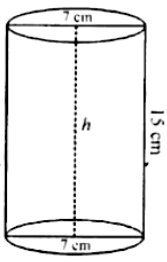
Height $(h) = 15 \ cm$
Curved surface area $= 2\pi rh$
$=2 \times \frac{22}{7} \times 7 \times 15=660 \ cm ^2$
Total surface area $= 2\pi r (h + r)$
$=2 \times \frac{22}{7} \times 7(15+7) $
$ =2 \times \frac{22}{7} \times 7 \times 22=968 \ cm ^2$ View full question & answer→Question 74 Marks
If radii of two cylinders are in the ratio $4 : 3$ and their heights are in the ratio $5: 6$, find the ratio of their curved surfaces.
AnswerThe ratio in radii of two cylinders $=4: 3$
and ratio in their heights $=5: 6$
Let $r_1$ and $r_2$ be the radii and $h_1, h_2$ be their heights respectively.
$\therefore r_1: r_2=4: 3$ and $h_1: h_2=5: 6$
$\therefore r_1=\frac{4}{3}$ and $\frac{h_1}{h_2}=\frac{5}{6}$
$\therefore$ Surface area of the first cylinder $=2 \pi r_1 h_1$
and area of second cylinder $=2 \pi r_2 h_2$
$\frac{2 \pi r_1 h_1}{2 \pi r_2 h_2}=\frac{r_1}{r_2} \times \frac{h_1}{h_2}=\frac{4}{3} \times \frac{5}{6}=\frac{20}{18}$
$ =\frac{10}{9}=10: 9$
$\therefore$ Ratio in their surface areas $=10: 9$
View full question & answer→Question 84 Marks
The ratio between the lengths of the edges of two cubes is in the ratio $3: 2.$ Find the ratio between their : $(i)$ total surface area $ (ii)$ volume.
AnswerRatio in edges of two cubes $= 3:2$ Let edge of first cube $= 3x$
Then edge of second cube $= 2x$
$(i)$ Now total surface area of first cube $= 6 \times (3x)^2 = 6 \times 9x^2 = 54x^2$
and of surface area of second cube $= 6 \times (2x)^2 = 6 \times 4x^2 = 24x^2$
Ratio $= 54x^2: 24x^2 = 9:4$
$(ii)$ Volume of first cube $= (3x)^3 = 27x^3$
and second cube $= (2x)^3 = 8x^3$
Ratio $= 27x^3: 8x^3 = 27 :8$
View full question & answer→Question 94 Marks
The height of a rectangular solid is $5$ times its width and its length is $8$ times its height. If the volume of the wall is $102.4\ cm^3,$ find its length.
AnswerHeight of rectangular solid $=5 \times$ width
and length $=8 \times$ height $=8 \times 5 \times$ width $=40 \times$ width
volume $=102.4 \ cm ^3$
Let width $= w$
Then height $=40 w$
and height $=5 w$
$\therefore w \times 40 w \times 5 w =102.4$
$w ^3=\frac{102.4}{40 \times 5}=0.512$
$=(0.8)^3$
$\therefore w=0.8$
$\therefore$ Length $=40 w =40 \times 0.8=32 \ cm$
View full question & answer→Question 104 Marks
Three solid cubes of edges $6\ cm, 10\ cm$, and $x\ cm$ are melted to form a single cube of edge $12\ cm$ , find the value of $x$.
AnswerEdge of first cube $=6 \ cm$
Volume $=(6)^3=216 \ cm^3$
Edge of second cube $=10 \ cm$
Volume $=(10)^3=1000 \ cm^3$
Edge of third cube $=x$
Volume $=x^3$
Edge of resulting cube $=12 \ cm$
Volume $= (12)^3 = 1728 \ cm^3$
$216 + 1000 + x^3 = 1728$
$x^3 = 1728 – 216 – 1000 = 512 = (8)^3$
$x = 8$
Edge of third cube $= 8 \ cm$
View full question & answer→Question 114 Marks
The edges of three solid cubes are $6\ cm, 8\ cm$, and $10\ cm$. These cubes are melted and recast into a single cube. Find the edge of the resulting cube.
AnswerEdge of first solid cube $= 6 \ cm$
Volume $= (6)^3 = 216 \ cm^3$
Edge of second cube $=8 \ cm$
Volume $=(8)^3=512 \ cm^3$
Edge of third cube $=10 \ cm$
Volume $=(10)^3=1000 \ cm^3$
Sum of volumes of three cubes $= 216 + 512 + 1000= 1728 \ cm^3$
Let a be the edge of so formed cube volume $= a^3$
$a^3 = 1728 = (12)^3$
$a = 12 \ cm$
View full question & answer→Question 124 Marks
A closed box measures $66 \ cm, 36 \ cm$ and $21 \ cm$ from outside. If its walls are made of metal$-$sheet, $0.5 \ cm$ thick; find : $(i)$ the capacity of the box ; $(ii) $the volume of metal$-$sheet and $(iii)$ weight of the box, if $1\ cm^3 $of metal weighs $3.6\ gm.$
AnswerExternal length of the closed box $=66\ cm$
External breadth of the closed box $=36\ cm$
External height of the closed box $=21\ cm$
External volume of the closed box $=66 \times 36 \times 21=49896\ cm^3$
Internal length of the box $=(66-2 \times 0.5)=66-1=65\ cm$
Internal breadth of the box $=(36-2 \times 0.5)=36-1=35\ cm$
Internal height of the box $=(21-2 \times 0.5)=21-1=20\ cm$
Internal Volume of the box $=65 \times 35 \times 20=45500\ cm^3$
$(i)$ Capacity of the box $=45500\ cm^3$
$(ii)$ Volume of metal sheet of the box $=$ External volume $-$ Internal volume
$=49896-45500=4396\ cm^3$
$(iii) 1\ cm^3$ of metal weigh $3.6\ grams$.
Weight of the box $=4396 \times 3.6\ gm =15825.6\ gm$
View full question & answer→Question 134 Marks
Find the volume of wood required to make a closed box of external dimensions $80\ cm, 75\ cm$, and $60\ cm$ , the thickness of walls of the box being $2\ cm$ throughout.
AnswerExternal length of the closed box $=80\ cm$
External Breadth of the closed box $=75\ cm$
External Height of the closed box $=60\ cm$
External volume of the closed box $=80 \times 75 \times 60=360000\ cm^3$
Internal length of the closed box $=80-4=76\ cm$
Internal Breadth of the closed box $=75-4=71\ cm$
Internal Height of the closed box $=60-4=56\ cm$
Internal volume of the closed box $=76 \times 71 \times 56\ cm=302176\ cm^3$
Volume of wood required to make the closed box $=360000-302176=57824\ cm^3$
View full question & answer→Question 144 Marks
The dimension of a class$-$room are; length $= 15\ m$, breadth $= 12\ m$ and height $= 7.5\ m$. Find, how many children can be accommodated in this class$-$room; assuming $3.6\ m^3$ of air is needed for each child.
AnswerLength of the room $=15\ m$
Breadth of the room $=12\ m$
Height of the room $=7.5\ m$
Volume of the room $=L \times B \times H=15 \times 12 \times 7.5\ m^ 3=1350\ m ^3$
Volume of air required for each child $=3.6\ m ^3$
No. of children who can be accommodated in the classroom.
$=\frac{\text { Volume of the classroom }}{\text { Volume of air needed for each child }}$
$=\frac{1350\ m ^3}{3.6\ m ^3}$
$ =375$
View full question & answer→Question 154 Marks
How many persons can be accommodated in a big-hall of dimensions $40\ m, 25\ m$, and $15\ m$ ; assuming that each person requires $5\ m^3$ of air?
Answer$\bigg[$ No. of persons $=\frac{\text { Vol. of the hall }}{\text { Vol. of air required for each person }}\bigg]$
Length of the hall $=40\ m$
breadth $=25\ m$
Height $=15\ m$
Volume of the hall $= L \times B \times H$
$=40 \times 25 \times 15$
$=15000\ m ^3$
The volume of the air required for each person $=5\ m ^3$
No. of persons who can be accommodated $=\frac{\text { Volume of the hall }}{\text { Volume of air required for each person }}$
$=\frac{15000\ m^3}{5\ m ^3}$
$ =3000$
View full question & answer→Question 164 Marks
A wall $9\ m$ long, $6\ m$ high and $20\ cm$ thick, is to be constructed using bricks of dimensions $30\ cm, 15\ cm$, and $10\ cm$. How many bricks will be required?
AnswerLength of the wall $=9\ m =9 \times 100 \ cm =900 \ cm$
Height of the wall $=6\ m =6 \times 100 \ cm =600 \ cm$
Breadth of the wall $=20 \ cm$
Volume of the wall $=900 \times 600 \times 20 \ cm ^3=10800000 \ cm ^3$
Volume of one Brick $=30 \times 15 \times 10 \ cm ^3=4500 \ cm ^3$
Number of bricks required to construct the wall $=\frac{\text { Volume of wall }}{\text { Volume of one brick }}$
$=\frac{10800000}{4500}$
$=2400$
View full question & answer→Question 174 Marks
Find the volume and total surface area of a cube whose each edge is : $(i) 8\ cm\ (ii) 2\ m\ 40\ cm.$
Answer$(i)$ Edge of the given cube $=8 \ cm$
Volume of the given cube $=(\text { Edge })^3=(8)^3=8 \times 8 \times 8=512 \ cm^3$
Total surface area of la cube $=6(\text { Edge })^2=6 \times(8)^2=384 \ cm^2$
$(ii)$ Edge of the given cube $=2m\ 40 \ cm=2.40\ m$
Volume of a cube $=(E d g e)^3$
Volume of the given cube $=(2.40)^3=2.40 \times 2.40 \times 2.40=13.824\ m^2$
Total surface area of the given cube $=6 \times 2.4 \times 2.4=34.56\ m^2$
View full question & answer→Question 184 Marks
The breadth and height of a rectangular solid are $1.20\ m$ and $80\ cm$ respectively. If the volume of the cuboid is $1.92\ m^3;$ find its length.
AnswerVolume of a rectangular solid $=1.92\ m ^3$
Breadth of a rectangular solid $=1.20\ m$
Height of a rectangular solid $=80 \ cm =0.8\ m$
We know
Length $\times$ Breadth $\times$ Height $=$ Volume of a rectangular solid $($cubical$)$
Length $\times 1.20 \times 0.8=1.92$
Length $\times 0.96=1.92$
$\Rightarrow$ Length $=\frac{1.92}{0.96}$
$\Rightarrow$ Length $=\frac{192}{96}$
$\Rightarrow$ Length $=2\ m$
View full question & answer→Question 194 Marks
Four cubes, each of edge $9 cm$, are joined as shown below :
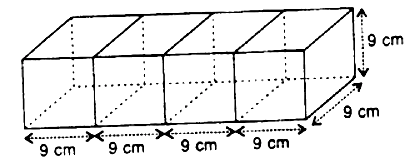
Write the dimensions of the resulting cuboid obtained. Also, find the total surface area and the volume AnswerEdge of each cube $=9 \ cm( i )$ Length of the cuboid fonned by $4$ cubes $(I)=9 \times 4=36 \ cm$
Breadth $(b)=9 \ cm$ and height $( h )=9 \ cm$
$(ii) $Total surface area of the cuboid $= 2(lb + bh + hl)$
$= 2 (36 \times 9 + 9 \times 9 + 9 \times 36) \ cm^2$
$= 2 (324 + 81 + 324) \ cm^2$
$= 2 \times 729 \ cm^2$
$= 1458 \ cm^2$
$(iii)$ Volume $= l \times b \times h = 36 \times 9 \times 9 \ cm^2 = 2916 \ cm^3$
View full question & answer→Question 204 Marks
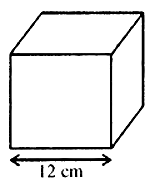
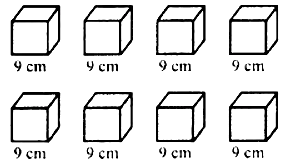
A solid cube of side $12 \ cm$ is cut into $8$ identical cubes. What will be the side of the new cube? Also, find the ratio between the surface area of the original cube and the total surface area of all the small cubes formed.
AnswerHere, the cube of side $12 \ cm$ is divided into $8$ cubes of side $9 \ cm.$
Given that,
Their volumes are equal.
The volume of big cube of $12 \ cm =$ Volume of $8$ cubes of side $a \ cm$
$($Side of the big cube$) ^3=8 \times ($Side of the small cube$) ^3$
$(12)^3=8 \times a^3$
$ \Rightarrow a^3=\frac{12 \times 12 \times 12}{8}$
$ \Rightarrow a^3=6^3 \ cm ^3$
$ \Rightarrow a=6 \ cm$
Ratio of their surface $=\frac{\text { Surface area of the original cube }}{\text { Total surface area of the small cube }}$
$ =\frac{6(\text { side of big cube })^2}{8 \times 6(\text { side of small cube })^2}$
$ =\frac{6 \times 12 \times 12}{8 \times 6 \times 6 \times 6}=\frac{4}{8}=1: 2$
So, the ratio is $1: 2$ View full question & answer→Question 214 Marks
The length of a hall is double its breadth. Its height is $3\ m$. The area of its four walls $($including doors and windows$)$ is $108\ m^2,$ find its volume.
AnswerLet the breadth be $x$
and the length be $2 x$
Height $=3\ m$
Area of four walls $=108\ m ^2$
$\Rightarrow 2( l + b ) h =108$
$\Rightarrow 2(2 x+x) 3=108$
$\Rightarrow 6 \times 3 x=108$
$\Rightarrow 3 x=\frac{108}{6}$
$\Rightarrow x=\frac{18}{3}=6\ m$
$\therefore$ Breadth $= x =6\ m$
and length $=2 x=12\ m$
Hence, Volume $=l \times b \times h$
$=12 \times 6 \times 3$
$=216\ m ^3$
View full question & answer→Question 224 Marks
The floor of a rectangular hall has a perimeter $250\ m$. If the cost of painting the four walls at the rate of $₹\ 10$ per $m^2$ is $₹\ 15,000,$ find the height of the hall.
AnswerLet the length, breadth, and height of the rectangular hall be $l\ m, b\ m,$ and $h\ m$ respectively.
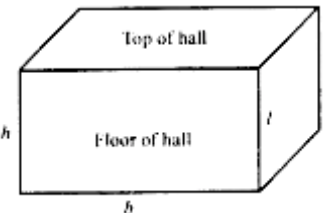
The perimeter of the floor of hall $= 2(l + b)$
$250\ m = 2(l + b)$
$( l + b )=\frac{250}{2}=125 \ cm$
Area of four walls $=$ Area of cuboid $–$ Area of floor $–$ Area of top
$= 2 (lb + bh + hl) – (l \times b) – (l \times b)$
$= 2(lb) + 2 (bh) + 2(hl) – 2lb = 2 lh + 2 bh$
$= 2h(l + b)$
$= 2h \times 125 [$From $(i)]$
$= 250\ h\ m^2$
Area of four walls $= 250\ h\ m^2$
Cost of painting $1m^2$ area $= ₹\ 10$
Cost of painting $250\ h\ m^2$ area $= ₹ 10 \times 250\ h = 2500\ h$
$15000 = 2500\ h$
$h=\frac{15000}{2500}$
The height of the hall is $6\ m$. View full question & answer→Question 234 Marks
The curved surface area and the volume of a toy, cylindrical in shape, are $132\ cm^2$ and $462\ cm^3$ respectively. Find, its diameter and its length.
AnswerLet the radius of a toy $=r$ and
height of the toy $= h$
The curved surface area of a toy $=132 \ cm ^2$
$=2 \pi r h=132 \ cm ^2$
$ \Rightarrow 2 \pi r h=132 \ cm ^2$
$ \Rightarrow r=\frac{132}{2 \pi \times h} \ cm ^2 \ldots . . .(\text { i) }$
Also, volume of a toy $=462 \ cm ^3$
$\Rightarrow \pi r^2 h=462 \ cm ^3$
$\Rightarrow r^2=\frac{462}{\pi \times h}$
Now, substitute the volume of $r$, we get
$\frac{(132)^2}{(2)^2 \times(\pi)^2 \times h^2}=\frac{462}{\pi \times h}$
$ \Rightarrow \frac{132^2}{4 \times \pi \times h}=462$
$ \Rightarrow 4 \times \pi \times h=\frac{132 \times 132}{462}$
$\Rightarrow h=\frac{132 \times 132}{462 \times \pi \times h}$
$ \Rightarrow h=\frac{132 \times 132 \times 7}{462 \times 22 \times 4}=3 \ cm$
Now, put the value of $h$ in eq. $(i),$ we get
$r=\frac{132 \times 7}{2 \times 22 \times 3}=7 \ cm$
$\therefore$ Diameter of the toy $=2 \times r$
$=2 \times 7 \ cm =14 \ cm$
View full question & answer→Question 244 Marks
The external dimensions of an open wooden box are $65\ cm, 34 \ cm,$ and $25 \ cm$. If the box is made up of wood $2 \ cm$ thick, find the capacity of the box and the volume of wood used to make it.
AnswerExternal length $= 65 \ cm$ External breath $= 34 \ cm$ External height $= 25 \ cm$
Volume $= l \times b \times h$
$= 65 \times 34 \times 25$
$= 55,250 \ cm^3$
Thickness $= 2 \ cm$
Internal length $= 65 - 4 = 61 \ cm$
Internal breath $= 34 - 4 = 30 \ cm$
Internal height $= 25 - 2 = 23 \ cm$
Capacity of the box $(V) = 61 \times 30 \times 23$
$= 42,090 \ cm^3$
The volume of wood used to make the box $= V_{ext} - V_{int}$
$= 65 \times 34 \times 25 \ cm^3 - 61 \times 30 \times 23 \ cm^3$
$= 55,250 - 42,090$
$= 13,160 \ cm^3$
View full question & answer→Question 254 Marks
The length, breadth, and height of a cuboid are in the ratio $6: 5 : 3$. If its total surface area is $504\ cm^2,$ find its volume.
AnswerLet the length of the given cuboid $=6 x$
The breadth of the given cuboid $=5 x$
Height of the given cuboid $=3 x$
The total surface area of the given cuboid
$=2( lb + bh + hl )$
$ =2(6 x \times 5 x+5 x \times 3 x+3 x \times 6 x)$
$ =\left(30 x^2+15 x^2+18 x^2\right)$
$ =2 \times 63 x^2=126 x^2$
But, we are given total surface area $=504 \ cm ^2$
$\therefore 126 x^2=504$
$\Rightarrow x^2=\frac{504}{126}$
$ \Rightarrow x^2=4$
$ \Rightarrow x^2=(2)^2$
$\Rightarrow x =2 \ cm$
$\therefore$ Length of the given cuboid $=6 x$
$=6 \times 2 \ cm =12 \ cm$
Breadth of the given cuboid $=5 x$
$=5 \times 2 \ cm =10 \ cm$
Height of the given cuboid $=3 x$
$=3 \times 2 \ cm =6 \ cm$
Now, volume of the cuboid $=l \times b \times h$
$=12 \times 10 \times 6=720 \ cm ^3$
View full question & answer→Question 264 Marks
The sum of the radius and the height of a cylinder is $37\ cm$ and the total surface area of the cylinder is $1628 \ cm^2$. Find the height and the volume of the cylinder.
AnswerLet $r$ and $h$ be the radius and height of the solid cylinder respectively.
Given$, r + h =37 \ cm$
The total surface area of the cylinder $=1628 \ cm ^2\ ($Given$)$
$\therefore 2 \pi r(r+h)=1628 \ cm ^2$
$\Rightarrow 2 \pi r \times 37=1628 \ cm ^2$
$\Rightarrow 2 \times \frac{22}{7} \times r \times 37=1628 \ cm ^2$
$\Rightarrow r=\frac{1628 \times 7}{2 \times 22 \times 37}=7 \ cm$
$rth =37 \ cm $
$\Rightarrow 7+ h =37 \ cm $
$\Rightarrow h =30 \ cm$
The volume of the cylinder $=\pi r^2 h$
$=\frac{22}{7} \times 7 \times 7 \times 30=4620 \ cm ^3$
View full question & answer→Question 274 Marks
The length, breadth, and height of a cuboid $($rectangular solid$)$ are $4 : 3: 2. (i)$ If its surface area is $2548 \ cm^2,$ find its volume.$(ii)$ If its volume is $3000\ m^3,$ find its surface area.
AnswerSurface area of cuboid $=2548 \ cm ^2$
Ratio in length, breadth and height of a cuboid $=4: 3: 2$
Let length $=4 x$, Breadth $=3 x$ and height $=2 x$
$\therefore$ Surface area $=2(4 x \times 3 x+3 x \times 2 x+2 x \times 4 x)$
$=2\left(12 x^2+6 x^2+8 x^2\right)$
$=2 \times 26 x^2=52 x^2$
$\therefore 52 x^2=2548$
$x^2=\frac{2548}{52}=49=(7)^2$
$\therefore x=7$
$\therefore$ Length $=4 x=4 \times 7=28 \ cm$
$\therefore$ Breadth $=3 x=3 \times 7=21 \ cm$
and height $=2 x=2 \times 7=14 \ cm$
$\therefore$ Volume $=l b h$
$=28 \times 21 \times 14 \ cm ^3=8232 \ cm ^2$
$(ii)$ If volume $=3000\ m ^3$
$\Rightarrow 4 x \times 3 x \times 2 x=3000$
$\Rightarrow 24 x^3=3000$
$\Rightarrow x^3=\frac{3000}{24}=125=(5)^3$
$\therefore x=5\ m$
Length $=5 \times 4=20$, breadth $=5 \times 3=15\ m$
and height $=5 \times 2=10\ m$
$\therefore$ Surface area $=2[l b+b h+h l]$
$=2[20 \times 15+15 \times 10+10 \times 20]\ m ^2$
$=2[300+150+200]\ m ^2$
$=2 \times 650=1300\ m ^2$
View full question & answer→Question 284 Marks
A cube of edge $6 \ cm$ and a cuboid with dimensions $4 \ cm \times x \ cm \times 15 \ cm$ are equal in volume. Find : $(i)$ the value of $x.(ii)$ the total surface area of the cuboid. $(iii)$ the total surface area of the cube.$(iv)$ which of these two has a greater surface and by how much?
AnswerEdge of a cube $=6 \ cm$
volume $=a^3=(6)^3=216 \ cm ^3$
Dimensions of a cuboid $=4 \ cm \times \ cm \times 15 \ cm$
volume $=60 \times \ cm ^3$
The volume of both is equal
$(i) \therefore 60 x=216 $
$\Rightarrow x=\frac{216}{60}=\frac{36}{10}$
$\therefore x =3.6 \ cm$
$(ii)$ Total surface area of cuboid $=2[l b+b h+h l]$
$=2[4 \times 3.6+3.6 \times 15+15 \times 4] \ cm ^2$
$=2[14.4+54.0+60] \ cm ^2$
$=128.4 \times 2=256.8 \ cm ^2$
$(iii)$ Total surface area of cube
$=6 a^2=6(6)^2=6 \times 36=216 \ cm ^2$
$(iv)$ Difference of surface areas $=256.8-216$
$=40.8 \ cm ^2$
$\therefore$ Surface area of cuboid is greater
View full question & answer→Question 294 Marks
The internal length, breadth, and height of a closed box are $1\ m, 80\ cm$, and $25 \ cm$. respectively. If its sides are made of $2.5 \ cm$ thick wood; find : $(i)$ the capacity of the box $(ii)$ the volume of wood used to make the box.
AnswerInternal length of the closed box $=1\ m =100 \ cm$
breadth $=80 \ cm$
height $=25 \ cm$
volume $=100 \times 80 \times 25$
$=200000 \ cm ^3$
External length of the box $=(100+2 \times 2.5)$
$=100+5=105 \ cm$
External breadth $=(80+2 \times 2.5)$
$=80+5=85 \ cm$
External height $=(25+2 \times 2.5)$
$=(25+5)=30 \ cm$
External volume $=105 \times 85 \times 30 \ cm ^3$
$=267750 \ cm ^3$
$(i)$ The capacity of the box $=100 \times 80 \times 25 \ cm ^3$
$=200000 \ cm ^3$
$=\frac{200000}{100 \times 100 \times 100} m ^3$
$=0.2 m ^3$
$(ii)$ The volume of wood used to make the box
$=$ External volume $-$ internal volume
$ =267750-200000$
$ =67750 \ cm ^3$
$ =\frac{67750}{100 \times 100 \times 100} m ^3$
$ =0.06775\ m ^3$
View full question & answer→Question 304 Marks
The dining$-$hall of a hotel is $75\ m$ long$ ; 60\ m$ broad and $16\ m$ high. It has five $-$ doors $4\ m$ by $3\ m$ each and four windows $3\ m$ by $1.6\ m$ each. Find the cost of : $(i)$ papering its walls at the rate of $Rs.12$ per $m^2;$$(ii)$ carpetting its floor at the rate of $Rs.25$ per $m^2.$
AnswerLength of the dining hall of a hotel $=75\ m$
The breadth of the dining hall of a hotel $=60\ m$
Height of the dining hall of a hotel $=16\ m$
$(i)$ Area of four walls of the dining hall $=2[L+B) \times H=2(75+60) \times 16$
$=2(135) \times 16$
$=270 \times 16$
$=4320\ m ^2$
Area of one door $=4 \times 3\ m ^2$
$=12\ m ^2$
Area of $5$ doors $=12 \times 5=60\ m ^2$
Area of one window $=3 \times 1.6=4.8\ m ^2$
Area of $4$ window $=4.8 \times 4=19.2\ m ^2$
Area of the walls to be papered
$=4320-(60+19.2)$
$=4320-79.2$
$=4240.8\ m ^2$
$=4240.8 \times 12$
$ = Rs. 50889.60$
$(ii)$ Area of floor $=L \times B$
$=75 \times 60$
$ =4500\ m ^2$
Cost of carpetting the floor $@Rs. 25$ per $m^2$
$=4500 \times 25$
$= Rs. 112500$
View full question & answer→Question 314 Marks
A room $5\ m$ long$, 4.5\ m$ wide and $3.6\ m$ high have one door $1.5\ m$ by $2.4\ m$ and two windows, each $1\ m$ by $0.75
\ m$. Find : $(i)$ the area of its walls, excluding door and windows ;$(ii)$ the cost of distempering its walls at the rate of $Rs.4.50$ per $m^2$.$(iii)$ the cost of painting its roof at the rate of $Rs.9$ per $m^2$.
AnswerLength of the room $=5\ m$
The breadth of the room $=4.5\ m$
Height of the room $=3.6\ m$
Area of the roof $= L \times B$
$=5 \times 4.5\ m ^2$
$=22.5\ m ^2$
Area of four walls $=2[L+B] \times H$
$=2[5+4.5] \times 3.6$
$=2(9.5) \times 3.6$
$=19 \times 3.6$
$=68.4\ m ^2$
Area of one door $=1.5 \times 2.4\ m ^2$
$=3.60\ m ^2$
$=3.6\ m ^2$
Area of one window $=1 \times 0.75\ m ^2$
$=0.75\ m ^2$
Area of 2 window $=0.75 \times 2\ m ^2$
$=1.5\ m ^2$
$(i)$ Area of four walls excluding door and windows $=68.4-(3.6+1.5)$
$= 68.4 - 5.1$
$= 63.3\ m^2$
$(ii)$ Cost of distempering four walls $@ Rs. 4.50$ per $m^2$
$= 63.3 \times 4.50$
$= Rs. 284.85$
$(iii)$ Cost of painting the roof $@ Rs.9$ per $m^2$
$= 22.5 \times 9$
$= Rs. 202.50$
View full question & answer→Question 324 Marks
Find the length of each edge of a cube, if its volume is : $(i)\ 216 \ cm^3(ii)\ 1.728\ m^3$
Answer$(i)\ ($Edge$)^3=$ Volume of a cube
$($Edge$)^3=216 \ cm ^3$
$\Rightarrow$ Edge $=(216)^{\frac{1}{3}}$
$\Rightarrow$ Edge $=(3 \times 3 \times 3 \times 2 \times 2 \times 2)^{\frac{1}{3}}$
$\Rightarrow$ Edge $=3 \times 2$
$\Rightarrow$ Edge $=6 \ cm$.
$(ii)\ ($Edge$)^3=$ Volume of a cube
$($Edge$)^3=1.728 \ cm ^3$
$\Rightarrow($Edge$)^3=\frac{1.728}{1.000}=\frac{1728}{1000}$
$\Rightarrow$ Edge $=\left(\frac{1728}{1000}\right)^{\frac{1}{3}}$
$\Rightarrow$ Edge $=\left(\frac{2 \times 2 \times 2 \times 2 \times 2 \times 2 \times 3 \times 3 \times 3}{10 \times 10 \times 10}\right)^{\frac{1}{3}}$
$\Rightarrow$ Edge $=\frac{2 \times 2 \times 3}{10}$
$\Rightarrow$ Edge $=\frac{12}{10}\ m$
$\Rightarrow$ Edge $=1.2\ m$
View full question & answer→Question 334 Marks
The length, breadth, and height of a cuboid are in the ratio $6: 5 : 3$. If its total surface area is $504 \ cm^2;$ find its dimensions. Also, find the volume of the cuboid.
AnswerLet length of the cuboid $=6 x$
Breadth of the cuboid $=5 x$
Height of the cuboid $=3 x$
Total surface area of the given cuboid $=2(\mid \times b+b \times h+h \times l)$
$=2(6 \times \times 5 x+5 \times \times 3 x+3 \times \times 6 x)=2(30 \times 2+15 \times 2+18 \times 2)$
$ =2 \times 63 \times 2=126 x^2$
But we are given total surface area of the given cuboid $=504 \ cm ^2$
$126 x^2=504 \ cm ^2$
$ \Rightarrow x^2=\frac{504}{126}$
$ \Rightarrow x^2=4$
$ \Rightarrow x=\sqrt{4}$
$ \Rightarrow x=2 \ cm$
Length of the cuboid $=6 x=6 \times 2=12 \ cm$
Breadth of the cuboid $=5 x =5 \times 2=10 \ cm$
Height of the cuboid $=3 x =3 \times 2=6 \ cm$
Volume of the cuboid $=1 \times b \times h =12 \times 10 \times 6=720 \ cm ^3$
View full question & answer→Question 344 Marks
The length, breadth, and height of a cuboid are in the ratio $5 : 3: 2$. If its volume is $240 \ cm^3;$ find its dimensions. Also, find the total surface area of the cuboid.
AnswerLet length of the given cuboid $=5 x$
Breadth of the given cuboid $=3 x$
Height of the given cuboid $=2 x$
Volume of the given cuboid $=$ Length $x$ Breadth $x$ Height $=5 x \times 3 x \times 2 x =30 x ^3$
But we are given volume $=240 \ cm ^3$
$30 x ^3=240 \ cm ^3$
$\Rightarrow x ^3=\frac{240}{30}$
$\Rightarrow x ^3=8$
$\Rightarrow x =8^{\frac{1}{3}}$
$\Rightarrow x=(2 \times 2 \times 2)^{\frac{1}{3}}$
$\Rightarrow x =2 \ cm$
Length of the given cube $=5 x=5 \times 2=10 \ cm$
Breadth of the given cube $=3 x=3 \times 2=6 \ cm$
Height of the given cube $=2 x =2 \times 2=4 \ cm$
Total surface area of the given cuboid $=2(\mid \times b+b \times h+h \times l)$
$=2(10 \times 6+6 \times 4+4 \times 10)=2(60+24+40)=2 \times 124$
$=248 \ cm ^2$
View full question & answer→Question 354 Marks
A closed box is cuboid in shape with length $= 40 \ cm,$ breadth $= 30 \ cm$ and height $= 50 \ cm$. It is made of a thin metal sheet. Find the cost of metal sheet required to make $20$ such boxes, if $1\ m^2$ of metal sheet costs $Rs. 45$.
Answer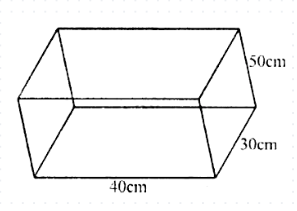
Length of closed box $(l) = 40 \ cm$
Breadth $(b) = 30 \ cm$
and height $(h) = 50 \ cm$
Total surface area $= 2 (lb + bh + hl)$
$= 2 (40 \times 30 + 30 \times 50 + 50 \times 40) \ cm^2$
$= 2 (1200 + 1500 + 2000) \ cm^2$
$= 2 \times 4700$
$= 9400 \ cm^2$
Surface area of sheet used for $20$ such boxes $= 9400 \times 20 = 188000 \ cm^2$
$\therefore 188000 \ cm ^2=\frac{188000}{100 \times 100}=18.8\ m ^2$
Cost of $1\ m^2$ sheet $= Rs. 45$
Total cost $= ₹.\ 18.8 \times 45 = ₹.\ 846$ View full question & answer→