Questions

MCQ

🎯

Test yourself on this topic

17 questions · timed · auto-graded

MCQ 11 Mark
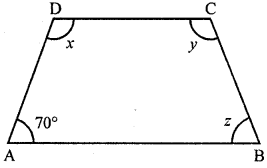
In the given figure, $\text{ABCD}$ is an isosceles trapezium. The values of $x, y$ and $z$ respectively are
Image
  • $110^{\circ}, 110^{\circ}, 70^{\circ}$
  • B
    $110^{\circ}, 70^{\circ}, 110^{\circ}$
  • C
    $70^{\circ}, 110^{\circ}, 110^{\circ}$
  • D
    none of these
Answer
Correct option: A.
$110^{\circ}, 110^{\circ}, 70^{\circ}$
In isosceles trapezium $\angle A=70^{\circ}$
But $\angle B=\angle A=70^{\circ}$
$\Rightarrow z=70^{\circ}$
But $x +70^{\circ}=180^{\circ}$
$\Rightarrow x =180^{\circ}-70^{\circ}=110^{\circ}$
But $y = x =110^{\circ}$
$\therefore 110^{\circ}, 110^{\circ}, 70^{\circ}$
View full question & answer
MCQ 21 Mark
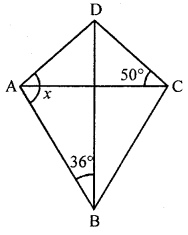
In the given figure, $\text{ABCD}$ is a kite, the value of angle $x$ is
Image
  • A
    $86^{\circ}$
  • B
    $100^{\circ}$
  • $104^{\circ}$
  • D
    none of these
Answer
Correct option: C.
$104^{\circ}$
In the given figure, $\text{ABCD}$ is a kite whose
diagonals $AC$ and $BD$ intersect at $O$ at right angles.
Image
$\text { In } \triangle \text{OAB,} \angle O=90^{\circ}$
$\therefore \angle \text{OAB}+\angle A B O=90^{\circ}$
$\Rightarrow \angle \text{OAB}+36^{\circ}=90^{\circ}$
$\Rightarrow \angle \text{OAB}=90^{\circ}-36^{\circ}=54^{\circ}$
$\text { But } \angle \text{OAD}=\angle \text{OCD}=50^{\circ}$
$x=\angle \text{DAO} +\angle \text{AOB}$
$\Rightarrow x=50^{\circ}+54^{\circ}=104^{\circ}$
View full question & answer
MCQ 31 Mark
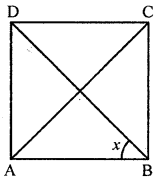
In the given figure, $\text{ABCD}$ is a square, the value of angle $x$ is
Image
  • A
    $30^{\circ}$
  • $45^{\circ}$
  • C
    $60^{\circ}$
  • D
    not possible to find
Answer
Correct option: B.
$45^{\circ}$
In the given figure,
$\text{ABCD}$ is a square whose diagonals $AC$ and $BD$
bisect each other at $O$.
Image
$\because$ Diagonals of a square bisect the opposite angles.
$\therefore x =\frac{1}{2} \times \angle B=\frac{1}{2} \times 90^{\circ}=45^{\circ}$
View full question & answer
MCQ 41 Mark
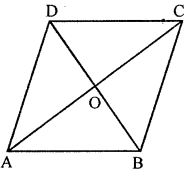
In a rhombus $\text{ABCD,}$ the diagonals $AC$ and $BD$ are respectively $8 \ cm$ and $6 \ cm.$ The length of each side of the rhombus is
  • A
    $7 \ cm$
  • $5 \ cm$
  • C
    $6 \ cm$
  • D
    $8 \ cm$
Answer
Correct option: B.
$5 \ cm$
In rhombus $\text{ABCD}$
Diagonals $AC$ and $BD$ are $8 \ cm$ and $6 \ cm$
Image
$\therefore A C=8 \ cm$ and $B D=6 \ cm$
$\because$ Diagonals of a rhombus bisect each other at right angles
$AO=OC=\frac{8}{2}=4 \ cm$
$BO=OD=\frac{6}{2}=3 \ cm$
$\therefore$ In right $\triangle \text{AOB}$
$AB =\sqrt{ AO^2+ BO^2}=\sqrt{4^2+3^2}$
$=\sqrt{16+9}=\sqrt{25}=5 \ cm$
Each side of rhombus $=5 \ cm$ 
View full question & answer
MCQ 51 Mark
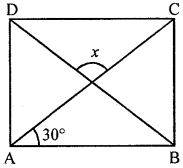
In the given figure $, \text{ABCD}$ is a rectangle, the value of angle $x$ is
Image
  • A
    $60^{\circ}$
  • B
    $90^{\circ}$
  • $120^{\circ}$
  • D
    none of these
Answer
Correct option: C.
$120^{\circ}$
In the given figure $, \text{ABCD}$ is a rectangle
Image
$\therefore \angle O B A=\angle O A B=30^{\circ}$
$\text { In } \triangle A O B,$
$\angle A O B=\angle C O D \ ($Vertically opposite angles$)$
$\angle A O B=x$
$\angle A O B+\angle O B A+\angle O A B=180^{\circ} \ ($Angles of a triangle$)$
$\Rightarrow x+30^{\circ}+30^{\circ}=180^{\circ}$
$\Rightarrow x=180^{\circ}-30^{\circ}-30^{\circ}=120^{\circ}$
$\therefore x=120^{\circ} $
View full question & answer
MCQ 61 Mark
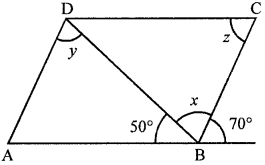
In the given figure, $\text{ABCD}$ is a parallelogram, the values of $x, y$ and $z$ respectively are
Image
  • $60^{\circ}, 60^{\circ}, 70^{\circ}$
  • B
    $60^{\circ}, 70^{\circ}, 60^{\circ}$
  • C
    $70^{\circ}, 60^{\circ}, 60^{\circ}$
  • D
    none of these
Answer
Correct option: A.
$60^{\circ}, 60^{\circ}, 70^{\circ}$
In the given figure,
Image
$\text{ABCD}$ is a parallelogram, $BD$ is its one diagonal
$\ce{\angle ABD +\angle DBC +\angle CBE =180^{\circ}}$
$($Angles on one side of a line$)$
$\Rightarrow 50^{\circ}+ x +70^{\circ}=180^{\circ}$
$x +120^{\circ}=180^{\circ}$
$\therefore x =180^{\circ}-120^{\circ}=60^{\circ}$
But $y = x ($Alternate angles$)$
$\therefore y=60^{\circ}$
$z=70^{\circ} ($Alternate angles $)$
$\therefore x=60^{\circ}, y=60^{\circ}, z=70^{\circ}$
View full question & answer
MCQ 71 Mark
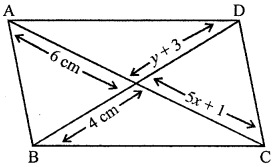
In the given figure, $\text{ABCD}$ is a parallelogram, the values of $x$ and $y$ respectively are
Image
  • $1 \ cm, 1 \ cm$
  • B
    $2 \ cm, 1 \ c$m
  • C
    $1 \ cm, 2 \ cm$
  • D
    $2 \ cm, 2 \ cm$
Answer
Correct option: A.
$1 \ cm, 1 \ cm$
In the given figure, $\text{ABCD}$ is a parallelogram
$\because$ Diagonals of a parallelogram bisect each other
$\therefore \text{AO=OC}$ and $\text{BO=OD}$
$\therefore 6=5 x+1$
$\Rightarrow 5 x=6-1=5$
$\Rightarrow x=\frac{5}{5}$
and $y+3=4$
$\Rightarrow y=4-3=1$
$\therefore x=1, y=1$
View full question & answer
MCQ 81 Mark
The lengths of two adjacent sides of a parallelogram are in the ratio $1 : 2.$ If the perimeter of parallelogram is $60 \ cm,$ then length of its sides are
  • A
    $6 \ cm, 12 \ cm$
  • B
    $8 \ cm, 16 \ cm$
  • C
    $9 \ cm, 18 \ cm$
  • $10 \ cm, 20 \ cm$
Answer
Correct option: D.
$10 \ cm, 20 \ cm$
Ratio in the length of two adjacent sides of a parallelogram $=1: 2$
Perimeter $=60 \ cm$
$\therefore$ Sum of two adjacent sides $=\frac{60}{2}=30 \ cm$
Let first side $= x$, then second side $=2 x$
$\therefore x+2 x=30$
$\Rightarrow 3 x=30$
$x=\frac{30}{2}=10 \ cm$
First side $=10 \ cm$
and second side $=10 \times 2=20 \ cm$
View full question & answer
MCQ 91 Mark
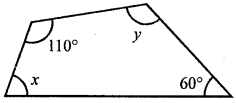
In the given figure, the value of $x+y$ is
Image
  • A
    $180^{\circ}$
  • $190^{\circ}$
  • C
    $170^{\circ}$
  • D
    $160^{\circ}$
Answer
Correct option: B.
$190^{\circ}$
In the given figure,
Sum of interior angles of a quadrilateral $=360^{\circ}$
$60^{\circ}+y+110^{\circ}+x=360^{\circ}$
$\Rightarrow x+y+170^{\circ}=360^{\circ}$
$\Rightarrow x+y=360^{\circ}-170^{\circ}$
$x+y=190^{\circ}$
View full question & answer
MCQ 101 Mark
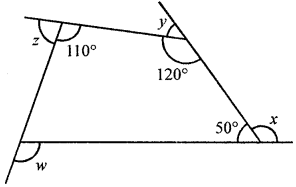
In the given figure, the value of $x + y + z + w$ is
Image
  • A
    $180^{\circ}$
  • B
    $270^{\circ}$
  • C
    $300^{\circ}$
  • $360^{\circ}$
Answer
Correct option: D.
$360^{\circ}$
In the given figure,
Sum of exterior angles of a quadrilateral $=360^{\circ}$
$\therefore x + y + z + w =360^{\circ}$
View full question & answer
MCQ 111 Mark
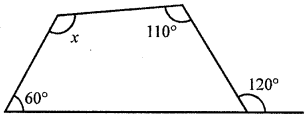
In the given figure, the value of $x$ is
Image
  • A
    $120^{\circ}$
  • $130^{\circ}$
  • C
    $140^{\circ}$
  • D
    $150^{\circ}$
Answer
Correct option: B.
$130^{\circ}$
In the given figure,
Sum of angles of a quadrilateral $=360^{\circ}$
$\therefore 60^{\circ}+\left(180^{\circ}-120^{\circ}\right)+110^{\circ}+ x =360^{\circ}$
$\Rightarrow 60^{\circ}+60^{\circ}+110^{\circ}+ x =360^{\circ}$
$230^{\circ}+ x =360^{\circ}$
$\therefore x =360^{\circ}-230^{\circ}=130^{\circ}$
View full question & answer
MCQ 121 Mark
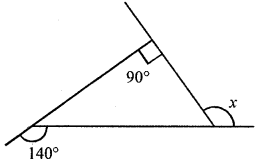
In the given figure, the value of $x$ is
Image
  • A
    $140^{\circ}$
  • B
    $50^{\circ}$
  • $130^{\circ}$
  • D
    $40^{\circ}$
Answer
Correct option: C.
$130^{\circ}$
In the given figure,
Sum of exterior angles of a triangle $=360^{\circ}$
$\therefore 140^{\circ}+ x +90^{\circ}=360^{\circ}$
$\Rightarrow x +230^{\circ}=360^{\circ}$
$\therefore x =360^{\circ}-230^{\circ}=130^{\circ}$
View full question & answer
MCQ 131 Mark
f the ratio between an exterior and interior angle of a regular polygon is $1 : 5$, then the number of sides of the polygon is
  • A
    $11$
  • $12$
  • C
    $13$
  • D
    $14$
Answer
Correct option: B.
$12$
Ratio between exterior angle and interior angle of a regular polygon $=1: 5$
But sum of angles $=180^{\circ}$
$\therefore$ Exterior angle $=\frac{180^{\circ}}{1+5} \times 1$
$=\frac{180^{\circ}}{6}=30^{\circ}$
$\therefore$ Number of sides $=\frac{360^{\circ}}{30}=12 \quad$
$($Sum of exterior angles $=360^{\circ})$ 
View full question & answer
MCQ 141 Mark
The sum of all exterior angles of a pentagon is
  • A
    $590^{\circ}$
  • $360^{\circ}$
  • C
    $180^{\circ}$
  • D
    none of these
Answer
Correct option: B.
$360^{\circ}$
Sum of exterior angles of a pentagon $=360^{\circ}$ 
View full question & answer
MCQ 151 Mark
If the sum of all interior angles of a polygon is $1260^\circ,$ then number of sides of polygon is
  • A
    $6$
  • B
    $7$
  • C
    $8$
  • $9$
Answer
Correct option: D.
$9$
Sum of all interior angles of a polygon $=1260^{\circ}$
$\therefore(2 n-4) \times 90^{\circ}=1260^{\circ}$
$\Rightarrow 2 n-4=\frac{1260^{\circ}}{90}$
$\Rightarrow 2 n=14+4=18$
$\Rightarrow n=\frac{18}{2}=9$
$\therefore$ Polygon is $9$ sided.
View full question & answer
MCQ 161 Mark
If each interior angle of a regular polygon is $144^\circ ,$ then number of sides of polygon is
  • A
    $8$
  • B
    $9$
  • $10$
  • D
    $11$
Answer
Correct option: C.
$10$
Each interior angle of a regular polygon is $144^{\circ}.$
Then $\frac{2 n-4}{n} \times 90^{\circ}=144^{\circ}$
$\Rightarrow \frac{2 n-4}{n}=\frac{144^{\circ}}{90^{\circ}}$
$\Rightarrow 10 n-20^{\circ}=8 n$
$\Rightarrow 10 n-8 n=20^{\circ}$
$\Rightarrow 2 n=20^{\circ}$
$\Rightarrow n=10$
$\therefore$ It is $10 -$sided polygon. 
View full question & answer
MCQ 171 Mark
Sum of all interior angles of a $11-$sided polygon is
  • $1620^{\circ}$
  • B
    $1440^{\circ}$
  • C
    $1260\  v$
  • D
    none of these
Answer
Correct option: A.
$1620^{\circ}$
Sum of all interior angles of an $11 -$sided polygon is
$=(2 \times n-4) \times 90^{\circ}$
$=(2 \times 11-4) \times 90^{\circ}$
$=18 \times 90$
$=1620$
View full question & answer
MCQ - MATHS STD 8 Questions - Vidyadip