Questions

[3 marks sum]

🎯

Test yourself on this topic

18 questions · timed · auto-graded

Question 13 Marks
Two angles of a quadrilateral are $89^\circ$and $113^\circ$ . If the other two angles are equal; find the equal angles.
Answer
Let the other angle $=x^{\circ}$
According to given,
$89^{\circ}+113^{\circ}+x^{\circ}+x^{\circ}=360^{\circ}$
$ 2 x^{\circ}=360^{\circ}-202^{\circ}$
$ 2 x^{\circ}=158^{\circ}$
$ x^{\circ}=\frac{158}{2}$
other two angles $=79^{\circ}$ each
View full question & answer
Question 23 Marks
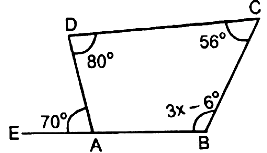
Use the information given in the following figure to find the value of $x$.
Answer
Take$ A, B, C, D$ as the vertices of Quadrilateral and $BA$ is produced to $E ($say$).$Since$ \angle EAD = 70^\circ \therefore \angle DAB = 180^\circ – 70^\circ = 110^\circ [EAB$ is a straight line and $AD$ stands on it $\angle EAD+ \angle DAB = 180^\circ ]$
$\therefore 110^\circ + 80^\circ + 56^\circ + 3x – 6^\circ = 360^\circ$
$[\because$ sum of interior angles of a quadrilateral $= 360^\circ ]$
$\therefore 3x = 360^\circ – 110^\circ – 80^\circ – 56^\circ + 6^\circ$
$3x = 360^\circ – 240^\circ = 120^\circ$
$\therefore x = 40^\circ$
View full question & answer
Question 33 Marks
Is it possible to have a regular polygon whose each exterior angle is: $ 40^\circ$ of a right angle.
Answer
Let the number of sides $=n$
Each exterior angle $=40 \%$ of a right angle
$=\frac{40}{100} \times 90$
$ =36^{\circ}$
$\mathrm{n}=\frac{360^{\circ}}{36^{\circ}}$
$n=10$
Which is a whole number.
Hence it is possible to have a regular polygon whose exterior angle is $40 \%$ of the right angle.
View full question & answer
Question 43 Marks
Is it possible to have a regular polygon whose each exterior angle is: $80^\circ$
Answer
Let no. of sides $=n$ each exterior angle $=80^{\circ}$
$\frac{360^{\circ}}{\mathrm{n}}=80^{\circ}$
$ \mathrm{n}=\frac{360^{\circ}}{80^{\circ}}$
$ \mathrm{n}=\frac{9}{2}$
Which is not a whole number.
Hence it is not possible to have a regular polygon whose each exterior angle is of $80^{\circ}$
View full question & answer
Question 53 Marks
Find the number of sides in a regular polygon, if its exterior angle is: two$-$fifth of right angle
Answer
Each exterior angle $=\frac{2}{5}$ of a right angle
$=\frac{2}{5} \times 90^{\circ}$
$= 36^\circ$
Let number of sides $= n$
$\therefore \frac{360^{\circ}}{ n }=36^{\circ} $
$ \therefore n =\frac{360^{\circ}}{36^{\circ}}$
$n = 10$
View full question & answer
Question 63 Marks
Find the number of sides in a regular polygon, if its exterior angle is : $\frac{1}{3}$ of right angle
Answer
Each exterior angle $=\frac{1}{3}$ of a right angle
$=\frac{1}{3} \times 90$
$ =30^{\circ}$
Let number of sides $=n$
$\therefore \frac{360^{\circ}}{\mathrm{n}}=30^{\circ}$
$ \therefore \mathrm{n}=\frac{360^{\circ}}{30^{\circ}}$
$\mathrm{n}=12$
View full question & answer
Question 73 Marks
Find the number of sides in a regular polygon, if its interior angle is: $1 \frac{1}{5}$ of a right angle
Answer
No. of. sides $=n$
Each interior angle $=1 \frac{1}{5}$ right angles
$=\frac{6}{5} \times 90$
$ =108^{\circ}$
$ \therefore \frac{n-2}{n} \times 180^{\circ}=108^{\circ}$
$ 180 n-360^{\circ}=108 n$
$ 180 n-108 n=360^{\circ}$
$ 72 n=360^{\circ}$
$ n=5$
View full question & answer
Question 83 Marks
Find the number of sides in a regular polygon, if its interior angle is: $135^\circ $
Answer
No. of. sides $=n$
Each interior angle $=135^{\circ}$
$\frac{n-2}{n} \times 180^{\circ}=135^{\circ}$
$ 180 n-360^{\circ}=135 n$
$ 180 n-135 n=360^{\circ}$
$ 45 n=360^{\circ}$
$n=8$
View full question & answer
Question 93 Marks
Find the number of sides in a regular polygon, if its interior angle is: $160^\circ$
Answer
Let no.of.sides of regular polygon be $n$.
Each interior angle $=160^{\circ}$
$\therefore \frac{n-2}{n} \times 180^{\circ}=160^{\circ}$
$ 180 n-360^{\circ}=160 n$
$ 180 n-160 n=360^{\circ}$
$ 20 n=360^{\circ}$
$n=18$
View full question & answer
Question 103 Marks
Calculate the number of sides of a regular polygon, if: its exterior angle exceeds its interior angle by $60^\circ $.
Answer
Let interior angle $=x$
Then exterior angle $=x+60$
$\therefore x+x+60^{\circ}=180^{\circ}$
$ \Rightarrow 2 x=180^{\circ}-60^{\circ}=120^{\circ}$
$ \Rightarrow x=\frac{120^{\circ}}{2}=60^{\circ}$
$\therefore$ Exterior angle $=60^{\circ}+60^{\circ}=120^{\circ}$
$\therefore$ Number of sides $=\frac{360^{\circ}}{120^{\circ}}=3$
View full question & answer
Question 113 Marks
Calculate the number of sides of a regular polygon, if: its interior angle is five times its exterior angle.
Answer
Let number of sides of a regular polygon $=n$
Let exterior angle $=x$
Then interior angle $=5 \mathrm{x}$
$x+5 x=180^{\circ}$
$ \Rightarrow 6 x=180^{\circ}$
$ \Rightarrow x=\frac{180^{\circ}}{6}=30^{\circ}$
$\therefore$ Number of sides $(n)=\frac{360^{\circ}}{30}=12$
View full question & answer
Question 123 Marks
Three of the exterior angles of a hexagon are $40^\circ , 51 ^\circ$ and $86^\circ$ . If each of the remaining exterior angles is $x^\circ$ , find the value of $x$.
Answer
Sum of exterior angles of a hexagon $=4 \times 90^{\circ}=360^{\circ}$
Three angles are $40^{\circ}, 51^{\circ}$ and $86^{\circ}$
Sum of three angle $=40^{\circ}+51^{\circ}+86^{\circ}=177^{\circ}$
Sum of other three angles $=360^{\circ}-177^{\circ}=183^{\circ}$
Each angle is $x^{\circ}$
$
\begin{aligned}
& 3 x=183^{\circ} \\
& x=\frac{183}{3}
\end{aligned}
$
Hence $x=61$
View full question & answer
Question 133 Marks
Find the sum of exterior angle obtained on producing, in order, the side of a polygon with $: 10$ sides
Answer
No. of sides $n = 10$ Sum of interior exterior angles at one vertec $x = 180^\circ$
Sum of all interior exterior angles $= 10 \times 180^\circ = 1800^\circ$
Sum of interior angles $= (n - 2) \times 180^\circ$
$= (10 - 2) \times 180^\circ$
$= 1440^\circ$
$\therefore$ Sum of exterior angles $= 1800^\circ - 1440^\circ = 360^\circ$
View full question & answer
Question 143 Marks
Find the number of sides in a polygon if the sum of its interior angle is: $ 32$ right$-$angles.
Answer
Let no. of sides $=n$ Sum of angles of polygon $=32$ right angles $=32 \times 90=2880^{\circ}$
$(n-2) \times 180^{\circ}=2880$
$ n-2=\frac{2880}{180}$
$ n-2=16$
$ n=16+2$
$ n=18$
View full question & answer
Question 153 Marks
Find the number of sides in a polygon if the sum of its interior angle is: $16$ right$-$angles.
Answer
Let no. of sides $=n$
Sum of angles of polygon $=16$ right angles $=16 \times 90=1440^{\circ}$
$(n-2) \times 180^{\circ}=1440^{\circ}$
$n-2=\frac{1440}{180}$
$n-2=8$
$\mathrm{n}=8+2$
$n=10$
View full question & answer
Question 163 Marks
Find the number of sides in a polygon if the sum of its interior angle is: $1620^\circ$
Answer
Let no. of sides $=n$
$\therefore$ Sum of angles of polygon $=1620^{\circ}$
$\therefore(2 \mathrm{n}-\mathrm{a}) \times 90^{\circ}=1620^{\circ}$
$\Rightarrow 2(\mathrm{n}-2)=\frac{1620^{\circ}}{90^{\circ}}$
$\Rightarrow \mathrm{n}-2=\frac{1620^{\circ}}{2 \times 90^{\circ}}$
$\Rightarrow \mathrm{n}-2=9$
$\Rightarrow \mathrm{n}=9+2$
$\Rightarrow n=11$
View full question & answer
Question 173 Marks
Find the number of sides in a polygon if the sum of its interior angle is: $900^\circ$
Answer
Let no. of sides $=n$
Sum of angles of polygon $=900^{\circ}$
$(n-2) \times 180^{\circ}=900^{\circ}$
$n-2=\frac{900}{180}$
$n-2=5$
$n=5+2$
$n=7$
View full question & answer
Question 183 Marks
In a pentagon, two angles are $40^\circ$ and $60^\circ$ , and the rest are in the ratio $1 : 3 : 7$. Find the biggest angle of the pentagon.
Answer
In a pentagon, two angles are $40^{\circ}$ and $60^{\circ}$ Sum of remaining $3$ angles $=3 \times 180^{\circ}$
$=540^{\circ}-40^{\circ}-60^{\circ}=540^{\circ}-100^{\circ}=440^{\circ}$
Ratio in these $3$ angles $=1: 3: 7$
Sum of ratios $=1+3+7=11$
Biggest angle $=\frac{440 \times 7}{11}=280^{\circ}$
View full question & answer