Questions

[5 marks sum]

🎯

Test yourself on this topic

18 questions · timed · auto-graded

Question 15 Marks
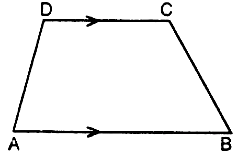
In quadrilateral $ABCD$, side $AB$ is parallel to side $DC$. If  $\angle A : \angle D = 1 : 2$ and $\angle C : \angle B = 4 : 5\ (i)$ Calculate each angle of the quadrilateral. $(ii)$ Assign a special name to quadrilateral $ABCD$
Answer
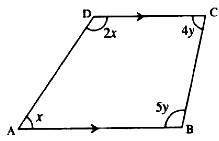

$\because \angle \mathrm{A}: \angle \mathrm{D}=1: 2$
Let $\angle A=x$ and $\angle B=2 x$
$\because \angle C: \angle B=4: 5$
Let $\angle C=4 y$ and $\angle B=5 y$
$\because \mathrm{AB}|| \mathrm{DC}$
$\therefore \angle \mathrm{A}+\angle \mathrm{D}=180^{\circ}$
$x+2 x=180^{\circ}$
$3 x=180^{\circ}$
$x=60^{\circ}$
$\therefore \mathrm{A}=60^{\circ}$
$\angle \mathrm{D}=2 \mathrm{x}=2 \times 60=120^{\circ}$
Again $\angle B+\angle C=180^{\circ}$
$5 y+4 y=180^{\circ}$
$9 \mathrm{y}=180^{\circ}$
$y=20^{\circ}$
$\therefore \angle \mathrm{B}=5 \mathrm{y}=520=100^{\circ}$
$\angle C=4 y=420=80^{\circ}$
Hence $\angle \mathrm{A}=60^{\circ} ; \angle \mathrm{B}=100^{\circ} ; \angle \mathrm{C}=80^{\circ}$
and $\angle \mathrm{D}=120^{\circ}$
$(ii) □ABCD$ is a trapezium.
View full question & answer
Question 25 Marks
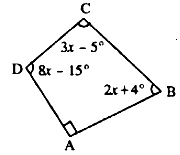
Use the information given in the following figure to find : $(i)\  x\ (ii)\  \angle B$ and $\angle C$
Answer
$\because \angle A = 90^\circ ($Given$)\angle B = (2x + 4^\circ )$
$\angle C = (3x - 5^\circ )$
$\angle D = (8x - 15^\circ )$
$\angle A + \angle B + \angle C + \angle D = 360^\circ$
$90^\circ + (2x + 4^\circ ) + (3x - 5^\circ ) + (8x - 15^\circ ) = 360^\circ$
$90^\circ + 2x + 4^\circ + 3x - 5^\circ + 8x - 15^\circ = 360^\circ$
$\Rightarrow 74^\circ + 13x = 360^\circ$
$\Rightarrow 13x = 360^\circ - 74^\circ$
$\Rightarrow 13x = 286^\circ$
$\Rightarrow x = 22^\circ$
$\because \angle B = 2x 4 = 2 \times 22^\circ + 4 = 48^\circ$
$\angle C = 3x - 5 = 3 \times 22^\circ - 5 = 61^\circ$
Hence $(i)\  22^\circ \ (ii)\  \angle B = 48^\circ , \angle C = 61^\circ$
View full question & answer
Question 35 Marks
Angles of a quadrilateral are $(4x)^\circ , 5(x+2)^\circ , (7x – 20)^\circ$ and $6(x+3)^\circ$ . Find : $ (i)$ the value of $x. (ii)$ each angle of the quadrilateral.
Answer
Angles of quadrilateral are, $(4x)^\circ , 5(x+2)^\circ , (7x – 20)^\circ$ and $6(x+3)^\circ$
$\therefore 4x + 5(x + 2) + (7x - 20) + 6(x + 3) = 360^\circ$
$4x + 5x + 10 + 7x - 20 + 6x + 18 = 360^\circ$
$22x + 8 = 360^\circ$
$22x = 360^\circ - 8^\circ$
$22x = 352^\circ$
$x = 16^\circ$
Hence angles are,
$(4x)^\circ = (4 \times 16)^\circ = 64^\circ$
$5(x + 2)^\circ = 5(16 + 2)^\circ = 90^\circ$
$(7x - 20)^\circ = (7 \times 16 - 20)^\circ = 92^\circ$
$6(x + 3)^\circ = 6(16 + 3) = 114^\circ$
View full question & answer
Question 45 Marks
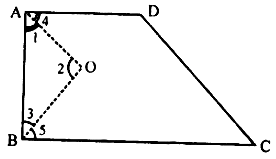
In a quadrilateral $ABCD, AO$ and $BO$ are bisectors of angle $A$ and angle $B$ respectively. Show that : $\angle AOB = `1/2` (\angle C + \angle D)$
Answer
Given: $AO$ and $BO$ are the bisectors of $\angle A$ and $\angle B$ respectively.
$\angle 1 = \angle 4$ and $\angle 3 = \angle 5 ……..(i)$

To prove : $\angle \mathrm{AOB}=\frac{1}{2}(\angle \mathrm{C}+\angle \mathrm{D})$
Proof : In quadrilateral $A B C D$
$\angle \mathrm{A}+\angle \mathrm{B}+\angle \mathrm{C}+\angle \mathrm{D}=360^{\circ}$
$ \frac{1}{2}(\angle \mathrm{A}+\angle \mathrm{B}+\angle \mathrm{C}+\angle \mathrm{D})=180^{\circ} .$
Now in $\triangle \mathrm{AOB}$
$\angle 1+\angle 2+\angle 3=180^{\circ}$
Equating equation $(ii)$ and equation $(iii)$, we get
$\angle 1+\angle 2+\angle 3=\angle \mathrm{A}+\angle \mathrm{B}+\frac{1}{2}(\angle \mathrm{C}+\angle \mathrm{D})$
$ \angle 1+\angle 2+\angle 3=\angle 1+\angle 3+\frac{1}{2}(\angle \mathrm{C}+\angle \mathrm{D})$
$\angle 2=\frac{1}{2}(\angle C+\angle D)$
$ \angle A O B=\frac{1}{2}(\angle C+\angle D)$
Hence proved.
View full question & answer
Question 55 Marks
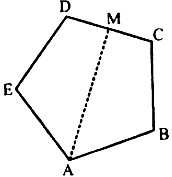
$ABCDE$ is a regular pentagon. The bisector of angle $A$ of the pentagon meets the side $CD$ in point $M$. Show that $\angle AMC = 90^\circ .$
Answer

Given: $\mathrm{ABCDE}$ is a regular pentagon.
The bisector $\angle A$ of the pentagon meets the side $C D$ at point $M$.
To prove : $\angle \mathrm{AMC}=90^{\circ}$
Proof: We know that the measure of each interior angle of a regular pentagon is $108^{\circ}$.
$\angle B A M=x 108^{\circ}=54^{\circ}$
Since, we know that the sum of a quadrilateral is $360^{\circ}$
In quadrilateral $\mathrm{ABCM}$, we have
$\angle \mathrm{BAM}+\angle \mathrm{ABC}+\angle \mathrm{BCM}+\angle \mathrm{AMC}=360^{\circ}$
$ 54^{\circ}+108^{\circ}+108^{\circ}+\angle \mathrm{AMC}=360^{\circ}$
$ \angle \mathrm{AMC}=360^{\circ}-270^{\circ}$
$ \angle \mathrm{AMC}=90^{\circ}$
View full question & answer
Question 65 Marks
The following figure shows a quadrilateral in which sides $AB$ and $DC$ are parallel. If $\angle A : \angle D= 4 : 5, \angle B = (3x – 15)^\circ$ and $\angle C = (4x + 20)^\circ $, find each angle of the quadrilateral $ABCD$.
Answer
Let $\angle A = 4x\angle D = 5x$
Since $\angle A + \angle D = 180^\circ [AB||DC]$
$4x + 5x = 180^\circ$
$\Rightarrow 9x = 180^\circ$
$\Rightarrow x = 20^\circ$
$\angle A = 4 (20) = 80^\circ ,$
$\angle D = 5 (20) = 100^\circ$
Again $\angle B + \angle C = 180^\circ [ AB||DC]$
$3x – 15^\circ + 4x + 20^\circ = 180^\circ$
$7x = 180^\circ – 5^\circ$
$\Rightarrow 7x = 175^\circ$
$\Rightarrow x = 25^\circ$
$\angle B = 75^\circ – 15^\circ = 60^\circ$
and $\angle C = 4 (25) + 20 = 100^\circ + 20^\circ = 120^\circ$
View full question & answer
Question 75 Marks
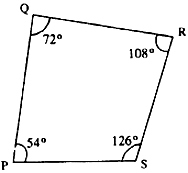
In quadrilateral $PQRS, \angle P : \angle Q : \angle R : \angle S = 3 : 4 : 6 : 7$. Calculate each angle of the quadrilateral and then prove that $PQ$ and $SR$ are parallel to each other$\ (i)\ $ Is $PS$ also parallel to $QR\ ?\ (ii)\  $Assign a special name to quadrilateral $PQRS.$
Answer

$\because \angle \mathrm{P}: \angle \mathrm{Q}: \angle \mathrm{R}: \angle \mathrm{S}=3: 4: 6: 7$
Let $\angle P=3 x$
$\angle \mathrm{Q}=4 \mathrm{x}$
$\angle \mathrm{R}=6 \mathrm{x}$
$\angle S=7 x$
$\therefore \angle \mathrm{P}+\angle \mathrm{Q}+\angle \mathrm{R}+\angle \mathrm{S}=360^{\circ}$
$3 x+4 x+6 x+7 x=360^{\circ}$
$20 x=360^{\circ}$
$x=18^{\circ}$
$\therefore \angle \mathrm{P}=3 \mathrm{x}=3 \times 18=54^{\circ}$
$\angle \mathrm{Q}=4 \mathrm{x}=4 \times 18=72^{\circ}$
$\angle R=6 x=6 \times 18=108^{\circ}$
$\angle S=7 x=7 \times 18=126^{\circ}$
$\angle \mathrm{Q}+\angle \mathrm{R}=72^{\circ}+108^{\circ}=180^{\circ}$
or $\angle \mathrm{P}+\angle \mathrm{S}=54^{\circ}+126^{\circ}=180^{\circ}$
Hence $PQ || SR$
As $\angle \mathrm{P}+\angle \mathrm{Q}=72^{\circ}+54^{\circ}=126^{\circ}$
Which is $\neq 180^{\circ}$
$\therefore P S$ and $Q R$ are not parallel.
$PQRS$ is a Trapezium as its one pair of opposite side is parallel.
View full question & answer
Question 85 Marks
Fill in the blanks : In case of regular polygon, with :
No.of.sides Each exterior angle Each interior angle
$(i) ....8....$ $........$ $........$
$(ii) ....12.......$ $........$ $........$
$(iii) ...........$ $.......72^\circ .......$ $........$
$(iv) ...........$ $.......45^\circ .......$ $........$
$(v) ...........$ $........$ $.......150^\circ .......$
$(vi) ...........$ $........$ $........140^\circ .......$
Answer
No.of. sides Each exterior angle Each interior angle
$(i)\  8$ $45^\circ $ $135^\circ $
$(ii)\  12$ $30^\circ $ $150^\circ $
$(iii)\  5$ $72^\circ $ $108^\circ $
$(iv)\  8$ $45^\circ $ $135^\circ $
$(v)\  12$ $30^\circ $ $150^\circ $
$(vi)\  9$ $40^\circ $ $140^\circ $
Explanation:
$(i)$ Each exterior angle $=\frac{360^{\circ}}{8}=45^{\circ}$
Each interior angle $=180^{\circ}-45^{\circ}=135^{\circ}$
$(ii)$ Each exterior angle $=\frac{360^{\circ}}{12}=30^{\circ}$
Each interior angle $=180^{\circ}-30^{\circ}=150^{\circ}$
$(iii)$ Since each exterior $=72^{\circ}$
$\therefore$ Number of sides $=\frac{360^{\circ}}{72^{\circ}}=5$
Also interior angle $=180^{\circ}-72^{\circ}=108^{\circ}$
$(iv)$ Since each exterior $=45^{\circ}$
$\therefore$ Number of sides $=\frac{360^{\circ}}{45^{\circ}}=8$
Also interior angle $=180^{\circ}-45^{\circ}=135^{\circ}$
$(v)$ Since interior angle $=150^{\circ}$
Exterior angle $=180^{\circ}-150^{\circ}=30^{\circ}$
$\therefore$ Number of sides $=\frac{360^{\circ}}{30^{\circ}}=12$
$(vi)$ Since interior angle $=140^{\circ}$
Exterior angle $=180^{\circ}-140^{\circ}=40^{\circ}$
$\therefore$ Number of sides $=\frac{360^{\circ}}{40^{\circ}}=9$
View full question & answer
Question 95 Marks
The ratio between the number of sides of two regular polygons is $3 : 4$ and the ratio between the sum of their interior angles is $2 : 3$. Find the number of sides in each polygon.
Answer
Ratio of sides of two regular polygons $=3: 4$
Let sides of first polygon $=3\  n$
and sides of second polygon $=4\  n$
Sum of interior angles of first polygon
$=(2 \times 3 n-4) \times 90^{\circ}=(6 n-4) \times 90^{\circ}$
and sum of interior angle of second polygon
$=(2 \times 4 n-4) \times 90^{\circ}=(8 n-4) \times 90^{\circ}$
$ \therefore \frac{(6 n-4) \times 90^{\circ}}{(8 n-4) \times 90^{\circ}}=\frac{2}{3}$
$ \Rightarrow \frac{6 n-4}{8 n-4}=\frac{2}{3}$
$ \Rightarrow 18\  n-12=16\  n-8$
$ \Rightarrow 18\  n-16\  n=-8+12$
$ \Rightarrow 2\  n=4$
$ \Rightarrow n=2$
$\therefore$ No. of sides of first polygon
$=3\  n=3 \times 2=6$
and no. of sides of second polygon
$= 3\ n = 3 \times 2 = 6$
and no. of sides of second polygon
$= 4\ n = 4 \times 2 = 8$
View full question & answer
Question 105 Marks
If the difference between the exterior angle of a $\ 'n\ '$ sided regular polygon and $an (n + 1)$ sided regular polygon is $12^\circ$ , find the value of $n.$
Answer
We know that sum of exterior angles of a polygon $=360^{\circ}$
Each exterior angle of a regular polygon of $=360^{\circ}$
$\mathrm{n} \text { sides }=\frac{360^{\circ}}{\mathrm{n}}$
and exterior angle of the regular polygon of
$(n+1) \text { sides }=\frac{360^{\circ}}{n+1}$
$ \therefore \frac{360^{\circ}}{n}-\frac{360^{\circ}}{n+1}=12$
$ \Rightarrow 360\left[\frac{1}{n}-\frac{1}{n+1}\right]=12$
$ \Rightarrow 360\left[\frac{n+1-n}{n(n+1)}\right]=12$
$ \Rightarrow \frac{30 \times 1}{n^2+n}=12$
$ \Rightarrow 12\left(n^2+n\right)=360^{\circ}$
$ \Rightarrow n^2+n=36 \quad($Dividing by $12)$
$ \Rightarrow n^2+n-30=0$
$ \Rightarrow n^2+6 n-5 n-30=0 \ldots\{\because-30=6 \times(-5), 1=6-5\}$
$ \Rightarrow n(n+6)-5(n+6)=0$
$\Rightarrow n(n+6)-5(n+6)=0$
$ \Rightarrow(n+6)(n+5)=0$
Either $n+6=0$, then $n=-6$ which is not possible being negative orn $-5=0$ then $n=5$
Hence $n=5$.
View full question & answer
Question 115 Marks
The difference between the exterior angles of two regular polygons, having the sides equal to $(n – 1)$ and $(n + 1)$ is $9^\circ$. Find the value of $n.$
Answer
We know that sum of exterior angles of a polynomial is $360^{\circ}$
$(i)$ If sides of a regular polygon $=n-1$
Then each angle $=\frac{360^{\circ}}{\mathrm{n}-1}$
and if sides are $n+1$, then
each angle $=\frac{360^{\circ}}{\mathrm{n}+1}$
According to the condition,
$\frac{360^{\circ}}{\mathrm{n}-1}-\frac{360^{\circ}}{\mathrm{n}+1}=9$
$ \Rightarrow 360\left[\frac{1}{\mathrm{x}-1}-\frac{1}{\mathrm{x}+1}\right]=9$
$ \Rightarrow 360\left[\frac{\mathrm{n}+1-\mathrm{n}+1}{\mathrm{n}-1}(\mathrm{n}+1)\right]=9$
$ \Rightarrow \frac{2 \times 360}{\mathrm{n}^2-1}=9$
$ \Rightarrow \mathrm{n}^2-1=\frac{2 \times 360}{9}=80$
$ \Rightarrow n^2-1=80$
$ \Rightarrow n^2=1-80=0$
$ \Rightarrow \mathrm{n}^2-81=0$
$\Rightarrow(n)^2-(9)^2=0$
$ \Rightarrow(n+9)(n-9)=0$
Either $n+9=0$. then $n=-9$ which is not possible being negative, or $\mathrm{n}-9=0$, then $\mathrm{n}=9$
$\therefore \mathrm{n}=9$
$\therefore$ No. of. sides of a regular polygon $=9$
View full question & answer
Question 125 Marks
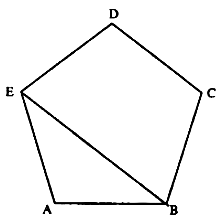
In a regular pentagon $\text{ABCDE}$, draw a diagonal $BE$ and then find the measure of : $(i)\ \angle BAE \ (ii)\ \angle ABE\ (iii)\ \angle BED$
Answer
$(i)$ Since number of sides in the pentagon $=5$
Each exterior angle $=\frac{360}{5}=72^{\circ}$
$\angle \mathrm{BAE}=180^{\circ}-72^{\circ}=108^{\circ}$

$ (ii)$ In $\triangle A B E, A B=A E$
$ \therefore \angle A B E=\angle A E B$
$\text { But } \angle \mathrm{BAE}+\angle \mathrm{ABE}+\angle \mathrm{AEB}=180^{\circ}$
$ \therefore 108^{\circ}+2 \angle \mathrm{ABE}=180^{\circ}-108^{\circ}=72^{\circ}$
$ \Rightarrow \angle \mathrm{ABE}=36^{\circ}$
$(iii)$ Since $\angle \mathrm{AED}=108^{\circ}$.. $\left[\because\right.$ each interior angle $\left.=108^{\circ}\right]$
$\Rightarrow \angle \mathrm{AEB}=36^{\circ}$
$\Rightarrow \angle \mathrm{BED}=108^{\circ}-36^{\circ}=72^{\circ}$
View full question & answer
Question 135 Marks
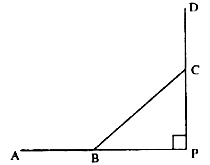
Two alternate sides of a regular polygon, when produced, meet at the right angle. Calculate the number of sides in the polygon.
Answer

Let number of sides of regular polygon $=n$
$A B \ D C$ when produced meet at $P$ such that
$\angle \mathrm{P}=90^{\circ}$
$\because$ Interior angles are equal.
$\therefore \angle \mathrm{ABC}=\angle \mathrm{BCD}$
$\therefore 180^{\circ}-\angle \mathrm{ABC}=180^{\circ}-\angle \mathrm{BCD}$
$\therefore \angle \mathrm{PBC}=\angle \mathrm{BCP}$
But $\angle \mathrm{P}=90^{\circ}$ (given)
$\therefore \angle \mathrm{PBC}+\angle \mathrm{BCP}=180^{\circ}-90^{\circ}=90^{\circ}$
$\therefore \angle \mathrm{PBC}=\angle \mathrm{BCP}$
$=\frac{1}{2} X \times 90^{\circ}=45^{\circ}$
$\therefore$ Each exterior angle $=45^{\circ}$
$\therefore 45^{\circ}=\frac{360^{\circ}}{\mathrm{n}}$
$\mathrm{n}=\frac{360^{\circ}}{45^{\circ}}$
$\mathrm{n}=8$
View full question & answer
Question 145 Marks
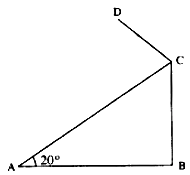
$AB, BC$ and $CD$ are three consecutive sides of a regular polygon. If angle $BAC = 20^\circ$ ; find : $(i)$ its each interior angle, $(ii)$ its each exterior angle $(iii)$ the number of sides in the polygon.
Answer

$\because$ Polygon is regular $($Given$)$
$\therefore A B=B C$
$\Rightarrow \angle \mathrm{BAC}=\angle \mathrm{BCA} \ldots[\angle \mathrm{S}$ opposite to equal sides $]$
But $\angle B A C=20^{\circ}$
$\therefore \angle B C A=20^{\circ}$
i.e. In $\triangle \mathrm{ABC}$,
$\angle \mathrm{B}+\angle \mathrm{BAC}+\angle \mathrm{BCA}=180^{\circ}$
$ \angle \mathrm{B}+20^{\circ}+20^{\circ}=180^{\circ}$
$ \angle \mathrm{B}=180^{\circ}-40^{\circ}$
$ \angle \mathrm{B}=140^{\circ}$
$(i)$ each interior angle $=140^{\circ}$
$(ii)$ each exterior angle $=180^{\circ}-140^{\circ}=40^{\circ}$
$(iii)$ Let no. of. sides $=n$
$\therefore \frac{360^{\circ}}{n}=40^{\circ}$
$ n=\frac{360^{\circ}}{40^{\circ}}=9$
$ n=9$
View full question & answer
Question 155 Marks
The interior angles of a pentagon are in the ratio $4 : 5 : 6 : 7 : 5$. Find each angle of the pentagon.
Answer
Let the interior angles of the pentagon be $4 x, 5 x, 6 x, 7 x, 5 x$.
Their sum $=4 x+5 x+6 x+7 x+5 x=27 x$
Sum of interior angles of a polygon $=(n-2) \times 180^{\circ}$
$=(5-2) \times 180^{\circ}$
$ =540^{\circ}$
$\therefore 27 x=540$
$ \Rightarrow x=\frac{540}{27}$
$ \Rightarrow x=20^{\circ}$
$\therefore$ Angles are $4 \times 20^{\circ}=80^{\circ}$
$5 \times 20^{\circ}=100^{\circ}$
$6 \times 20^{\circ}=120^{\circ}$
$7 \times 20^{\circ}=140^{\circ}$
$5 \times 20^{\circ}=100^{\circ}$
View full question & answer
Question 165 Marks
The sides of a hexagon are produced in order. If the measures of exterior angles so obtained are $(6x – 1)^\circ , (10x + 2)^\circ , (8x + 2)^\circ (9x – 3)^\circ , (5x + 4)^\circ$ and $(12x + 6)^\circ$ ; find each exterior angle.
Answer
Sum of exterior angles of hexagon formed by producing sides of order $=360^{\circ}$
$\therefore(6 x-1)^{\circ}+(10 x+2)^{\circ}+(8 x+2)^{\circ}+(9 x-3)^{\circ}+(5 x+4)^{\circ}+(12 x+6)^{\circ}=360^{\circ}$
$ 50 x+10^{\circ}=360^{\circ}$
$ 50 x=360^{\circ}-10^{\circ}$
$ 50 x=350^{\circ}$
$ x=\frac{350}{50}$
$ x=7$
$\therefore$ Angles are
$(6 x-1)^{\circ} ;(10 x+2)^{\circ} ;(8 x+2)^{\circ} ;(9 x-3)^{\circ} ;(5 x+4)^{\circ} $ and $(12 x+6)^{\circ}$
i.e. $(6 \times 7-1)^{\circ},(10 \times 7+2)^{\circ},(8 \times 7+2)^{\circ}(9 \times 7-3)^{\circ},(5 \times 7+4)^{\circ}$ and $(12 \times 7+6)^{\circ}$
i.e. $41^{\circ} ; 72^{\circ}, 58^{\circ} ; 60^{\circ} ; 39^{\circ}$ and  $90^{\circ}$
View full question & answer
Question 175 Marks
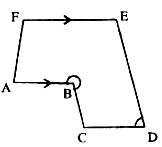
In a hexagon $\text{ABCDEF}$, side $AB$ is parallel to side $FE$ and $\angle B : \angle C : \angle D : \angle E = 6 : 4 : 2 : 3$. Find $\angle B$ and $\angle D.$
Answer

Given: Hexagon $\mathrm{ABCDEF}$ in which $\mathrm{AB}|| \mathrm{EF}$ and $\angle \mathrm{B}: \angle \mathrm{C}: \angle \mathrm{D}: \angle \mathrm{E}=6: 4: 2: 3$.
To find: $\angle B$ and $\angle D$
Proof: No. of. sides $n=6$
$\therefore$ Sum of interior angles $=(n-2) \times 180^{\circ}$
$=(6-2) \times 180^{\circ}$
$ =720^{\circ}$
$ \because A B \| E F ($Given$)$ 
$ \therefore \angle A+\angle F=180^{\circ}$
But $\angle \mathrm{A}+\angle \mathrm{B}+\angle \mathrm{C}+\angle \mathrm{D}+\angle \mathrm{E}+\angle \mathrm{F}=720^{\circ} ($Proved$)$
$\angle \mathrm{B}+\angle \mathrm{C}+\angle \mathrm{D}+\angle \mathrm{E}+180^{\circ}=720^{\circ}$
$\therefore \angle \mathrm{B}+\angle \mathrm{C}+\angle \mathrm{D}+\angle \mathrm{E}=720^{\circ}-180^{\circ}$
Ratio $=6: 4: 2: 3$
Sum of parts $=6+4+2+3=15$
$\therefore \angle \mathrm{B}=\frac{6}{15} \times 540=216^{\circ}$
$ \angle \mathrm{D}=\frac{2}{15} \times 540^{\circ}=72^{\circ}$
Hence $\angle B=216^{\circ} ; \angle D=72^{\circ}$
View full question & answer
Question 185 Marks
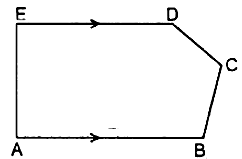
The figure, given below, shows a pentagon $\text{ABCDE}$ with sides $AB$ and $ED$ parallel to each other, and $\angle B : \angle C : \angle D = 5: 6: 7$.
$(i)\  $Using the formula, find the sum of the interior angles of the pentagon. $(ii)$ Write the value of $\angle A + \angle E\ (iii)\ $ Find angles $B, C$ and $D$.
 
Answer
$(i)$ Sum of interior angles of the pentagon$= (5 - 2) \times 180^\circ$
$= 3 \times 180^\circ = 540^\circ ...[\because$ sum for a polygon of $x$ sides $= (x - 2) \times 180^\circ ]$
$(ii)$ Since $AB || ED$
$\therefore \angle A + \angle E = 180^\circ$
$(iii)$ Let $\angle B = 5x , \angle C = 6x , \angle D = 7x$
$\therefore 5x + 6x + 7x + 180^\circ = 540^\circ ...(\angle A + \angle E = 180^\circ ) ($Proved in $(ii))$
$18x = 540^\circ - 180^\circ$
$\Rightarrow 18x = 360^\circ$
$\Rightarrow x = 20^\circ$
$\therefore \angle B = 5 \times 20^\circ = 100^\circ , \angle C = 6 \times 20 = 120^\circ$
$\angle D = 7 \times 20 = 140^\circ$
View full question & answer
[5 marks sum] - MATHS STD 8 Questions - Vidyadip