Questions

[1 Mark Question Answer]

🎯

Test yourself on this topic

22 questions · timed · auto-graded

Question 11 Mark
What are the two kinds of charges?
Answer
The two kinds of charges are
$1.$ Negative charge
$2.$ Positive charge
View full question & answer
Question 21 Mark
Name two substances which can be charged by friction.
Answer
Two substances which can be charged by friction are
$1.$ Glass.
$2.$ Ebonite.
View full question & answer
Question 31 Mark
When a charged rod is touched with the disc of a positively charged gold-leaf electroscope, it is observed that the divergence of leaves decreases. What is the kind of charge on the rod?
Answer
As on touching the disc with the charged rod, divergence in the leaves decreases, this means the rod has opposite kind of charge than leaves i.e. rod has a negative charge.
View full question & answer
Question 41 Mark
A negatively charged ebonite rod is touched with the disc of a negatively charged gold leaf electroscope. What will be your observation?
Answer
Divergence of leaves will increase because similar charge will increase.
View full question & answer
Question 51 Mark
Who discovered the way of producing electricity by friction?
Answer
The ancient Greek philosopher Thales of Miletus discovered the electricity by friction.
View full question & answer
Question 61 Mark
Can you charge an insulator by the method of conduction?
Answer
No, we cannot charge an insulator by the method of conduction.
View full question & answer
Question 71 Mark
Why does a plastic comb rubbed with dry hair attract bits of paper?
Answer
Plastic comb rubbed with dry hair gets electrically charged and therefore it attracts the bits of paper.
View full question & answer
Question 81 Mark
Name the way of charging a conductor in which the charge is shared.
Answer
By conduction is the way of charging a conductor in which the charge is shared.
View full question & answer
Question 91 Mark
What do you understand by electricity at rest?
Answer
When the charges are not allowed to flow are termed as static electricity, i.e., the electricity at rest.
View full question & answer
Question 101 Mark
What are free electrons?
Answer
FREE ELECTRONS. Electrons of the outermost orbit of a solid, which can easily leave the atom and become free to move inside the solid are called FREE ELECTRONS
View full question & answer
Question 121 Mark
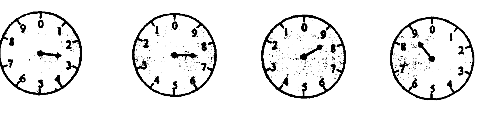
The diagram below in figure shows the reading on the dials of a meter. State what is its reading.
Answer
The reading is $2\  7\  8\  9$
View full question & answer
Question 131 Mark
How can you check just by seeing the meter whether the electricity is in use or not?
Answer
If the electricity is in use, the counter fixed on the armature of the meter rotates and reads the number of rotations
$($A red mark is seen rotating$)$.
View full question & answer
Question 141 Mark
For which unit do we pay our electricity bill?
Answer
$\text{UNIT}$ is a board of trade unit which is $\text{kWh} ($Kilowatt per hour$) = 1000 W$ used in $1$ hour.
View full question & answer
Question 151 Mark
State the purpose of $\text{kWh}$ meter.
Answer
Purpose of $\text{kWh}$ meter is to measure the electric energy consumed in $\text{kWh}$ for which the electricity bill is to be paid. i.e. units of energy consumed.
View full question & answer
Question 161 Mark
State the voltage at which electricity is supplied to our houses.
Answer
Electricity voltage is supplied to our houses at $220$ volts in India and $120$ volts in the $\text{USA}.$
View full question & answer
Question 171 Mark
From where does the electricity come to our home ?
Answer
In our homes electricity comes from the CITY SUBSTATION.
View full question & answer
Question 201 Mark
Name the material of a fuse wire.
Answer
The material used in fuse wire is an ALLOY of LEAD $(50\%)$ and TIN $50\%$ having low $\text{M.P}$. of $200^\circ C$
View full question & answer
Question 211 Mark
State one property of the material of a fuse wire.
Answer
Two CHARACTERISTICS OF FUSE WIRE are:
$(i)$ Has LOW MELTING POINT.
$(ii)$ Has HIGH RESISTANCE.
View full question & answer
Question 221 Mark
If an appliance of power $P$ watt is used for time $t$ hour. How much electrical energy is consumed in $\text{kWh}$?
Answer
Power $P =\frac{w}{t}=$ Electrical energy 
$\therefore$ Electrical energy $= P \times t$
View full question & answer
[1 Mark Question Answer] - PHYSICS STD 8 Questions - Vidyadip