Questions

[2 Mark Question Answer]

🎯

Test yourself on this topic

26 questions · timed · auto-graded

Question 12 Marks
An ebonite rod is rubbed with fur. State the kind of-charge acquired by each.
Answer
Electrostatic charge is obtained. When the ebonite rod is rubbed with wool or fur, the wool or the fur loses electrons to the rod because the electrons in the outermost orbit in case of fur are loosely bound as compared to those in the rod. now the ebonite rod has an excess of electrons, so it becomes negatively charged while the wool or fur has a deficiency of electrons, so it acquires a positively charged.
View full question & answer
Question 22 Marks
What are the effects of lightning?
Answer
 
Effects of lightning:
$1.$ Lightning can cause fire and shatter buildings resulting in a lot of destruction and damage to the property.
$2.$ Lightning can burn trees and cause forest fires.
$3.$ Lightning injuries or sometimes even kill animals and human beings instantly.
 
View full question & answer
Question 32 Marks
A positively charged glass rod is touched with the disc of an uncharged gold leaf electroscope. What will be your observation?
Answer
Leaves will $\text{DIVERGE}$ as both leaves have positive charge due to conduction and diverge as like charges $\text{REPEL EACH}$ other.
View full question & answer
Question 42 Marks
How will you use a pith ball electroscope to find out whether the charge on a charged body is positive or negative?
Answer
Take a positively charged pith ball electroscope. Bring the charged body near the pith ball $($without touching it$)$. If the pith ball moves away, the body has a similar charge $($positive charge$)$ and if the pith ball moves towards the body, the body has negative charge.
View full question & answer
Question 52 Marks
A metal rod $A$ is to be charged positively by using another charged rod $B$. What should be the kind of charge on the rod $B$ if charging is to be done by conduction?
Answer
Rod $A$ is uncharged and Rod $B$ is charged body.
$A $ is to be charged positively by touching i.e. by conduction. So rod $B$ should have a similar charge as is required by $A$ i. e. $+$ vely.
So rod $B$ should be positively charged,
$\therefore$ By conduction same kind of charge is produced and shared by uncharged body.
View full question & answer
Question 62 Marks
Give one example each of a conductor and an insulator of electricity.
Answer
Example of Conductor : Hydrochloric acid, copper, aluminium, gold, and silver
Example of Insulator : Mica, glass, air, plastic, rubber, and wood
View full question & answer
Question 72 Marks
In each of the following cases, State which body loses electrons:
$(a)$ A glass rod when rubbed with silk.
$(b)$ An ebonite rod when rubbed with fur.
Answer
$(a)$ A glass rod is rubbed with silk. Glass rod loses electrons and becomes positively charged.
$(b)$ An Ebonite rod is rubbed with fur. Fur loses electrons and acquires positive charge.
View full question & answer
Question 82 Marks
Name three constituents of an atom and state the kind of charge on each of them.
Answer
The three constituents of an atom are:
$i.$ Protons $—$ These carry a positive charge.
$ii.$ Electrons $—$ These carry a negative charge.
$iii.$ Neutrons $—$ They have no charge or are electrically neutral.
View full question & answer
Question 92 Marks
An ebonite rod is rubbed with fur. Compare the charges acquired by them.
Answer
An ebonite rod is rubbed with fur, the electrons are transferred from fur to ebonite rod. Ebonite has an excess of electrons is negatively charged and fur due to a deficit of the same number of electrons gets a positive charge.
View full question & answer
Question 102 Marks
An ebonite rod rubbed with fur is suspended near another ebonite rod rubbed with fur. State your observation and give a reason to support your answer.
Answer
Both ebonite rods are rubbed fur with having a similar charge $(-$ve charge$)$. We know like charges repel each other.
$\therefore$ Rods repel each other.
Reason: Like charges $\text{REPEL}$ each other.
View full question & answer
Question 112 Marks
A glass rod rubbed with silk is suspended near an ebonite r rod rubbed with fur. What will be your observation? Give a reason to your answer.
Answer
A glass rod rubbed with silk i.e. vely charged is brought near ebonite rod rubbed with fur i.e. negatively charged, $\text{ATTRACTION}$ is seen as they have opposite charge.
View full question & answer
Question 122 Marks
Name the unit in which you pay the cost of your electricity bill. How is it related to joule?
Answer
UNIT in which the electricity bill is charged is board of $\text{TRADE}$
UNIT $= \text{kWh}$
$1$ Unit $= \text{kWh} =3600000 J = 3.6 \times 10^6J$
$1 \text{kWh} = 3.6 \times 10^6J$
View full question & answer
Question 132 Marks
One day the meter reading is found to be $7643$ units while the next day, it was $7657$ units. What is the consumption of electricity in a day?
Answer
Final reading $7657$ units
Initial reading $7643$ units
Consumption of electricity in a day
$=$Final reading$-$initial reading
$= 7657 – 7643$
$= 14$ units.
View full question & answer
Question 142 Marks
What is an electric meter ? Where is it fixed in our house?
Answer
ELECTRIC METER : Is $\text{ENERGY}$ meter or $\text{kWh}$ meter and measures the amount of electric energy consumed in $\text{kWh}$ for which electricity bill is paid.
It is connected through a cable after company fuse on the front or outside wall of the house.
View full question & answer
Question 152 Marks
Why is the metal covering of an electrical appliance earthed?
Answer
EARTHING OF THE APPLIANCE: To protect from the electric shock electric appliance is earthed. Sometimes due to break of insulation of wires, the live wire comes in contact with the body of the appliance and we get a fatal shock when the appliance is touched. If the appliance is earthed, the current will pass to the earth and we remain protected from the electric shock.
View full question & answer
Question 162 Marks
Draw a labelled diagram with the necessary switches to connect a bulb, a fan and a plug socket in a room with the mains. In what arrangement will you connect them to the mains?
View full question & answer
Question 172 Marks
In the household electric circuit, if one bulb is fused in a room, the other bulbs keep glowing. Explain the reason.
Answer
In the household electric circuit, the appliances are connected in parallel and each appliance has an independent path for current and works at the same voltage. Hence, if one bulb in a room is fused, the other bulbs keep glowing.
View full question & answer
Question 182 Marks
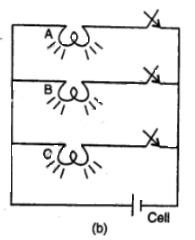
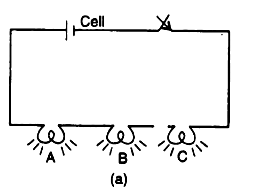
Figure shows two ways of connecting the three bulbs $A, B$ and $C$ to a battery. Name the two arrangements. Which of them do you prefer to use in a household circuit? Give a reason to support your answer.

Image
Answer
$(a)$ is $\text{SERIES}$ arrangement .
$(b)$ is parallel arrangement.
A parallel arrangement of bulbs is preferred as if one of the bulbs gets fused, the other two will keep glowing.
View full question & answer
Question 192 Marks
What do you mean by short$-$circuiting of a circuit?
Answer
SHORT CIRCUIT : If the insulation on the cable used in the wiring $($or used with an appliance$)$ breaks, THE LIVE WIRE COMES IN CONTACT WITH THE NEUTRAL WIRE, This results in a SHORT CIRCUIT.
View full question & answer
Question 202 Marks
How is $\text{M.C.B}$. superior to the fuse wire?
Answer
$\text{M.C.B}$ is more sensitive to current than a fuse. It detects any abnormality in the current flow and automatically switches off the electrical circuit.
$\text{M.C.B}$ doesn't need to be replaced every time when high current passes from it but fuse needs to be replaced because it melts and breaks
View full question & answer
Question 212 Marks
Which fuse wire is thick : $5 A$ or $15 A$?
Answer
$\therefore R\  \alpha\  l/a$
More the area, lesser is the resistance and more is the current flowing.
$\therefore 15 A $ fuse wire is thick.
View full question & answer
Question 222 Marks
How does a fuse protect the electric wiring $($or an appliance$)$ from being damaged?
Answer
Due to voltage fluctuations or insulation on the wire of cable gets worn and torn $($breaks$)$, the live wire comes in contact with the neutral wire and results in Short circuit. To prevent this damage, a fuse is used in the $\text{LIVE WIRE}$. The fuse wire gets heated up to the extent that it melts, a gap is produced in the live wire and the circuit becomes incomplete, no current flows and the appliance is saved.
View full question & answer
Question 232 Marks
Can we use copper wire as a fuse wire? Give reason.
Answer
Copper wire cannot be used as a fuse wire since the melting point of Copper $(Cu)$ is high and resistance is very low. The current can flow through without melting it which can damage the appliances.
View full question & answer
Question 242 Marks
What is an electric fuse? State its purpose in the household electrical circuit.
Answer
$\text{FUSE}$ : “Is a safety device that is used to limit the current in an electric circuit.
PURPOSE OF FUSE IN HOUSEHOLD CIRCUIT: It safeguards the circuit and the appliance connected in the circuit from being damaged if the current in the circuit exceeds the specified value due to voltage fluctuation or short-circuiting.
View full question & answer
Question 252 Marks
An electrical appliance is rated as $60\  W – 150\  V.$
How much current will flow through the appliance when in use?
Answer
$ P = Vl $
$\therefore$ Current will through the appliance
$ I =\frac{ P }{ V }=\frac{60 W }{150 v }=0.4 A $
View full question & answer
Question 262 Marks
An electrical appliance is rated as $60W – 150V$. What do you understand by this statement?
Answer
$60 W -150 V$ power rating of appliance means, “If the appliance is put in the circuit on $150$ volts, it will consume $60 w$ electrical power i.e. electric energy consumed by it in $1$ sec. is $60 J.$
View full question & answer
[2 Mark Question Answer] - PHYSICS STD 8 Questions - Vidyadip