Questions

[5 Mark Question Answer]

🎯

Test yourself on this topic

15 questions · timed · auto-graded

Question 15 Marks
How will you show that like charges repel and unlike charges attract each other?
Answer
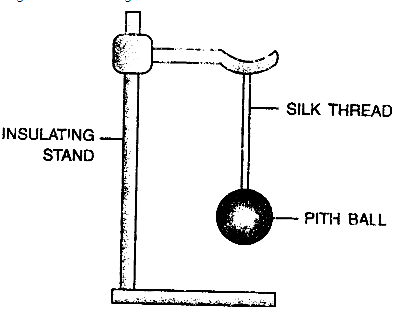
Experiment: Take a glass rod rubbed with silk piece $(+$vely charged$)$ Suspend it in a stand with the help of a thread.
Bring a $-$vely charged Ebonite rod $($rubbed with fur$)$ near the glass rod.
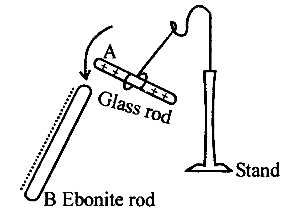
Attraction is seen between the two rods. Now interchange them i.e. suspend $B$ and bring $A$ near it, again attraction is there. This show that unlike charges attract each other.
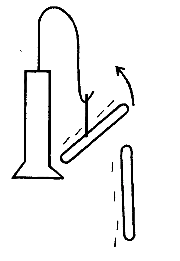
$-$vely charged ebonite rods
Now take two glass rods $(+$vely charged$)$ and bring them near each other, repulsion takes place. Similarly, if we take two $-$vely charged ebonite rods and suspend one of them and bring the second rod near it again the suspended rod moves away showing repulsion between like charges.
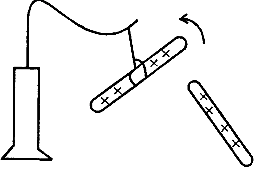
$+$vely charged glass rods
View full question & answer
Question 25 Marks
Describe an experiment to demonstrate that there are two $r$ kinds of charges.
Answer
Aim $-$ To show that there are two kinds of charges.
Apparatus $-$ gold-leaf electroscope, glass rod rubbed with a silk cloth.
any two non$-$identical bodies say $A$ and $B$.
Procedure $-$
$i.$ Charge the gold leaf electroscope positively by touching it with glass rod rubbed with a silk cloth.
$ii.$ The gold leaf electroscope shows its charging by showing its leaves diverging.
$iii.$ Touch the brass cap of this electroscope with body $A-$Note the divergence of the gold leaves.
$iv.$ Now touch the brass cap with body Band note the divergence.
Observation
In the case of body $A -$ Leaves further diverge.
In the case of body $B -$ leaves converge.
Inference $-$ Body $A \ ($positively charged$)$
Body $B \ ($negatively charged$)$
So there are two types of charges.
View full question & answer
Question 35 Marks
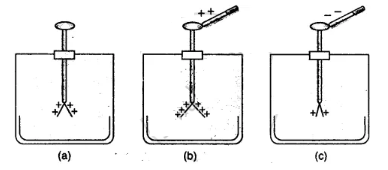
How will you use a gold leaf electroscope to find out whether the charge on a charged body is positive or negative?
Answer
Image
$(a)$ Charge negatively the gold$-$leaf electroscope by conduction i.e. To detect the kind of charge by a positively charged gold leaf electroscope touching the disc of $\text{G.L.E}$. with negatively charged ebonite rod. The leaves diverge $($because of repulsion$)$ Note the divergence as shown in figure $(a).$
$(b)$ Bringa charged body to be tested in contact with the disc. If divergence in leaves increases, it has a similar charge i.e. negative as shown in figure $(b)$
$(c)$ If divergence decrease, the body has opposite charge i.e. positive charge as shown in figure $(c).$
View full question & answer
Question 45 Marks
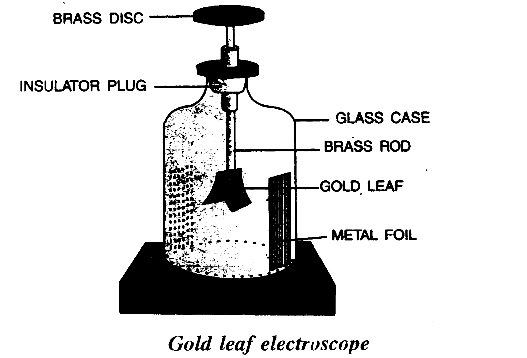
Draw a labelled diagram of a gold leaf electroscope and describe its construction.
Answer
Construction
$1.$ Brass rod which passes through an insulator stopper in a glass case.
$2.$ Brass disc is at the top end of brass rod.
$3.$ Gold leaves Lower end carries two gold $($or aluminium$)$ leave held parallel when uncharged.
$4.$ Glass case protects the gold leaves from the outside air current.
$5.$ Metal foil present at the lower part of the glass case. This is connected to the earth when the electroscope is used.
View full question & answer
Question 55 Marks
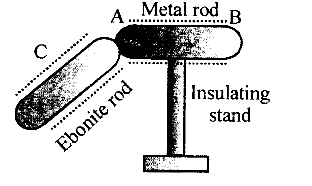
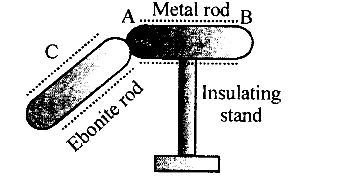
Figure below shows a metal rod $AB$ placed on an insulating stand. In figure $(a)$ a negatively charged ebonite rod $C$ is touched with the metal rod $AB$, while in figure $(b)$, the negatively charged ebonite rod $C$ is held near the rod $AB$. State the kind of charges at the ends $A$ and $B$ of the rod, in each case.
Answer
In figure $(a)$ conduction takes place.
There is negative charge at both ends $A$ and $B$

In figure $(b)$ Induction takes place.
End $A$ has oppositely positive charge called Bound charge and End $B$ is similarly charged i.e. negative free charge.
View full question & answer
Question 65 Marks
Describe the method of charging a conductor by induction.
Answer
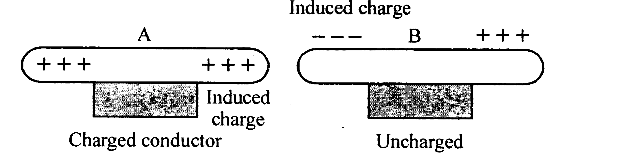
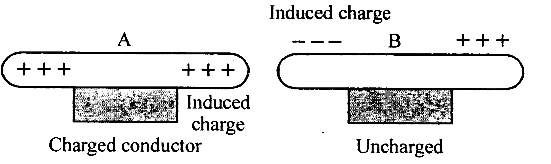
$\text{INDUCTION}$ : “Charging an uncharged conductor by bringing a charged conductor near it without touching is called $\text{INDUCTION}$

Place uncharged conductor $B$ near positively charged conductor $A$ nearer end of $B$ has negatively charged electrons attracted towards positively protons remain on the farther end of $B$.
Hence, nearer end of $B$ is charged oppositely i.e. negative. We can test it by pith ball electroscope. On removing charged body $A$ away from $B$, The body $B$ becomes neutral due to protons and electron in $B$ are equal and have opposite charge.
View full question & answer
Question 75 Marks
Explain the charging by conduction in terms of movement of electrons.
Answer
$\text{CHARGING A CONDUCTOR BY CONDUCTION}$:

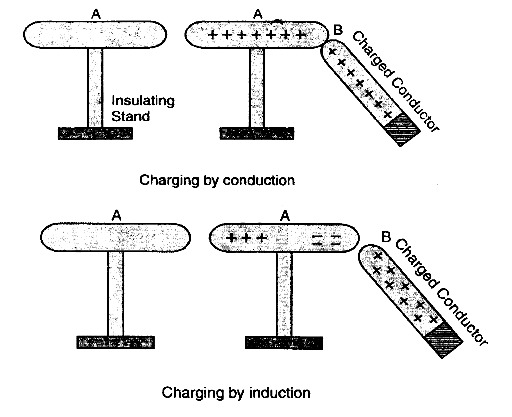
Place rod $A$ on an insulating stand and bring a $+$vely charged conductor $B$ near $A$ and touch it.
Charge from $B$ is transferred on A till charge on both of them is same. Remove conductor $B$. A gets charged positively.
Explanation on the bases of electrons: Suppose body $A ($neutral rod$)$ has $10$ protons and $10$ electrons. Body $B$ is positively charged is deficient in electrons has $20$ electrons and $30$ protons. On touching $B$ with $A, 5$ protons are transferred to $A.$
Now $B$ is $+$vely charged as $B$ has $25 P$ and $20$ electrons.
A is also $+$vely charged as $A$ has $15$ protons and $10$ electrons.
$\therefore A$ and $B$ each has, $5$ protons in excess and have $+5$ charge.
View full question & answer
Question 85 Marks
Describe the method of charging a conductor by conduction.
Answer
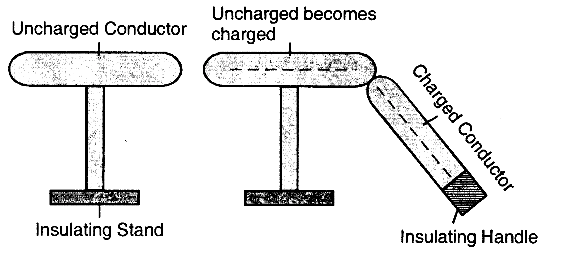
Conduction : The process of charging an uncharged conductor with a charged conductor by touching the uncharged one. Here the uncharged conductor shares the charge of the charged conductor.

Method of charging: Mount the uncharged conductor on an insulating stand take the charged conductor with an insulating handle to the uncharged conductor. If the charged conductor is positively charged then the uncharged will be charged positive and if the charged is negatively charged then the uncharged will be negatively charged.
View full question & answer
Question 95 Marks
State two ways of charging a conductor.
Answer
The two methods of charging a conductor are:
$1.$ Conduction: The process of charging an uncharged conductor by touching with a charged conductor, the uncharged conductor shares the charge of the charged conductor.
$2.$ Induction: The process of charging an uncharged conductor with a charged conductor, without actually touching it is called induction. Here the nearer end of the uncharged conductor acquires a charge of Opposite nature as compared to the charge on a charged conductor.
View full question & answer
Question 105 Marks
Distinguish between conductors and insulators of electricity.
Answer
DISTINCTIONS BETWEEN CONDUCTORS AND INSULATORS OF ELECTRICITY:
CONDUCTORS INSULATORS
$(i)$ They allow the current electricity to flow through them. Do not allow the current electricity to flow through them.
$(ii)$ They have a large number of free electrons. They have a small number of free electrons.
$(iii)$ All metals like Ag, Cu, iron, gold, wet wood etc. Cotton, dry wood, rubber, glass distilled water etc.
$(iv)$ Conductors cannot be charged by rubbing. Can be charged by rubbing.
View full question & answer
Question 115 Marks
A glass rod is rubbed with silk. Explain the charging of the glass rod and the silk on the basis of electron movement.
Answer
A glass rod is rubbed with silk. Glass rod loses electrons and becomes positively charged.
Silk gains electrons and becomes negatively charged.
Explanation : Suppose glass rod in neutral form has $10$ protons and $10$ electrons
i.e. $10$ units of positive charge
and $10$ units of negative charge.
While silk has $($in neutral state$) 7$ electrons and $7$ protons i.e. $7$ units of negative charge and $7$ units of positive charge.
Suppose on rubbing together glass rod loses $2$ electrons and silk gains $2$ electrons.
Now glass rod has $8$ electrons and $10$ protons on it.
i.e. $8$ units of negative charge and $10$ units of positive charge i.e. glass rod has net $2$ units of positive charge. Thus, the glass rod has acquired positive charge.
Silk has now $9$ units of negative charge and $7$ units of positive charge i.e. silk has net $2$ units of negative charge. Thus, silk has acquired negative charge.
View full question & answer
Question 125 Marks
What causes the charging of two objects when they are rubbed together?
Answer
$\text{CAUSE OF CHARGING OF TWO OBJECTS WHEN RUBBED}$:
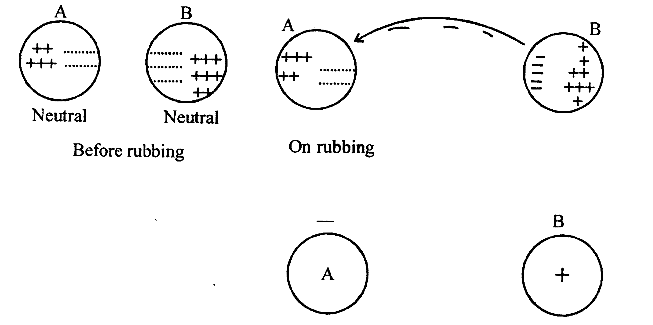
Both objects before rubbing are neutral.
On Rubbing transfer of electrons from one object to other object takes place.
The body from which electrons are transferred gets $\text{DEFICIENT}$ in $\text{ELECTRONS}$ and becomes $\text{POSITIVELY}$ charged.
The body to which electrons are transferred has $\text{EXCESS ELECTRONS}$ and becomes $\text{NEGATIVELY}$ charged.
View full question & answer
Question 135 Marks
Match the following
Column $A$ Column $B$
$A.$ Two like charges $1.$ negative charge
$B.$ Two unlike charges $2.$ repel
$C.$ Silver is a $3.$ insulator
$D.$ Silk is an $4.$ attract
$E.$ Ebonite rod rubbed with fur acquires $5.$ conductor
Answer
Match the following
Column $A$ Column $B$
$A.$ Two like charges $1.$ repel
$B.$ Two unlike charges $2.$ attract
$C.$ Silver is a $3.$ conductor
$D.$ Silk is an $4.$ insulator
$E.$ Ebonite rod rubbed with fur acquires $5.$ negative charge
View full question & answer
Question 145 Marks
Match the following
Column $A$ Column $B$
Electric power volt
 $\text{kWh}$ joule
Electric current volt $\times$ ampere
Electric energy watt
watt ampere
potential difference electrical energy
Answer
Column $A$ Column $B$
Electric power watt
 $\text{kWh}$ electrical energy
Electric current ampere
Electric energy joule
watt volt $\times$ ampere
potential difference volt
View full question & answer
Question 155 Marks
In a premise $5$ bulbs each of $100 W, 2$ fans each of $60 W, 2 A.$ Cs each of $1.5\  kW$ is used for $5 h$ per day. Find:
$(a)$ Total power consumed per day,
$(b)$ Total power consumed in $30$ days,
$(c)$ Total electrical energy consumed in $30$ days.
$(d)$ the cost of electricity at the rate of $₹. 6.25$ per unit.
Answer
Power consumed by
$5$ bulbs $= 5 \times 100 = 500 W$
$2$ fans $= 2 \times 60= 120 W$
$2$ A.C $= 2 \times 1.5 \times 1000 = 3000 W$
$(a)$ Total power consumed per day $= 3620 W$
$(b)$ Total power consumed in $30$ days = $\frac{3620}{1000} \times 30 = 108.6\  kw$
$(c)$ Electric energy is used for $5$ h per day. The total electrical energy consumed in $30$ days.
$(d)$ Cost of electricity $= P \times t = 108.6 \times 5 = 543\  kWh$
$= 543 \times 6.25 = ₹. 3393.75$
View full question & answer
[5 Mark Question Answer] - PHYSICS STD 8 Questions - Vidyadip