Questions

[3 Mark Question Answer]

🎯

Test yourself on this topic

14 questions · timed · auto-graded

Question 13 Marks
How does the atmospheric pressure change with altitude?
Answer
Pressure at sea level is taken as $76 \ cm$ of $\text{MERCURY}$ column which is one atmosphere. But his pressure varies with altitude as the density of air decreases as we rise up and the air becomes rarer. For every $105\  m$ rise in height, pressure decreases by $1 \ cm$ of the mercury column.
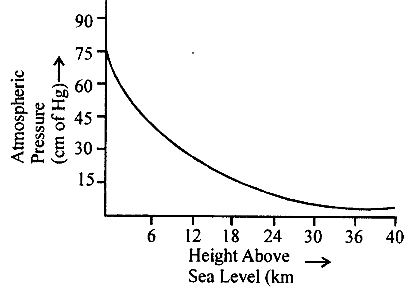
The graph shows the approximate variation of pressure with altitude.
View full question & answer
Question 23 Marks
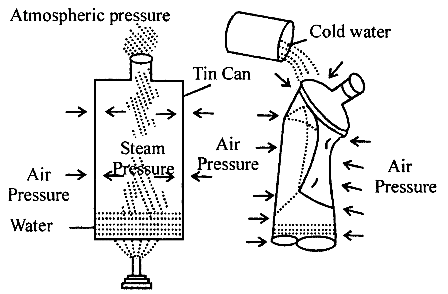
Describe a simple experiment to illustrate that air exerts pressure.
Answer
EXPERIMENT : Take a tin$-$can having air tight cap $($screw cap$)$. Remove cap and boil some water in it, so that steam comes out and in this way air from inside goes out. While boiling replace the cap and allow it to cool. Vapours inside condense and form water creating vacuum above them. We see the can crumbles due to air pressure from outside. This proves that air exerts pressure.
View full question & answer
Question 33 Marks
Describe an experiment to show that the liquid pressure at a point increases with the increase in height of the liquid column above that point.
Answer
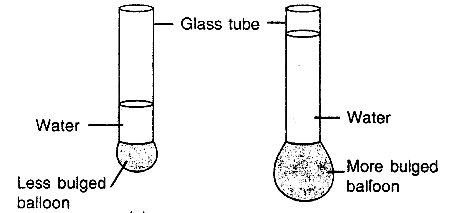
Experiment : Tie a balloon at one end of a glass tube open at both ends. Pour some water and note the bulging of the balloon as in

Now add more water in the tube bulging also increases. Add still more water bulging also increases further as liquid pressure at a point increases with increase in height of the liquid column above that point.
View full question & answer
Question 43 Marks
State two factors on which the pressure at a point in a liquid depends.
Answer
The two factors on which the pressure at a point in a liquid depends are :
$1.$ The height of the liquid column : Liquid pressure increases with the height of the liquid column above the point.
$2.$ The density of the liquid : Liquid pressure increases with the increase in density of the liquid.
View full question & answer
Question 53 Marks
Describe a suitable experiment to demonstrate that a liquid exerts pressure sideways also?
Answer
A LIQUID EXERTS PRESSURE SIDEWAYS :
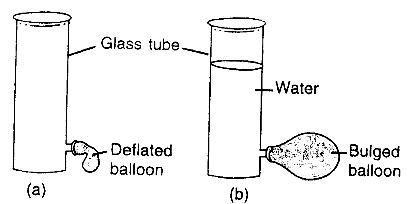
Set up the apparatus as shown in fig.

A deflated balloon is tied on the side tube of the container opened at one side. Now fill water in the container, balloon connected inflates due to the pressure of liquid exerted sideways. This shows that liquids exert pressure sideways also.
View full question & answer
Question 63 Marks
Describe an experiment to show that a liquid exerts pressure at the bottom of the container in which it is kept.
Answer
A LIQUID EXERTS PRESSURE AT THE BOTTOM OF ITS CONTAINER:

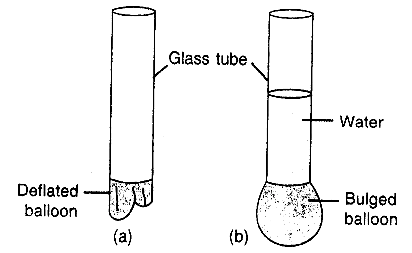
Take a balloon and tie it at the lower end of a glass tube and hold vertically as in fig. $(a)$ pour some water in the tube, balloon bulges out as in
$(b)$ because water column exerts pressure $(\therefore$ liquid has weight$)$ at its bottom. Force on the balloon is equal to the weight of the Thrust water column which is called the thrust $P =$ Thrust $/$ Area
This shows that a liquid exerts pressure at the bottom of the container in which it is kept.
View full question & answer
Question 73 Marks
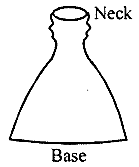
A gum bottle rests on its base. If it is placed upside down, how does the thrust change?
Answer
When the bottle is placed upside down, the mass and acceleration does not change and so the thrust remains the same.
View full question & answer
Question 83 Marks
When does a man exert more pressure on the floor : while standing or while walking?
Answer
The force acting per unit area is called pressure exerted by an object. It is given by $: P = \frac{ F }{ A }$
Pressure is inversely proportional to the area of the cross-section. While walking, the area that is in touch with floor is more, so it will exert less pressure.
On the other hand, while standing, the area in touch is less. So, it will exert more pressure.
Hence, while standing a man will exert more pressure.
View full question & answer
Question 93 Marks
Calculate the pressure in pascal exerted by a force of $300\  N $ acting normally on an area of $30\ cm^2.$
Answer
Given : $F =300\ N ; A =30\ cm^2=\frac{30}{100 \times 100} m^2=30 \times 10^{-4} m^2$
To Find : Pressure
$\therefore P=\frac{F}{A} $
$ =\frac{300}{\frac{30}{100 \times 100}} $
$ =\frac{300 \times 100 \times 100}{30} $
$ =100000 $
$=10^5 Pa $
View full question & answer
Question 103 Marks
Find the area of a body which experiences a pressure of $50000\ Pa$ by a thrust of $100\  N$ ?
Answer
Pressure on the body $=50,000\  pa$
Force or thrust $=100\  N$
We know that,
Pressure $=\frac{\text { Force }}{\text { Area }} $
By substituting the values we get,
$ a=\frac{100}{50,000}=\frac{10}{5000} $
$ A=\frac{10}{5000}=\frac{10}{5 \times 10^3}=\frac{2}{10^3}=2 \times 10^{-3} m ^2 $
View full question & answer
Question 113 Marks
A wheel of diameter $2\  m$ can be rotated about an axis passing through its center by a moment of force equal to $2.0\ N m$. What minimum force must be applied on its rim?
Answer
Given:
Moment of force $=2.0\  N m$
Diameter $=2\  m$
So, radius $=\frac{\text { diameter }}{2}=1\  m$
Therefore perpendicular distance $d=$ radius $=1\  m$
Force $f =$ ?
Moment of force $=$ diameter $\times$ force
Force $=\frac{\text { moment of force }}{\text { diameter }}$
Force $=\frac{2 \cdot 0 Nm }{1 m }$
Force $=2 N$.
View full question & answer
Question 123 Marks
A boy weighing $60 \ kgf$ stands on platform of dimensions $2.5 \ cm \times 0.5 \ cm$. What pressure in pascal does he exert?
Answer
Force$=$Thrust $=$ Weight $= 60 \ kgf$
$=60 \times 10=600 N $
Area of platform $=2.5 \ cm \times 0.5 \ cm$
$ =\frac{2.5}{100} m \times \frac{0.5}{100} m=\frac{25}{1000} \times \frac{5}{1000}$
$=\frac{1}{40} \times \frac{1}{200}=\frac{1}{8000} m^2$
Pressure $P =\frac{F}{A}=\frac{600 N}{\frac{1 m^2}{8000}}$
$=\frac{600 \times 8000}{1}$
$=4800000$
$=\frac{4800000}{10} \times 10$
$=4.8 \times 10^6 Pa$
View full question & answer
Question 133 Marks
Calculate the pressure exerted on a surface of $0.5\ m^2$ by a thrust of $100\  kgf.$
Answer
Given:
Thrust $(F)=100\  kgf$
Area $=0.5 m ^2$
Pressure $= ?$
Pressure $=\frac{\text { Thrust }}{\text { Area }}$
$=\frac{100}{0.5}$
$=\frac{1000}{5}$
Pressure $=200\ kgf m ^{-2}$
View full question & answer
Question 143 Marks
The base of a container measures $15\ cm \times 20\ cm.$ It is placed on a table top. If the weight of the container is $60\ N,$ what is the pressure exerted by the container on the table top?
Answer
Area of the base of container $A=15 \ cm \times 20 \ cm$
$=\frac{15 \times 20}{100 \times 100} $
$ =\frac{300}{10000} m^2 $
$ =\frac{3}{100} m^2$
Force $=$ weight $=60 N$
Pressure exerted $=\frac{ F }{ A } $
$P=\frac{60}{\frac{3}{100}} $
$ P=60 \times \frac{100}{3} $
$P=20 \times 100$
$ P=2000\ Pa$
View full question & answer
[3 Mark Question Answer] - PHYSICS STD 8 Questions - Vidyadip