Questions

[3 Mark Question Answer]

🎯

Test yourself on this topic

11 questions · timed · auto-graded

Question 13 Marks
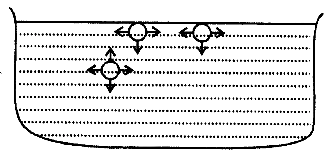
Give reason for the increase in rate of evaporation of a liquid when air is blown above the liquid.
Answer
$a.$ When air is blown above the liquid, the speed by which the vapours move increases. Hence the rate of evaporation increases.
When the surface area is increased, rate of evaporation also increases.
$b.$ This is because evaporation occurs among the molecules on the surface, not in the interior. This means ; increasing the surface area will increase the chance of more molecules to evaporate.
$c.$ As temperature increases, rate of evaporation also increases. This is due to increasing kinetic energy of the surface molecules which leads them to free and become vapour.
View full question & answer
Question 23 Marks
Comment on the statement ‘evaporation is a surface phenomenon’.
Answer
Change of liquid into vapours at all temperatures from the surface is called evaporation . Evaporation takes place at the surface in those molecules which are at the surface and have sufficient $K.E.$ to overcome attractive force due to inner surrounding molecules.
View full question & answer
Question 33 Marks
No heat is supplied to a liquid during evaporation. How does then the liquid change into its vapours?
Answer
Though no heat is supplied to the liquid molecules near the surface of the liquid acquire sufficient kinetic energy by collisions with other liquid molecules and with this $K.E$ . they overcome the attractive forces of other molecules and change into vapours.
During evaporation, particles of water absorb heat from the surroundings to change their state. The particles at the surface absorb more heat and change into vapour.
View full question & answer
Question 43 Marks
Do all the molecules of a liquid take part in evaporation? If not, explain your answer.
Answer
No, all the molecules of the liquid do not take part in evaporation only those molecules near the surface of the liquid which acquire sufficient Kinetic energy $($Threshold velocity$)$ escape as they overcome attractive forces of other molecules. Then other molecules come to the surface of the liquid and acquire more $K.E.$ and escape the surface. This continues till all the liquid evaporates.
View full question & answer
Question 53 Marks
Distinguish between liquid and vapour $($or gas$)$ states of matter on the basis of the following factors
$a.$ Arrangement of molecules
$b.$ Inter$-$molecular separation
$c.$ Inter$-$molecular force, and
$d.$ Kinetic energy of molecules
Answer
Distinguish between liquid and vapour on the bases of :
  Liquid Vapour
$(a)$ Arrangement of molecules loosely packed Very loosely packed
$(b)$ Intermolecular separation Least Maximum
$(c)$ Intermolecular force Maximum Least
$(d)$ Kinetic energy of molecules Least Maximum
View full question & answer
Question 63 Marks
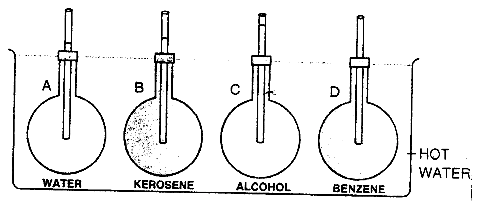
Describe an experiment to show that same volume of different liquids heated to same rise in temperature expand by different amounts.
Answer
CUBICAL EXPANSION OF DIFFERENT LIQUIDS IS DIFFERENT:

Experiment: Take four identical glass flasks each fitted with a narrow glass tube through a cork at its mouth. Fill flask $A$ with water, $B$ with kerosene, $C$ with alcohol and $D$ with Benzene. So that volume of each is same i.e. to the same level and their levels are visible above hot water bath. Put enough hot water in hot$-$water$-$bath. So that each flask is in the hot water. After some time we will see those different liquids rise to different levels. Water expands the least and benzene the most. This shows that different liquids of the same volume expand by a different amount.
View full question & answer
Question 73 Marks
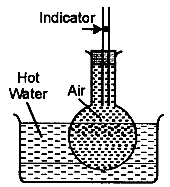
Describe an experiment to showthat air expands on heating.
Answer
Take a glass fL bottomed flask. Close its mouth with a cork having capillary tube containing an indicator visible in the tube as shown. Make it airtight. Place the flask in hot water. After a few minutes, we see the indicator moving up. This happens because the air inside the flask expands with rise in temperature. This proves that gases expand on heating.
View full question & answer
Question 83 Marks
Name the three states of matter and distinguish them on the basis of their $(i)$ volume, and $(ii)$ shape
Answer
THREE STATES OF MATTER :
$\text{(i) SOLID (ii) LIQUID (iii) GASEOUS}$
DISTINCTION BETWEEN THREE STATES ON THE BASES OF
$\text{(i) VOLUME}$ :
$\text{SOLID}$: have a definite volume.
$\text{LIQUID}$: have a definite volume.
$\text{GASEOUS}$: have no definite volume.
$(ii)\text{ SHAPE}$ :
$\text{SOLID}$: Have a definite shape.
$\text{LIQUID}$: Have no definite shape.
$\text{GASEOUS}$: Have no definite shape
View full question & answer
Question 93 Marks
A cubical metal solid block is heated. How will its volume change?
Answer
When a solid is heated, it expands in all directions. The volume of a cube also increases.
Let $V_0$ be the volume of cube of side $L_0$ at $0^{\circ}C$. i.e. $V_0 = L_{30} – V$
When temperature increases to $t^{\circ} C$ each side increases to $V_t$
$\therefore V_t = L^3_t$​​​​​​​
Increase in volume $= (V_t — V_0) [L^3_t — L^3_0]$
Increase in temperature $= (t — O)^{\circ}C = t^{\circ}C$
View full question & answer
Question 103 Marks
One rod of copper and another identical rod of iron are heated to the same rise in temperature. Which rod will expand more ? Give reason.
Answer
When two identical rods $($same length$)$ are of different material and heated to the same rise in temperature, the copper rod will expand more than iron, since expansion depends on the nature of the material.
$($Coefficient of linear expansion of copper $17 \times 10^{-6}$ per $^{\circ}C > $iron $13 \times 10^{-6}$ per $^{\circ}C)$
View full question & answer
Question 113 Marks
What is boiling ? Explain it on the basis of molecular motion?
Answer
BOILING: “The change of liquid to vapours on heating at a constant temperature is called $\text{BOILING}$”
$K.E = \frac{1}{2}Mv^2$: more the speed of molecules more is the kinetic energy. Heating of the liquid increases the average kinetic energy of liquid molecules and molecules acquire sufficient $K.E.$ needed to overcome the force of attraction of other molecules. These molecules start leaving the liquid not only at the surface but also near the walls of the containing vessel and bubbles are seen on the walls of the vessel. This causes the agitation in the whole of the liquid and this is called boiling.
View full question & answer
[3 Mark Question Answer] - PHYSICS STD 8 Questions - Vidyadip