Questions

[2 Mark Question Answer]

🎯

Test yourself on this topic

16 questions · timed · auto-graded

Question 12 Marks
Define refraction. State the two laws of refraction.
Answer
The phenomenon of bending of light is known as refraction. The two laws of refraction are given as follows.
a. The incident ray, the normal at the point of incidence and the refracted ray all lie on the same plane.
b. For a given pair of media of different densities, the ratio of the sine of angle of incidence to the sine of angle of refraction is always a constant, that is,
$\frac{\sin i}{\sin r}=$ constant
View full question & answer
Question 22 Marks
What do you understand by lateral displacement.
Answer
When a ray of light passes through a rectangular glass slab, it emerges parallel to the incident ray and is shifted from its original path. The perpendicular distance between the emergent ray and the incident ray is called the lateral displacement.
View full question & answer
Question 32 Marks
Describe dispersion of white light. Why do different colours of light bend to different extents when passed through a prism?
Answer
The phenomenon of splitting of white light into its constituent colours is called dispersion. When white light is allowed to pass through a prism, it splits into a band of seven colours-violet, indigo, blue, green, yellow, orange and red $\text{(VIBGYOR)}$. Dispersion of light occurs because different colours of light bend to different extents when passed through a prism.

This is because the refractive index of a medium with respect to another medium is different for different colours. Red colour deviates $($or bends$)$ the least, whereas violet deviates the most. This is why red forms the top band of the spectrum and violet forms the bottom band.
View full question & answer
Question 42 Marks
A ray of light is incident at an angle i on the surface of a glass slab. If its angle of refraction inside the glass block is $r$, then find the relation between $i$ and $r$ assuming that light enters from air and emerges into air.
Answer
The relation between $i$ and $r$ is given by the Snell’s law, which states that for a given pair of media of different densities, the ratio of the sine of angle of incidence to the sine of angle of refraction is always a constant, that is,
$\frac{\sin i}{\sin r}=$ constant
The value of the constant is fixed for a set of two transparent media and depends upon their nature. It is called the refractive index of the second medium with respect to the first. In case of a glass slab, light ray is entering the glass slab from the air. So, the ratio of sin $i$ to sin $r$ is equal to the refractive index of glass with respect to air.
$\frac{\sin i}{\sin r}=$ refractive index of glass with respect to air
View full question & answer
Question 52 Marks
How is a rainbow formed.
Answer
Rainbow is formed due to dispersion of sunlight and is visible in the sky after a spell of rain. Just after a rainfall,
there are a large number of water droplets suspended in the atmosphere. These droplets act like tiny prisms. When sunlight passes through these spherical droplets, it undergoes dispersion. With a large number of water droplets contributing to this phenomenon, we get to see a huge continuous band of seven colours displayed in the sky.
View full question & answer
Question 62 Marks
Why does a pencil appear to be bent when placed in a beaker of water?
Answer
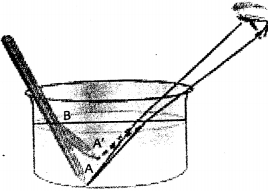
A pencil appears to be bent when placed in a beaker of water due to refraction of light. The ray of light from the tip of the pencil $(A)$ travels from an optically denser medium $($water$)$ to an optically rarer medium $($air$)$. The ray is refracted at the surface of water, and bends away from the normal.

When this ray reaches the eye of the viewer, it appears to come from a point $A’$. Similarly, all points between $AB$ appear to come from corresponding points between $A’B$. Therefore, the pencil appears to be bent and shorter, when viewed from the top.
Image
View full question & answer
Question 72 Marks
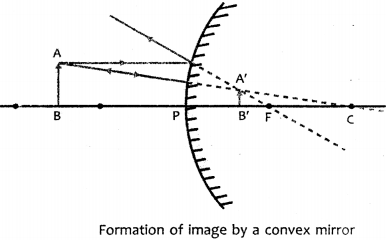
Name the type of a spherical mirror which always forms a virtual, erect and diminished image. What is the position of such type of images with respect to the mirror ? Draw a ray diagram for the same.
Answer
Convex mirror always form a virtual, erect and diminished image. The image is always formed between the focus and the pole of the mirror, irrespective of the position of the object in front of the mirror.
Image
View full question & answer
Question 82 Marks
The speed of light in diamond is found to be $1,24,000 \ km/s$. What is the refractive index of diamond?
Answer
Speed of light in diamond $= 1,24,000 \ km/s= 1.2 \times 105 \ km/s = 1.2 \times 108 m/s$
Speed of light in vacuum $= 3 \times 108 m/s$
Refractive index of diamond with respect to vacuum
$ =\frac{\text { speed of light in vacuum }}{\text { speed of light in diamond }}$
$ =\frac{3 \times 10^8 m / s }{1.2 \times 10^8 m / s }=2.5$
View full question & answer
Question 92 Marks
Find the refractive index of a medium if the speed of light in that medium is $2.25 \times 10s \ m/s$.
Answer
Speed of light in the medium $= 2.25 \times 10^8\ m/s$
Speed of light in vacuum $= 3 \times 10^8\ m/s$
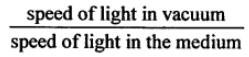
Refractive index of the medium with respect to vacuum $ =\frac{\text { speed of light in vacuum }}{\text { speed of light in the medium }}$
$ =\frac{3 \times 10^8 \ m / s }{2.25 \times 10^8 \ m / s }=1.33$
View full question & answer
Question 102 Marks
Find the speed of light in a transparent medium if the refractive index of the medium is $1.8.$
Answer
Refractive index of a medium $= 1.8$
Speed of light in vacuum $= 3 \times 108\  m/s$
From the expression,
Refractive index of the medium with respect to vacuum
Image
we get,
$1.8=\frac{3 \times 10^8 m / s }{1.8}=1.66 \times 10^8 m / s$
View full question & answer
Question 112 Marks
The speed of light in a transparent medium is $2.44 \times 10^8\ m/s$. Find the refractive index of the medium.
Answer
Speed of light in the transparent medium $= 2.44 \times 108\ m/s$
Speed of light in vacuum $= 3 \times 108\ m/s$
Refractive index of the medium with respect to vacuum
$\frac{\text { speed of light in air }}{\text { speed of light in glass }}=\frac{3 \times 10^8 \ m / s }{2 \times 10^8\  m / s }$
speed of light in the medium $2.44 \times 108\ m/s$
$= 1.23$
View full question & answer
Question 122 Marks
If the speed of light in glass is $2 \times 10^8\  m/s,$ and that in air is $3 \times 10^8\ m/s,$ calculate the refractive index of glass with respect to air.
Answer
Speed of light in glass $= 2 \times 10^8 \ m/s$
Speed of light in air $= 3 \times 10^8 \ m/s$
Refractive index of glass with respect to air
$ \frac{\text { speed of light in air }}{\text { speed of light in glass }}=\frac{3 \times 10^8\ m / s }{2 \times 10^8\ m / s }$
$ =1.5$
View full question & answer
Question 132 Marks
Will it be easy to watch the activities of customers in’ a departmental store with concave mirrors ? Why or why not?
Answer
No, it won’t be easy to watch the activities of customers in a departmental store with concave mirrors as the image formed by them changes its nature and position depending on the position of the customers. The image increases in size if the customer approaches the mirror. So, the shopkeeper doesn’t get a wide field of view. Moreover, the image formed is generally real and inverted. So, it is not easy to track the activities of the customers with the help of concave mirrors.
View full question & answer
Question 142 Marks
An object is placed at the centre of curvature of a concave mirror of radius of curvature $20 \ cm$ and focal length $10 \ cm$. At what distance from the pole will its image be formed?
Answer
Radius of curvature of a concave mirror $20 \ cm$ Focal length of the mirror $= 10 \ cm$ If the object is placed at the centre of curvature, then the image will also be formed at the centre of the curvature. So, the image will be formed at a distance of $20 \ cm$ from the pole of the mirror.
View full question & answer
Question 152 Marks
There is a coloured stone at the bottom of a swimming pool. Jasvinder is trying to hit it with an arrow. However, each time he misses the target by a narrow margin. Can you explain to Jasvinder why he misses the target and how can he hit it with more accuracy?
Answer
The coloured stone when viewed from the top $01$ the swimming pool appears to be raised due to refraction of light. Jasvinder is actually hitting the coloured stone where it appears to be and hence misses the target whenever he tries to hit it with an arrow. If he hits the target by aiming at a position a little below the position of the stone visible from the top, then he might be able to hit the target.
View full question & answer
Question 162 Marks
Why can concave mirrors not be used as rear view mirrors in vehicles ?
Answer
Concave mirror cannot be used as rear view mirrors in vehicles. This is because if they are used, they will mostly form a real and inverted image of the vehicles behind. Moreover, the size of the image of the vehicles behind will also vary as the distance of the vehicles behind changes from the rear view mirror. As the vehicles behind
approach the rear view mirror, their images will keep on magnifying, limiting the field of view of the vehicles coming behind.
View full question & answer
[2 Mark Question Answer] - PHYSICS STD 8 Questions - Vidyadip