Questions

[2 Mark Question Answer]

🎯

Test yourself on this topic

13 questions · timed · auto-graded

Question 12 Marks
Describe the process of sublimation with examples.
Answer
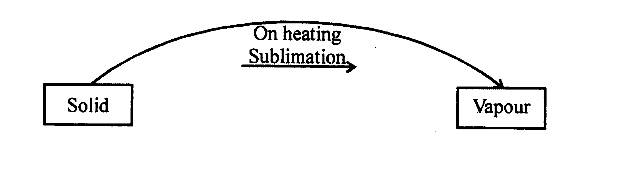
Sublimation is a form of phase transition or shift in a state of matter. The process of change of solid directly into vapours on heating is sublimation without ever going through a liquid phase. A common example of sublimation is the dry ice, heavy $\ce{CO_2}.$
View full question & answer
Question 22 Marks
Differentiate between melting point and boiling point, giving atleast one example of each.
Answer
MELTING POINT :
The temperature at which a solid starts changing into $\text{LIQUID}$ without further increase in temperature is called MELTING POINT.” Or The constant temperature at which solid changes into liquid.”
Example : Ice $($solid$)$ melts at $0^\circ C$ into water $\text{LIQUID}$ when heated.
BOILING POINT :
“The temperature at which a $\text{LIQUID}$ start changing in vapour without a further rise in temperature.
Or
‘The constant temperature at which a $\text{LIQUID}$ starts changing into $\text{GAS} ($vapours$)$
Example: Boiling point of water $\text{LIQUID}$ is $100^\circ C.$
View full question & answer
Question 32 Marks
What is meant by the intermolecular forces of attraction? How do they vary in solids, liquids and gases?
Answer
INTERMOLECULAR FORCES OF ATTRACTION :
“The forces of attraction between the molecules of the matter is called the intermolecular force of attraction.”
This intermolecular force is
maximum in solids
less in liquids
least in gases.
View full question & answer
Question 42 Marks
State three properties of molecules of a matter.
Answer
$1.$ They are very small in size.
$2.$ They have spaces between them.
$3.$ They are in constant motion and they possess kinetic energy.
View full question & answer
Question 52 Marks
A patient suffering from high fever is advised to put wet clot strips on his forehead. Why?
Answer
Water in wet strips evaporates taking latent heat required for evaporation from the forehead. The temperature of the forehead $($body of the patient$)$ falls and he feels relieved.
View full question & answer
Question 62 Marks
Explain why in hot summer days water remains cool in earthen pots.
Answer
Water seeps out through the pores in the earthen pot and it evaporates. The latent heat required for evaporation is taken, from the water inside the pot which gets cooled.
View full question & answer
Question 72 Marks
Explain with an example to demonstrates that when a liquid evaporates, it takes heat from its surroundings.
Answer
If some spirit is poured on cotton wrapped around the bulb of a thermometer, the reading of the thermometer falls. This shows that cooling is produced when a liquid evaporates taking heat from surroundings.
View full question & answer
Question 82 Marks
Why is cooling produced on evaporation of a liquid?
Answer
For evaporation of a liquid, it requires $\text{HEAT}$. This heat is taken from the surroundings like body or palm or forehead or finger and its temperature falls and we feel cool.
View full question & answer
Question 92 Marks
A certain quantity of water is heated from $20^\circ C$ to $100^\circ C$. Its temperature is recorded after each $1$ minute. The observations are:
Time $($in minute$)$ Temperature $($in $^\circ C)$
$0$ $20$
$1$ $30$
$2$ $40$
$3$ $50$
$4$ $60$
$5$ $70$
$6$ $80$
$7$ $90$
$8$ $100$
$9$ $100$
$10$ $100$
$11$ $100$
$12$ $100$
What conclusion do you draw from the above table about the boiling point of water? Explain.
Answer
From the table given above, we note that as thermometer shows $100^\circ C$, it becomes constant and through heat is being supplied. This means boiling point of water is $100^\circ C$ and heat supplied is being used to convert every molecule of water into vapours $($steam$)$ till the whole of the water gets boiled off.
View full question & answer
Question 102 Marks
Why are volatile liquids such as alcohol and spirit stored in tightly closed bottles?
Answer
Rate of evaporation depends on the NATURE OF LIQUID i.e. more volatile liquids like $\text{ALCOHOL}$ and $\text{SPIRIT}$ evaporate easily, hence these are stored in tightly closed bottles to avoid their evaporation.
View full question & answer
Question 112 Marks
State three factors which affect the rate of evaporation of a liquid.
Answer
Three factors on which affect the rate of evaporation of a liquid:
$i.$ Area of the exposed surface.
$ii.$ The temperature of the liquid.
$iii.$ Nature of the liquid.
$iv.$ Presence of humidity.
View full question & answer
Question 122 Marks
Some ice is taken in a beaker and its temperature is recorded after each one minute. The observations are listed below
Time $($in minute$)$ Temperature $($in $^\circ C)$
$0$ $0$
$1$ $0$
$2$ $0$
$3$ $0$
$4$ $0$
$5$ $0$
$6$ $3.8$
$7$ $7.6$
$8$ $11.4$
From the above observations, what conclusion do you draw about the melting point of ice?
Answer
From the above observations we conclude that ice melts at $0^\circ C$ during which heat is supplied but the temperature does not rise shows that heat supplied is used to change every molecule of ice into water and when the whole of ice is melted, the temperature starts rising.
View full question & answer
Question 132 Marks
Explain the terms vaporization.
Answer
VAPORIZATION: “Change of liquid to vapours $($gas$)$ on heating at constant temperature is called VAPORIZATION.”
When we heat a liquid temperature starts rising till it starts changing into vapours and then temperature remains constant for some time, though we are supplying heat. This heat supplied is being used to change every molecule of liquid into vapours and temperature does not rise till the whole of liquid is changed into vapours.
View full question & answer
[2 Mark Question Answer] - PHYSICS STD 8 Questions - Vidyadip