Questions

[3 Mark Question Answer]

🎯

Test yourself on this topic

7 questions · timed · auto-graded

Question 13 Marks
Describe the process of condensation with examples.
Answer
CONDENSATION :
“The change of vapours on cooling at a fixed temperature to liquid is called condensation.”
Condensation is the change of physical state of matter from gaseous phase into the liquid phase.
It is a process in which water vapour $($gaseous form$)$ in the air changes into liquid water when it touches a cooler surface. When the water in the air comes in contact with a cold surface, it condenses to form water droplets. This phenomenon is known as condensation. The reverse of condensation is Evaporation reaction.
Example : When water vapours at $100^\circ C$ are cooled they change into water $($liquid$)$.
View full question & answer
Question 23 Marks
What do you mean by the change of state? Write the flow chart showing the complete cycle of change of state.
Answer
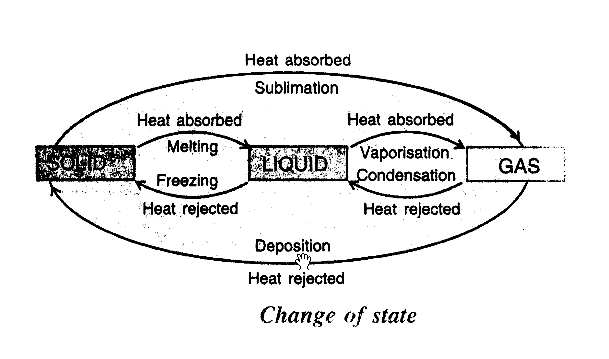
CHANGE OF STATE : “The process of change from one state $($form$)$ to another state $($form$)$ either by absorption or rejection of heat at a constant temperature is called the CHANGE OF STATE.”
COMPLETE CYCLE OF CHANGE OF STATE : On heating solid changes to liquid and liquid on heating changes to vapours. On cooling vapours condense to LIQUID, LIQUIDS on the cooling freeze to SOLIDS. Some SOLIDS on heating change to vapours. On rejection of heat vapours solidify.
This cycle can be shown by the diagram
View full question & answer
Question 33 Marks
Describe an experiment to demonstrate the process of sublimation.
Answer
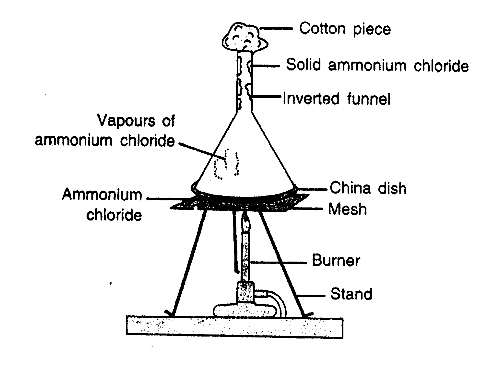
Experiment : Take some Ammonium chloride powder in a china dish. Cover the china dish with an inverted funnel and put a cotton plug$-$in end of the funnel so that vapours do not escape. Set up the apparatus as shown. Heat the dish with the burner. Solid ammonium chloride changes into vapours. Which when coming in contact with walls of funnel get cooled and change to solid and get deposited there.
View full question & answer
Question 43 Marks
What do you mean by sublimation? Explain with an example.
Answer
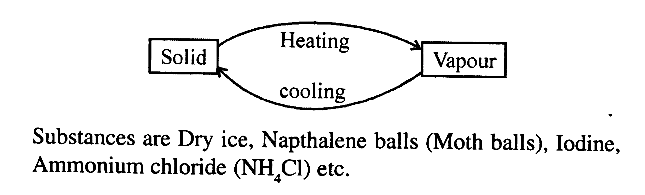
SUBLIMATION : “Change of solid state of matter directly on heating to vapour state $($without becoming liquid$)$ and on cooling vapours to solid is called sublimation
View full question & answer
Question 53 Marks
Give two applications of evaporation.
Answer
Two applications of evaporation:
$i.$ When we sprinkle water on the roads in the summer evening, water evaporates by taking heat from the road and produces coolness in the surroundings and it becomes pleasant.
$ii.$ After taking a bath in summer when we come out of the water, water evaporates taking heat from our body. The temperature of body falls and we feel refreshed.
View full question & answer
Question 63 Marks
Define the term matter. What is it composed of?
Answer
Matter is anything that has mass and occupied space. OR
Matter is anything that has both mass and volume.
The matter is composed of very small particles. They are made of Molecules. Then the molecules are made up of Atoms. These are made up of Subatomic particles and these are made of Antiparticles. These small particles are microscopic and therefore cannot be seen with the eye.
View full question & answer
Question 73 Marks
Describe an experiment to demonstrate that a substance absorbs heat during melting without change in its temperature.
Answer
To demonstrate that a substance absorbs heat during melting without change in its temperature
MELTING POINT OF SOLID (WAX) :
Put some wax in a test tube. Insert a thermometer in solid wax, so that bulb of thermometer remains in wax and does not touch the sides.
Clamp the test tube along with thermometer in hot bath i.e. in the water contained in the beaker and set up the apparatus. Note the temperature.
Heat the beaker over the flame of the burner and record the temperature after every minute. The temperature rises and then reaches $68^\circ C$ and wax shines in the test tube.
The temperature remains constant for nearly $5$ minutes i.e. at $68^\circ C$. This means Wax is melting and the temperature remains constant till the whole of the wax is melted. Then the temperature rises again every minute.
Conclusion: The temperature remains constant at $68^\circ C$ while changing from solid to liquid. This means $55^\circ C$ is the melting point and heat is absorbed without a change in temperature. This heat is absorbed at constant temperature till the whole of wax is melted.
View full question & answer
[3 Mark Question Answer] - PHYSICS STD 8 Questions - Vidyadip