Questions

[3 Mark Question Answer]

🎯

Test yourself on this topic

12 questions · timed · auto-graded

Question 13 Marks
What is a density bottle? How is it used to find the density of a liquid?
Answer
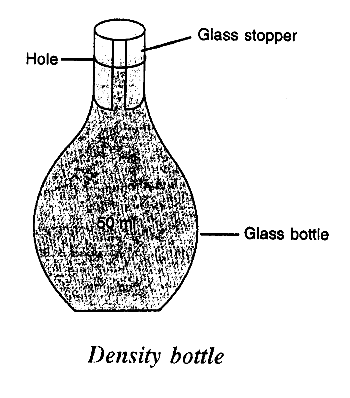
$\text{DENSITY}$ bottle is a small glass bottle having a glass stopper at its neck. The bottle can store a fixed volume of a liquid. Generally, the volume of the bottle is $25\  ml$ or $50\  ml$. The stopper has a narrow hole through it. When the bottle is filled with liquid and stopper is inserted, the excess liquid rises through the hole and drains out. Thus the bottle will contain the same volume of liquid each time when it is filled. It is used to determine the density of a liquid.
View full question & answer
Question 23 Marks
Describe an experiment to determine the density of a liquid.
Answer
To determine the density of a liquid $D=M / V$
We need to find $(i)$ the vol. of liquid say milk, $(ii)$ mass of liquid.
EXPERIMENT:
$(i)$ To find the mass of milk:
wt. of empty $100 c . c$ beaker $= M _1 g=70 g\  ($say$)$
Fill the beaker $($half$)$ with milk and weigh again $= M _2 g=116 g\  ($say$)$
$(ii)$ To find the vol. of milk:
Transfer this milk into measuring cylinder and note volume $V=40\  c.c\  ($say$)$
$\therefore$ Density of milk $= D =\frac{M}{V}=\frac{m_2-m_1}{40\  c . c}$
$=\frac{116-70}{40}=\frac{46}{40}=\frac{4.6}{4}=1.15\  g \ cm ^{-3}$
View full question & answer
Question 33 Marks
How does the density of a liquid $($or gas$)$ vary with temperature ?
Answer
Most of the liquids increase in volume with an increase in temperature, but water shows anomalous behaviour. Water has a maximum volume at $4^{\circ} C$ and maximum density at $4^{\circ} C$.
Actually, when volume increases density decreases and when volume decreases the density increases. But water when cooled from high-temperature contracts up to $4^{\circ} C$ because volume decreases and expands when cooled further below $4^{\circ} C$ and hence the density of water increases when it is cooled up to $4^{\circ} C$ while decreases when cooled further below $4^{\circ} C$. In other words, the density of water is maximum at $4^{\circ} C$ equal to $1\ g /Cm ^{-3}$ or $1000\ \ kg/ m ^{-3}$.
View full question & answer
Question 43 Marks
Name the $\text{S.I}$. unit of density. How is it related to g $Cm^{-3}?$
Answer
$\text{S.I}$ unit of density is $kg/ M ^{-3}$ ln $\text{CGS}$. system unit of mass is $g$ and unit of volume is $Cm ^3$, so $\text{CGS}$ unit of density is $g /Cm ^{-3} ($gram per cubic centimetre$)$
Relationship between $\text{S.I}$. and $\text{C G S}$. units
$ 1 \ kg/ m =\frac{1 \ kg }{1 m ^3} =\frac{1000 g }{(100 \ cm )^3}$
$ =\frac{1}{1000} g \ /cm ^{-3} $
thus, $ 1 \ kg/ m ^{-3}=10^{-3} g/cm ^{-3} $
or $1 g \ cm ^{-3}=1000 \ kg /m ^{-3}$
View full question & answer
Question 53 Marks
What is a submarine? How can it be made to dive in water and come to the surface of water?
Answer
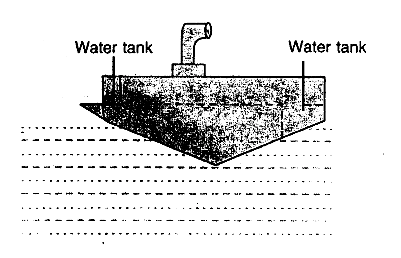
SUBMARINE: Submarine is a water-tight boat which can travel underwater like a ship. It is provided with water tanks. When the submarine is to dive, water is filled in water tanks, it is made heavier and average density of submarine becomes greater than the density of seawater and it sinks. To make the submarine rise to the surface of the water, water tanks are emptied. This makes the average density of submarine becomes less than the density of seawater and it rises to surface.

While a submarine is underwater soldiers can see the enemy activities through the periscope.
View full question & answer
Question 63 Marks
It is easier to swim in sea water than in river water. Explain the reason.
Answer
The density of seawater is greater than the density of river water, $[$because of impurities$]$
$i.$ In each case, the weight of water displaced will be equal to the weight of the man.
$\therefore$ Ratio of weight of seawater and river water displaced by man is $1: 1.$
$ii.$ With a smaller portion of man’s body submerged in seawater, the weight of seawater displaced is equal to the total weight of the body. While to displace the same weight of river water, a larger portion of the body will have to be submerged in water.
$\therefore$ It is easier for man to swim in seawater.
View full question & answer
Question 73 Marks
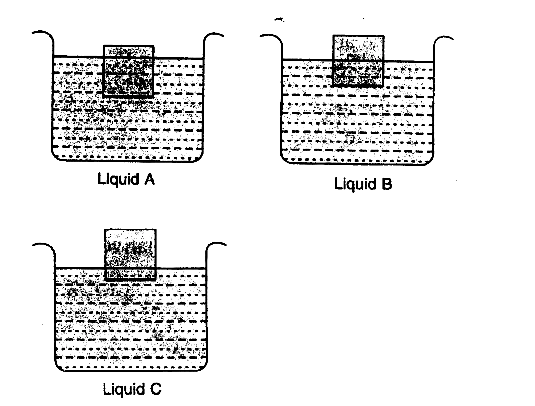
The diagram given below show a body floating in three different liquids. $A, B$ and $C$ at different levels.
$(a)$ In which liquid does the body experience the greatest buoyant force?
$(b)$ Which liquid has the least density?
$(c)$ Which liquid has the highest density?
Answer
$(a)$ Buoyant force is same in each case as the wt. of the body is same in each case and Buoyant force is equal to the weight of the liquid displaced by the immersed part of the body which balances the wt. of body.
$(b)$ The liquid $A$ has the least density as body immerses the maximum.
$(c)$ Liquid $C$ has the highest density as the body immerses the least.
View full question & answer
Question 83 Marks
Distinguish between density and relative density.
Answer
Density Relative Density
$1.$ It is the ratio of mass to volume.
$D =\frac{\text { Mass }}{\text { Volume }}=\frac{m}{v}$
It is the ratio of the density of a substance to the density of water.
$2.$ Units are $g/ cm ^{-3}$ or $\ kg/ m^-3$ It is a pure quantity. It has no units.
$3.$ Density in $\ kg/ m^{-3} =R.D \times 1000$ $R.D =$ Density in $g/ cm ^{-3}$
$R.D =\frac{\text { Density in } \ kg \ cm ^{-3}}{1000}$
View full question & answer
Question 93 Marks
The mass of an empty density bottle is $30g,$ it is $75g$ when filled completely with water and $65g$ when filled completely with a liquid. Find relative density of liquid.
Answer
Mass of empty density bottle $\left( M _1\right)=30g$
Mass of bottle $+$ Water $\left( M _2\right) 75g$
Mass of liquid $+$ Liquidx $\left(M_3\right)=65g$
Mass ofwater $= M _2- M _1=75-30=45g$
Mass of water in the density bottle $=75-30=45\  g$
$\therefore$ Volume of water in density bottle $=45\  cc$
and mass of equal volume of liquid in density bottle $65-30=35g$
$ \text { R.D.}$ of liquid  $=\frac{\text { mass of } 45 cc \text { of liquid }}{\text { mass of } 45 cc \text { of water }}=\frac{35}{45}=\frac{7}{9}$
$ =0.77$
View full question & answer
Question 103 Marks
The mass of an empty density bottle is $30g,$ it is $75 g $ when filled completely with water and $65 g$ when filled completely with a liquid. Find density of liquid.
Answer
Mass of empty density bottle $\left( M _1\right)=30 g$
Mass of bottle $+$ Water $\left( M _2\right) 75 g$
Mass of liquid $x+$ density bottle $\left( M _3\right)=65 g$
mass of density bottle $-$ liquid $x=30 g-65 g=35 g$
Mass of water $=M_2-M_1=75-30=45 g$
Density of Iiquid $x =$ ?
$D =\frac{\text { Mass of Liquid }}{\text { Mass of water }}=\frac{35}{45}$
Mass of liquid $=M_3-M_1=65-30=35 g$
$D =\frac{\text { Mass of liquid }}{\text { Mass ofwater}}=\frac{35}{45}=0.77 g / \ cm ^3$
View full question & answer
Question 113 Marks
The mass of an empty density bottle is $30 g$, it is $75 g$ when filled completely with water and $65 g$ when filled completely with a liquid. Find volume of density bottle.
Answer
Mass of empty density bottle $\left( M _1\right)=30 g$
Mass of bottle $+$ Water $\left( M _2\right)=75 g$
Mass of liquid $+$ Liquid $\left(M_3\right)=65 g$
Mass of water $= M_2- M_1$
$= 75 - 30$
$= 45 g$
Volume of density bottle $=$ Mass of water $= 45 g$
$\therefore 1 g = 1 mL$
Volume of density bottle $= 45 g = 45\  mL$
$\therefore $ Volume of density bottle $= 45\  mL$
View full question & answer
Question 123 Marks
From the following observations, calculate the density and relative density of a brine solution.
Mass of empty density bottle $= 22 g$
Mass of bottle $+$ water $= 50 g$
Mass of bottle $+$ brine solution $= 54 g$
Answer
Mass of empty bottle, $M _1=22 g$
Mass of bottle $+$ water, $M _2=50 g$
Mass of bottle $+$ brine solution, $M _3=54 g$
Mass of water $= M _2- M _1=50-22=28 g$
Mass of brine solution $=M_3-M_1=54-22=32 g$
$\therefore$ Density of brine solution $=\frac{\text { Mass of brine solution }}{\text { Mass of water }}$
= $\frac{32 g }{28 cm ^3}$
$= 1.14\  g /cm^{-3}$
∴ Relative density of brine solution $=\frac{M_3-M_1}{M_2-M_1}$
= $\frac{54-22}{50-22}$
= $\frac{32}{28}$
$= 1.14$
View full question & answer
[3 Mark Question Answer] - PHYSICS STD 8 Questions - Vidyadip