Questions

[5 Mark Question Answer]

🎯

Test yourself on this topic

5 questions · timed · auto-graded

Question 15 Marks
Obtain relationship between the time period and frequency.
Answer
 
Frequency is the number of times a cycle is completed in a second.
The frequency time period is inversely proportional.
The number of vibrations per second is called frequency
The $\text{s.i}$ unit of frequency is Hertz.
The time taken to complete one vibration is called time period.
Relationship between the Time Period $(T)$ and Frequency $(ƒ)$ : By definition time period is the time taken to complete $1$ vibration
Or
In time $T,$ the number of vibration $= 1$
$\therefore$ In $1$ second, the frequency or number of vibrations $= 1 / T$
$f=\frac{1}{t}$ Or $t=\frac{1}{f}$
 
View full question & answer
Question 25 Marks
Define the following terms :
$(a)$ Amplitude
$(b)$ Frequency
$(c)$ Time period.
Answer
Amplitude : The amplitude of particle executing $\text{S.H.M}$. is its maximum displacement on either side of the mean position. $A$ is the amplitude of the particle.
Frequency : The frequency of a particle executing $\text{S.H.M}$. is equal to the number of oscillations
completed in one second. $v=\frac{\omega}{2 \pi}=\frac{1}{2 \pi} \sqrt{\frac{ k }{ m }}$
Time Period : Time period of a particle executing $\text{S.H.M}$. is the time taken to complete one cycle and is denoted by $T.$ Time period $(T) =\frac{2 \pi}{\omega}$
$=2 \pi \sqrt{\frac{ m }{ k }}$ as $\omega=\sqrt{\frac{ m }{ k }}$
View full question & answer
Question 35 Marks
Explain the mechanism of the formation of a longitudinal wave when the source vibrates in the air.
Answer
$\text{PROPAGATION OF SOUND IN AIR}$ : When a source of sound vibrates, it creates a periodic disturbance in the medium near it $($i.e., the condition of medium changes$)$. The disturbance then travels in the medium in form of waves. This can be understood by the following example.
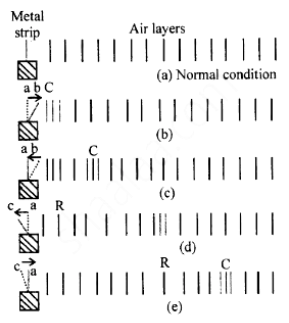
Example: Take a vertical metal strip with its lower end fixed. Push its upper end to one side and then release it. As it vibrates, i.e. moves alternately to the right and left, sound is produced. Figure shows the steady $($or mean position$)$ of the metal strip and normal condition of air layers near the strip.
Image
As the strip moves to the right from $a$ to $b$ in Figure it pushes the particles of air layer in front of it. So the particles of air in this layer come closer to each other i. e., air in that layer gets compressed $($or compression is formed at $C)$. The particles of this layer while moving towards right, pushes and compresses the layer next to it, which then compresses the next layer and so on. Thus the disturbance moves forward in form of compression. The particles of the medium do not move with the compression.
As the metal strip starts returning from $b$ to a in Figure after pushing the particles near the strip, the compression $C$ moves forward and the particles of air near the strip return back to their normal positions due to the elasticity of the medium.
When the strip moves to the left from $a$ to $c$ in Figure it pulls the layer of air near it towards left and thus produces a space of very low pressure on its right side. The air layers on the right side of the strip expand in this region thus forming the rarefied layers. ‘This region of low pressure is called a rarefaction $R$.
By the time the strip returns from $c$ to its mean position a in Figure the rarefaction $R$ moves forward and air layers near the strip return back to their normal position due to the elasticity of the medium.
In this manner, as strip moves to the right and left repeatedly, the compression and rarefaction regions are produced one after the other which carry the disturbance along with, definite speed depending on the nature of the medium.
One complete to and fro motion of the strip forms one compression and one rarefaction which together constitute one wave. This wave in which the particles of the medium vibrate about their mean positions, in the direction of propagation of sound, is called the longitudinal wave. Thus sound travels in air form of longitudinal waves. Actually, the longitudinal waves can be produced in solids, in liquids as well as in gases.
Thus, due to propagation of the wave in a medium, the particles of the medium vibrate about their mean positions $($without leaving their positions$)$ and they transfer the energy with a constant speed from one place of medium to the other place
View full question & answer
Question 45 Marks
How is it possible to detect the filling of a bucket under a water tap by hearing the sound standing at a distance?
Answer
As the bucket fills up, the air column or amount of air inside the bucket decreases. So as a result, the pitch or shrillness of the sound will increase, as frequency or pitch of the sound is inversely proportional to the length of the vibrating air column. Also, the amplitude or the loudness of the sound will decrease, as the amount of the air column vibrating decreases as the bucket fills up. So with the increase in the shrillness of the sound, you can detect the filling up of the bucket. So the more the shrillness, the more the bucket has been filled. When the bucket overflows, the shrill sound will be heard no more.
View full question & answer
Question 55 Marks
Match the following
column $A$ column $B$
$(A)$ Amplitude $(1)$ frequency
$(B)$ Frequency $(2)$ amplitude
$(C)$ Loudness $(3)$maximum displacement on either side
$(D)$ Pitch $(4)$ presence of other frequencies
$(E)$ Waveform $(5) 1/$ time period
Answer
column $A$ column $B$
$(A)$ Amplitude $(3)$ maximum displacement on either side
$(B)$ Frequency $(5) 1/$ time period
$(C)$ Loudness $(2)$ amplitude
$(D)$ Pitch $(1)$ frequency
$(E)$ Waveform $(4)$ presence of other frequencies
View full question & answer
[5 Mark Question Answer] - PHYSICS STD 8 Questions - Vidyadip