Questions

[1 Mark Question Answer]

🎯

Test yourself on this topic

19 questions · timed · auto-graded

Question 11 Mark
Consider the following two statements A and B and select the right option from (i)-(iv) about their correctness.
  1. Small intestine is shorter than large intestine.
  2. Small intestine is wider than large intestine.
Options :
(i)Both the statements are correct
(ii) Both the statements are wrong
(iii) Statement A is correct, B is wrong
(iv) Statement B is correct, A is wrong
Answer
(ii) Both statements are wrong.
The small intestine is longer (7 metres) than large intestine (1.5 metres). Also, large intestine is so called because of its width which is larger than that of small intestine.
View full question & answer
Question 21 Mark
Mention two reflexes which occur when a person chews and swallows food.
Answer
The two reflexes which occur when a person chews and swallows food are:
  1. Reflex when a person chews - Secretion of saliva
  2. Reflex when a person swallows - Tongue presses upward and back against the roof (palate)
View full question & answer
Question 31 Mark
What is the dental formula of a normal human adult?
Answer
The dental formula of a normal human adult is :
Human adult $=\frac{2,1,2,3}{2,1,2,3}=32($ Permanent teeth + Wisdom teeth $)$
View full question & answer
Question 41 Mark
Study the Following Dental Formula and Then Answer the Question that Follow:
$
\text { i } \frac{3}{4} c \frac{0}{0} pm \frac{0}{1} m \frac{1}{1}
$
Give the dental formula of an adult human being.
Answer
The dental formula of an adult human being is $\frac{2,1,2,3}{2,1,2,3}$.
View full question & answer
Question 51 Mark
Study the following dental formula and then answer the question that follow:
$
i \frac{3}{4} c \frac{0}{0} pm \frac{0}{1} m \frac{1}{1}
$
Name an animal possessing such a dentition.
Answer
The given dentition is likely to be present in any herbivore such as deer.
View full question & answer
Question 61 Mark
Study the following dental formula and then answer the question that follow :
$
\text { i } \frac{3}{4} \text { c } \frac{0}{0} pm \frac{0}{1} m \frac{1}{1}
$
State the total number of teeth present in the dentition.
Answer
A total of 20 teeth are present in the given dentition.
View full question & answer
Question 71 Mark
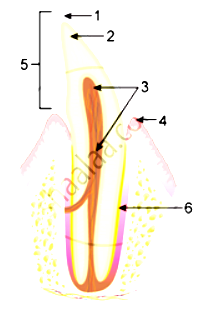
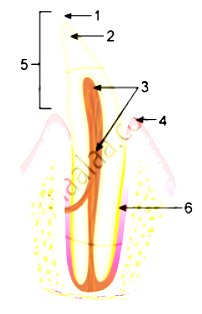
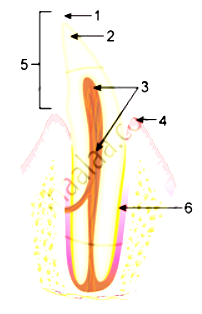
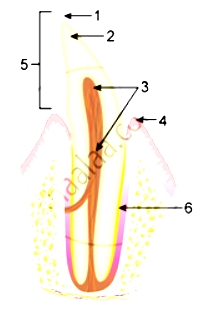
Study the diagram given below and then answer the question that follows:

Give the total number of the type of tooth mentioned in '1' above, in the mouth of an adult andstateits function.
Answer
Type of teeth in the mouth of an adult:
  1. Incisors (8) → Used for biting and cutting
  2. Canines (4) → Used for holding and tearing of food
  3. Premolars (8) → Used for grinding and crushing of food
  4. Molars (12)→ Used for grinding and crushing of food
View full question & answer
Question 81 Mark
Study the diagram given below and then answer the question that follows:

Describe the structure of the part labelled '3'.
Answer
The part labelled '3' (pulp) is a soft connective tissue present in the pulp cavity of the tooth. It consists of blood capillaries, lymph vessels and nervefibers. These extend from the crown of the tooth and open through the pulp cavity at the base of the root.
View full question & answer
Question 91 Mark
Study the diagram given below and then answer the question that follows:

Identify the tooth and give a reason to support your answer.
Answer
The tooth shown in the diagram has only one root, so it is an incisor or canine which is used for biting and piercing.
View full question & answer
Question 101 Mark
Study the diagram given below and then answer the question that follows:

Name the parts labelled 1, 2, 3, 4, 5 and 6.
Answer
1 → Enamel 2 → Dentine 3 → Pulp 4 → Gum 5 → Crown 6 → Cement
View full question & answer
Question 111 Mark
Try to swallow the saliva in your mouth, and feel with your hand your neck. What happens in the neck?
Answer
While swallowing saliva in the mouth, the larynx is pulled upwards to bring it close to the back of the tongue, when a flap called epiglottis closes its opening. Then, it goes towards the oesophagus.
View full question & answer
Question 121 Mark
The stomach secretes gastric juice, which contains hydrochloric acid. What is its function?
Answer
Functions of hydrochloric acid:
(1) It gets mixed with food and kills the bacteria present in food.
(2)It activates pepsin to act on proteins.
View full question & answer
Question 131 Mark
Mention two ways in which the ileum of the mammal is adapted for the absorption of digested food.
Answer
Adaptations of ileum for the absorption of digested food:
(1) Very long to provide more surface area for absorption
(2) Presence of large number of villi to further increase the surface area
View full question & answer
Question 141 Mark
What is the function of rectum?
Answer
Rectum acts as a temporary storage site for undigested food. It has voluntary smooth muscles that remove the faeces out of the body through the anus.
View full question & answer
Question 151 Mark
Define the following term:
Assimilation
Answer
Absorption of substances which are built into other compounds in the organisms.
View full question & answer
Question 161 Mark
Define the following term:
Kilocalorie
Answer
A kilocalorie is a unit of energy. It is the energy required to raise the temperature of 1 kg of water by 1 Celsius.
View full question & answer
Question 171 Mark
Define the following term :
Pylorus
Answer
Pylorus is the passage at the lower end of the stomach that opens into the duodenum.
View full question & answer
Question 191 Mark
Define the following terms :
Peristalsis
Answer
Peristalsis is the rhythmic contraction and relaxation of the muscles of the alimentary canal that pushes the food along the gut.
View full question & answer
[1 Mark Question Answer] - BIOLOGY STD 9 Questions - Vidyadip