Questions

[5 Mark Question Answer]

🎯

Test yourself on this topic

8 questions · timed · auto-graded

Question 15 Marks
Describe the digestion of food in small intestine.
Answer
Digestion in small intestine:

1. Digestion of carbohydrates in the small intestine:

40% starch is partially digested by ptyalin while remaining 60% starch is digested by pancreatic amylase. Starch ——Panerestic__, maltose + Isomaltose + Limit dextrin.
The enzymes of intestinal juice act as below:
Maltose —Mslt2s°_, 2 Glucose
Isom altose —lomaltase_. 2 Glucose
Surcrose —SU&*® _, Glucose + Fructose
Lactase Lactose —————— _ Glucose + Galactonse
Limit Dextrin Set Glucose fe xtrinase
The humans cannot digest the cellulose due to the absence of cellulose enzyme.

2. Digestion of protein the small intestine:

Action of pancreatic juice. It contains proenzymes trypsinogen, chymotry-psinogen and procarboxy peptidase.
Enterokinase . Tryp sin ogen of int erstinal juice Tryp sin
Chymotryp sin ogen —25"_ chymotrypsin
Pr ocarboxypeptidase —lrypsin_, Carbody - peptidase
Peptones ——25" _, pentides
Peptones —Shymotrypsin_. peptides
Peptides —atboxypentidase_, cry aller
peptides + Amino acid
Trysinogen converts into trypsin in the presence of enterokinase. Trypsin converts chymotrypsinogen into chymotrypsin; procarboxypeptidase into carboxy-peptidase; and peptones into peptides. Chymotrypsin also converts peptones into peptides. Peptides gets converted into smaller peptides and amino acids in the presence of carboxypeptidase.
Action of intestinal juice. Intestinal juice contains endokinase, aminopeptidase and dipeptidase. Actions of these enzymes are summarized below:
Peptides —Aminopentidase _. cm aller peptides + Amino acid Peptides —Dipentidase_. amino acid

3. Digestion of Fats:

Digestion of fats occurs in small intestine and reactions occur as below:
Fat —bile_. emulsified fat Emulsified fat —Fancreatic _, Fatty acid + Glycerol lipase

4. Digestion of Nucleic Acids:

Nucleic acids are digested in the small intestine as below:
DNA —2285€_, Deoxyribonucleotides
RNA —808S2_, Ribonucleatides
Nucleotides —Nudeotidase_. Nudeosides + Phosphate
Nucleosides —-Nudeoside_. Nitragenous bases + Pentose phosphate Phosphorylase
The enzyme Dnase converts DNA into Deoxyribonucleotides, Rnase converts RNA into ribonucleotides, nucleotidase converts the nucleotides into nucleosides and phosphate and finally nucleoside phosphorylase converts nucleosides into nitrogenous bases and pentose phosphate.
View full question & answer
Question 25 Marks
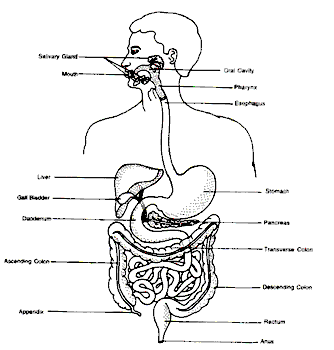
Describe the human alimentary canal.
Answer
Human alimentary canal consists of:
  1. Mouth - It is the first organ in the sequence which helps in sucking, chewing, salivation and swallowing. The food is ingested through mouth,
  2. Pharynx - It is situated behind the soft palate and leads into oesophagus. It is divided into three parts - nasopharynx, oropharyx and laryngopharynx.
  3. Oesophagus - It lies upto the middle of the thorax, behind the trachea and the heart. It pushes the food down into the stomach by peristaltic movements,
  4. Stomach - It is the widest organ ofthe alimentary canal. It is J - shaped and is divided into three parts: cardiac, body and pyloric.
  5. Intestine - It is of two types: small intestine and large intestine. Small intestine is the longest part of the alimentary canal and comprises of three regions - duodenum, jejunum and ileum. It helps in the absorption of food, Large intestine is divisible into three parts - caecum, colon and rectum. It absorbs water from the food.
View full question & answer
Question 35 Marks
Describe the process of digestion in human beings.
Answer
Digestion of proteins in humans:
There is no digestion of protein in the oral cavity because protein digestive enzymes are absent in the saliva.
(a) Digestion of protein in the stomach: Gastric juice contains $HCl$ and two proenzymes, pepsinogen and prorenin. $HCl$ maintains a pH of 2-3.7 and kills bacteria and other pathogens. Gastric juice mixes with food until it becomes a semi-solid mass called Chyme. Proenzymes become activated as below:
Pepsinogen $\xrightarrow[2-3.7 pH ]{ HCl }$ Pepsin
Prorennin $\xrightarrow{ HCl }$ Rennin
These enzymes act as follows:
Casein $\xrightarrow[\text { (Milk protein) }]{\text { Rennin }}$ Paracasein
Paracasein $+ Ca \rightarrow$ Calcium Paracasinate (Curd)
Calcium paracaseinate $\xrightarrow{\text { Pepsin }}$ Peptones
Protein $\xrightarrow{\text { Pepsin }}$ Peotone
(b) Digestion of protein the small intestine Action of pancreatic juice. It contains proenzymes trypsinogen, chymotrypsinogen, and procarboxy peptidase.
Trypsinogen $\xrightarrow[\text { of interstinal juice }]{\text { Enterokinase }}$ Trypsin
Chymotrypsinogen $\xrightarrow{\text { Trypsin }}$ Chymotrypsin
Procarboxypeptidase $\xrightarrow{\text { Trypsin }}$ Carbody - peptidase
Peptones $\xrightarrow{\text { Trypsin }}$ Peptides
Peptones $\xrightarrow{\text { Chymotrypsin }}$ Peptides
Peptides $\xrightarrow{\text { Carboxypeptidase }}$ Smaller peptides + Amino acid
The action of intestinal juice. Intestinal juice contains endokinase, aminopeptidase, and dipeptidase. Actions of these enzymes are summarized below:
Peptides $\xrightarrow{\text { Aminopeptidase }}$ Smaller peptides + Amino acid
Peptides $\xrightarrow{\text { Dipeptidase }}$ Amino acid
View full question & answer
Question 45 Marks
Describe the digestion of starch.
Answer
Digestion of starch:
(a) Digestion of starch in the oral cavity: Food is mixed with saliva and salivary amylase or ptyalin converts starch into maltose, isomaltose, and limit dextrins.
Starch $\xrightarrow[\text { Amlylase + }cl^{-}]{\text { Pancreatic }}$ Maltose + Isomaltose + Limit dextrin.
(b) Digestion of starch in the stomach: Gastric juice does not contain carbohydrate digestive enzyme, hence no digestion of starch takes place in the stomach.
(c) Digestion of starch in the small intestine: $40 \%$ starch is partially digested by ptyalin while the remaining $60 \%$ starch is digested by pancreatic amylase.
Starch $\xrightarrow[\text { Amlylase + }cl^{-}]{\text { Pancreatic }}$ Maltose + Isomaltose + Limit dextrin.
The enzymes of intestinal juice act as below:
Maltose $\xrightarrow{\text { Maltase }} 2$ Glucose
Isomaltose $\xrightarrow{\text { Isomaltase }} 2$ Glucose
Surcrose $\xrightarrow{\text { Sucrase }}$ Glucose + Fructose
Lactose $\xrightarrow{\text { Lactase }}$ Glucose + Galactonse
Limit Dextrin $\xrightarrow[\text { Dextrinase }]{\text { Limit }}$ Glucose
The humans cannot digest the cellulose due to the absence of cellulose enzyme.
View full question & answer
Question 55 Marks
Match items in column A with the appropriate items in Column B:
Column AColumn B
1HClaLactose
2RenninbPellagra
3EnteropeptidasecRumen
4CellulosedPepsin
5PtyalineStarch
6VitaminfPernicious anaemia
7Intestinal juicegTrypsin
8Bile salthCasein
9Vitamin AiMicelle
10GoitrejNight-blindness
kIodine
Answer
Column AColumn B
1HCldPepsin
2RenninhCasein
3EnteropeptidasegTrypsin
4CellulosecRumen
5PtyalineStarch
6VitaminfPernicious anaemia
7Intestinal juiceaLactose
8Bile saltiMicelle
9Vitamin AjNight-blindness
10GoitrekIodine
bPellagra
View full question & answer
Question 65 Marks
Name the enzymes of pancreatic juice, the substrates they digest, and the end products.
Answer
The pancreatic juice contains proenzymes trypsinogen, chymotrypsinogen, procarboxy peptidase, pancreatic amylase, and pancreatic lipase.
(a) Digestion of proteins by pancreatic juice: Trysinogen converts into trypsin in the presence of enterokinase. Trypsin converts chymotrypsinogen into chymotrypsin; procarboxypeptidase into carboxy-peptidase; and peptones into peptides. Trypsin, chymotrypsin, and carboxy-peptidase act upon proteins. Chymotrypsin also converts peptones into peptides. Peptides get converted into smaller peptides and amino acids in the presence of carboxypeptidase.
Trypsin ogen $\xrightarrow[\text { of interstinal juice }]{\text { Enterokinase }}$ Trypsin
Chymotrypsin ogen $\xrightarrow{\text { Trypsin }}$ Chymotrypsin
Procarboxypep tidase $\xrightarrow{\text { Trypsin }}$ Carboxy - peptidase
Peptones $\xrightarrow{\text { Trypsin }}$ Peptides
Peptones $\xrightarrow{\text { Chymotrypsin }}$ Peptides
Peptides $\xrightarrow{\text { carboxypeptidase }}$ Smaller Peptides + Amino acid
(b) Digestion of carbohydrates by pancreatic juice: Pancreatic amylase acts upon starch in the presence of chlor ide ions and converts it into maltose, isomaltose and dextrin.
Starch $\xrightarrow[\text { Amlylase + }cl^{-}]{\text { Pancreatic }}$ Maltose + Isomaltose + Limit dextrin.
(c) Digestion of fats: Pancreatic juice contains pancreatic lipase which emusifies the fats into fatty acids and glycerol.
Emulsified fat $\xrightarrow[\text { lipase }]{\text { Pancreatic }}$ Fatty acid + Glycerol
View full question & answer
Question 75 Marks
Describe the human salivary gland.
Answer
Salivary Glands - Three pairs in man and secrete 1000 to 1500 cc saliva per day. Saliva is slightly acidic and its pH is 6.8.


There are three types of salivary glands:

  1. Parotid glands: It is the largest salivary gland and situated near the ears. It opens into oral cavity by Stenoson's duct.
  2. Sublingual glands: It is located beneath the tongue. It opens into the floor of oral cavity by duct of Rivinus.
  3. Submadibular or sub-maxillary glands: It is situated at the angles of the lower jaws. It opens inot oral cavity by Whartson's duct.

Each gland secret secretes saliva which is transported to the mouth cavity. At the time secrete saliva.

View full question & answer
Question 85 Marks
Describe protein digestion in the human.
Answer
Digestion of proteins in humans:

There is no digestion of protein in the oral cavity because protein digestive enzymes are absent in the saliva.

1. Digestion of protein in the stomach:

Gastric juice contains HCl and two proenzyme, pepsinogen and prorennin. HCI maintains a pH of 2 - 3.7 and kills bacteria and other pathogens. Gastric juice mixes with food until it becomes semi-solid mass called Chyme. Proenzymes become activated as below:

These enzymes act as follows:

2. Digestion of protein the small intestine

Action of pancreatic juice. It contains proenzymes trypsinogen, chymotry-psinogen and procarboxy peptidase.

Action of intestinal juice. Intestinal juice contains endokinase, aminopeptidase and dipeptidase. Actions of these enzymes are summarized below:

Peptides —Aminopentidase _. cm aller peptides + Amino acid

Peptides —Dipentidase_. amino acid

View full question & answer
Generate Paper FreeAll Digestive System topics
[5 Mark Question Answer] - BIOLOGY STD 9 Questions - Vidyadip