Questions

[5 Mark Question Answer]

🎯

Test yourself on this topic

2 questions · timed · auto-graded

Question 15 Marks
Write down the different positions of floral leaves on the thalamus in detail?
Answer
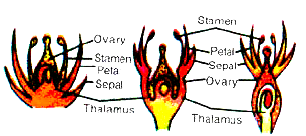
Based on the position of calyx, corolla, and androecium in respect to the ovary on the thalamus, there are three floral whorl conditions. These are
(i) Hypogyny - In this flower, the ovary occupies the highest position on the thalamus, while the petals, sepals, and stamens are separately inserted below the ovary. The ovary in such flowers is said to be superior. E.g., mustard and china rose.
(ii) Perigyny - In this condition, the margin of the thalamus grows upwards to form a cup-shaped structure called calyx tube enclosing the ovary. The ovary here is said to be half inferior. E.g., plum and rose
(iii)Epigyny - In this flower, the margin of thalamus grows upwards enclosing the ovary completely and getting fused with it. The other parts of the flower are above the ovary. Hence, the ovary is said to be inferior. E.g. Sunflower, flowers of cucumber.
View full question & answer
Question 25 Marks
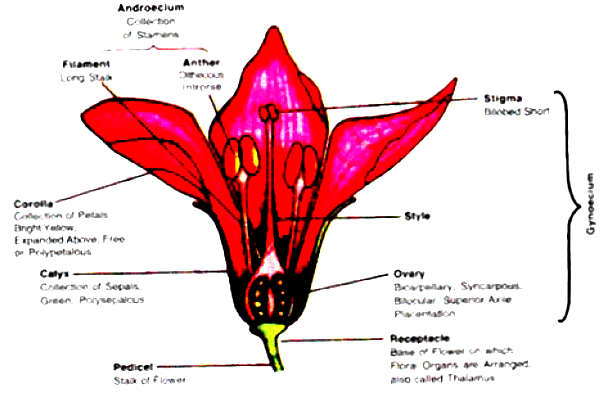
Write in detail the structure of a typical flower studied by you with the help of a labelled diagram.
Answer
A flower is a reproductive unit in angiosperms. It is a modified shoot in which internodes are shortened and leaves are modified into a floral structure. A flower is meant for sexual reproduction.
A typical flower has four different kinds of whorls arranged successively on the swollen parts of a flower stalk. Flower stalk consists of the stalk called pedicel and the swollen upper part called thalamus bearing the floral leaves.
The different floral whorls are calyx, corolla, androecium, and gynoecium. Calyx and corolla are accessory whorls, while androecium and gynoecium are reproductive whorls.
(i) Calyx - The calyx is the outermost whorl of the flower and its members are called sepals. Generally, sepals are green, leaf-like, and protect the inner whorls of the flower in the bud stage. They are also involved in producing food by photosynthesis. The calyx may be gamosepalous (sepals united) or polysepalous (sepals free).
(ii) Corolla - It is the second whorl composed of floral leaves called petals. Petals are usually brightly coloured to attract insects for pollination. Petals also protect the inner whorls. Like calyx, corolla may be also free (gamopetalous) or united (polypetalous). The shape and colour of corolla vary greatly in plants.
(iii) Androecium - It is the third whorl and is the male reproductive whorl of a flower. The androecium is composed of one or more stamens. Each stamen consists of three parts:
(a) Filament - It is the lower stalk of the stamen.
(b) Anther - Filament bears a bilobed fertile structure called anther at its distal end. Each lobe contains two pollen sacs. The pollen grains are produced in pollen-sacs.
(c) Connective - The filament of the stamen is extended in between the two anther lobes called connective.

(iv) Gynoecium - It is the innermost whorl and the female reproductive part of the flower. The gynoecium is made up of one or more carpels. A carpel consists of three parts namely stigma, style, and ovary. The ovary is the swollen basal part containing ovules. Each ovary bears one or more ovules attached to a flattened, cushion-like structure called the placenta. Style is the elongated threadlike structure attached to the apex of the ovary. It connects the ovary to the stigma. The stigma is situated at the tip of the style and is the receptive surface for pollen grains.
View full question & answer
[5 Mark Question Answer] - BIOLOGY STD 9 Questions - Vidyadip