Questions

[5 Mark Question Answer]

🎯

Test yourself on this topic

4 questions · timed · auto-graded

Question 15 Marks
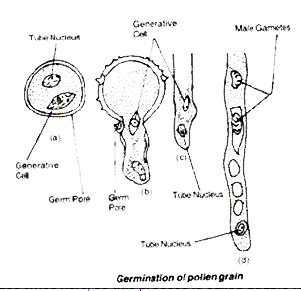
What is the function of pollen tube? Explain with the help of a diagram.
Answer
Pollen grains deposited on the stigma absorb water and swell, due to which its exine ruptures and intine grows out as pollen tube. The pollen tube grows through the style by secreting enzymes that digest reserve food in the tissues of stigma and style. The vegetative nucleus moves to the tip of the pollen tube followed by the generative nucleus which divides into two male nuclei. Now the pollen tube enters the ovule through the micropyle and discharges the two male gametes into the embryo sac.
View full question & answer
Question 25 Marks
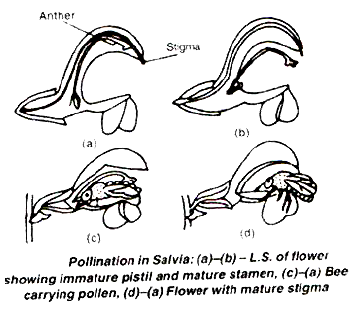
Explain the pollination process in Salvia
Answer
Pollination in Salvia - Insects bring about pollination in Salvia. Flowers of Salvia have corolla whose upper part is blipped and Iower part is tubular where two stamens are attached. Upper lip forms a hood like structure while lower lip serves as a landing platform for insects. Of the two stamens, the fertile one is situated under the hood like upper lip of corolla. When an insect sits on the lower lip and pushes its proboscis into the corolla tube for collecting nectar, its back touches the fertile anther, which gets dusted with pollen grains. When this insect visits another flower for nectar, the style bends down and touches the back of the insect, as a result pollination occurs.
View full question & answer
Question 35 Marks
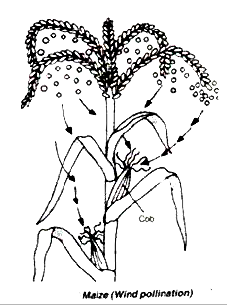
Explain the pollination process in maize.
Answer
Pollination in Maize - Pollination in maize is brought about by the wind. The maize plant is monoecious. The cluster of male flowers called tassel are borne terminally whereas the female inflorescence i.e. cobs are borne laterally at lower levels. Silky thread-like styles project out of the female flowers. Male flowers produce many heavy pollen grains, which get released during mild winds and fall down vertically. They fall on the stigma, bringing about pollination.
View full question & answer
Question 45 Marks
What are the adaptations which are required in self-pollinated plants?
Answer
Adaptations required by cross-pollinated plants are:
(i) Unisexuality - The stamens and carpels are found in different flowers. The male and female flowers may be borne on the same or different plants.
(ii) Dichogamy - In bisexual flowers, stamens and carpels mature at different times. It is of two kinds:
(a) Protandry wherein stamens mature before carpels. E.g - jasmine
(b) Protogyny wherein carpels mature before stamens. E.g. - Rose
(iii) Heterostyly - Here the style is either longer or shorter, thereby preventing self-pollination.
(iv) Herkogamy - Stigma, and stamen mature at the same time, but some type of barrier prevents self-pollination. E.g. - In caryophyllaceous flower, the stigma projects beyond the stamens so that pollens cannot fall on it.
(v) Self-sterility - Pollen of one flower cannot fertilize the female gametes of the same flower.
View full question & answer
[5 Mark Question Answer] - BIOLOGY STD 9 Questions - Vidyadip