Question 15 Marks
Describe three beans experiment. What does it demonstrate?
Answer
View full question & answer→Apparatus required for three beans experiment are beaker, bean seeds, and wooden piece.
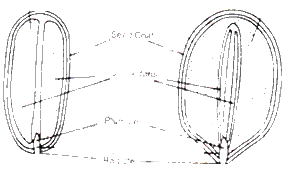
The air-dried seeds are attached to a piece of wood, one at each end and one in the middle. This is then placed in a beaker and water is poured into it till the middle seed is half immersed in it. The beaker is then left in a warm place for a couple of days. From time to time, water is added to maintain the original level.
It is observed that after a couple of days that the bean in the middle germinates normally since it has sufficient water, oxygen, and temperature. The bottom seed gets sufficient water and temperature but not oxygen hence it may develop a radicle but doesn't grow further. The upper seed gets oxygen and temperature but not water and hence fails to germinate.
This experiment shows that water, temperature, and oxygen are essential for seed germination and that germination will not occur if any one of these factors are absent.
The air-dried seeds are attached to a piece of wood, one at each end and one in the middle. This is then placed in a beaker and water is poured into it till the middle seed is half immersed in it. The beaker is then left in a warm place for a couple of days. From time to time, water is added to maintain the original level.
It is observed that after a couple of days that the bean in the middle germinates normally since it has sufficient water, oxygen, and temperature. The bottom seed gets sufficient water and temperature but not oxygen hence it may develop a radicle but doesn't grow further. The upper seed gets oxygen and temperature but not water and hence fails to germinate.
This experiment shows that water, temperature, and oxygen are essential for seed germination and that germination will not occur if any one of these factors are absent.