Questions

[2 Mark Question Answer]

🎯

Test yourself on this topic

15 questions · timed · auto-graded

Question 12 Marks
Observe the figures given below. These show two types of stamens. Name these types.
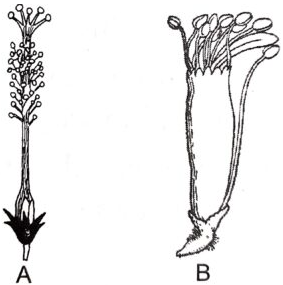
Image
A shows ............. stamens.
B shows ............. stamens.
Answer
Monodelphous, Didelphous
View full question & answer
Question 22 Marks
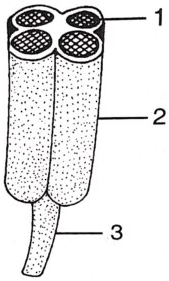
Observe the figure given below and answer the questions:
Image
(i) Label the parts marked 1, 2 and 3.
(ii) Whether it is a male or a female organ?
(iii) What is the function of this organ in a flower?
Answer
(i) 1 pollen chamber, 2 Anther and 3. filament
(ii) male organ
(iii) Produce male gamete (pollen grains)
View full question & answer
Question 32 Marks
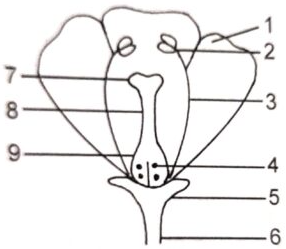
Look at the given picture and answer the questions:
Image
(i) Label the parts 1 to 9 in the figure shown below.
(ii) Whether the flower shown is unisexual or bisexual?
(iii) Give two plant names where such a flower is seen.
Answer
(i) 1. petal, 2. anther, 3. filament, 4. Ovule, 5. receptacle, 6. Pedicel, 7. stigma, 8. style, 9. ovary
(ii) bisexual
(iii) Mustard, Gram
View full question & answer
Question 42 Marks
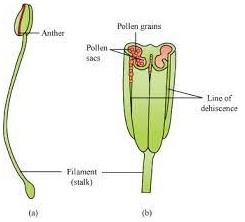
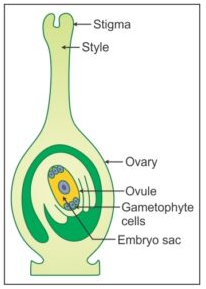
Make labelled drawings of (a) a stamen and (b) a pistil to show their various parts, and state the functions of each of the labelled parts.
Answer
(a) a stamen
Image
(b) a pistil
Image
View full question & answer
Question 52 Marks
Define inflorescence. Name the two types of inflorescences, along with examples.
Answer
The inflorescence is the manner in which the flowers are arranged on the flowering axis. During the flowering season, the vegetative apex of the stem gets converted into a floral meristem. Based on whether the floral axis continues to grow or end in a flower, the inflorescence is classified into racemose and cymose.
View full question & answer
Question 62 Marks
What is a neuter flower? Give one example of such a flower.
Answer
When both sexes are absent from a flower or are non-functional, the flower is said to be neuter. Neuter flowers have undeveloped or nonfunctional sexual organs. They have pistils and stamens that are nonfunctional or absent. The flowers are androgynous and the plants reproduce asexually. ex- sunflower
View full question & answer
Question 72 Marks
What do you mean by accessory and essential whorls? Mention their functions.
Answer
accessory whorls: sepals(calyx)-protection of reproductive inner part of flower. petals(carolla)- To attract bees, butterfly etc insects for transfer of pollen grains. Essential whorls: Gynocium (female reproductive part) - and Androcieum (male reproductive part)- both take part in sexual reproduction.
View full question & answer
Question 82 Marks
Distinguish between
Flower and Inflorescence
Answer
The main difference between flower inflorescence is that flower is a modified shoot, which serves as the reproductive organ of flowering plants whereas inflorescence is a group of flowers arranged on a floral axis. Flower and inflorescence are two structures produced by the sexual reproduction of flowering plants.
View full question & answer
Question 92 Marks
Distinguish between
Apocarpous and Syncarpous gynoecium.
Answer
The flowers with apocarpous ovaries have more than one carpel with free nature. The flowers which have syncarpous ovaries tend to have fused carpels. These free carpels constitute an aggregate of fruits.
View full question & answer
Question 102 Marks
Distinguish between
Polysepalous and Gamosepalous calyx
Answer
Gamosepalous refers to a flower that possesses a calyx, consisting of fused sepals. E.g. Hibiscus. Polysepalous refers to a flower that possesses a calyx, consisting of separate sepals.
View full question & answer
Question 112 Marks
Distinguish between
Complete and incomplete flower
Answer
Complete flowers contain four flower parts: petals, sepals, stamen, and pistil. Incomplete flowers are missing one or more of these four parts. It is possible for a perfect flower to be incomplete, but it is not possible for an imperfect flower to be complete
View full question & answer
Question 122 Marks
Difine :
Peduncle
Answer
The peduncle is the stalk of a flower or an inflorescence. When a flower is borne singly, the internode between the receptacle and the bract (the last leaf, often modified and usually smaller than the other leaves) is the peduncle.
View full question & answer
Question 132 Marks
Difine :
Pedicel
Answer
The pedicel is a stalk or stem that supports a single flower. It connects the single flower to the inflorescence. It is usually seen in pedicellate flowers (e.g., Rose).
View full question & answer
Question 142 Marks
Difine :
Syncarpous gynoecium
Answer
A syncarpous gynoecium is composed of two or more connate carpels. You can often tell that carpels are connate when several stigmas are present. The term "compound pistil" is equivalent to a "syncarpous gynoecium"
View full question & answer
Question 152 Marks
Difine :
Apocarpous gynoecium
Answer
Apocarpous gynoecium means the presence of more than one carpel and the carpels are separate or unfused. It is a primitive condition. The examples of Apocarpous gynoecium include -Strawberry and Buttercup
View full question & answer