Questions

[1 Mark Question Answer]

🎯

Test yourself on this topic

18 questions · timed · auto-graded

Question 11 Mark
What are bracts? State their function.
Answer
When a flower arises in the axil of a leaf-like structure, this structure is known as a bract. Because bracts are large and brightly coloured structures, they are often mistaken for petals. This helps to attract insects for pollination.
View full question & answer
Question 21 Mark
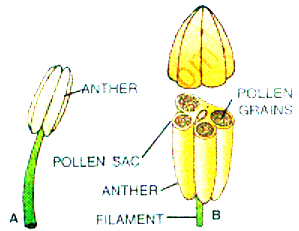
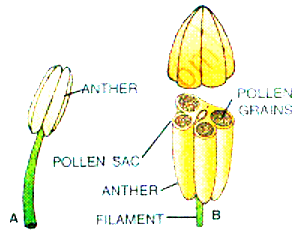
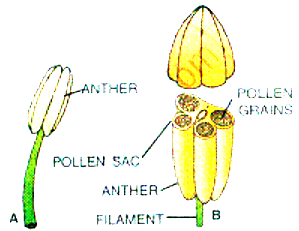
Given below are two figures (A and B) of a certain part of a flower. Study the figures carefully and answer the following question:

Can you state how the contents of the pollen sacs would come out?
Answer
The contents of the pollen sacs would come out through agents like air, wind, insects leading to pollination in flowers.
View full question & answer
Question 31 Mark
Given below are two figures (A and B) of a certain part of a flower. Study the figures carefully and answer the following question:

Are the contents of the pollen sacs in B male or female?
Answer
Contents of the pollen sacs in B are male gametes.
View full question & answer
Question 41 Mark
Given below are two figures (A and B) of a certain part of a flower. Study the figures carefully and answer the following question:

Which major organ of a flower does the figure A represent? What is the collective term for this organ ?
Answer
In the above figure A represents stamen. Stamens collectively form Androecium.
View full question & answer
Question 51 Mark
Why are the following described as stated:
Salvia sepals are petaloid.
Answer
Salvia sepals are petaloid because the three sepals are united and are red in color like petals. Hence, they are undifferentiated from the petals.
View full question & answer
Question 61 Mark
Why are the following described as stated:
Ray florets of sunflower are neuters.
Answer
Ray florets of sunflowers are neuters because both male and female reproductive organs are lacking or absent.
View full question & answer
Question 71 Mark
Why are the following described as stated:
The androecium of pea flower is diadelphous
Answer
The androecium of pea flower is diadelphous because the filaments of the anther are united in two bundles. In the case of pea, out of ten, nine stamens form a staminal tube while one is free.
View full question & answer
Question 81 Mark
Where the following structures/parts located and what are their functions?
Stigma
Answer
Stigma:
Location: Terminal knob-like part
Function: Serves as the landing place for pollen grains during pollination
View full question & answer
Question 91 Mark
Where the following structures/parts located and what are their functions?
Anther
Answer
Anther:
Location: Part of the stamen
Function: Produces male gametes or pollen grains
View full question & answer
Question 101 Mark
Where the following structures/parts located and what are their functions?
Thalamus
Answer
Thalamus:
Location: Tip of the flower stalk
Function: Bears all the parts of the flower
View full question & answer
Question 111 Mark
Where the following structures/parts located and what are their functions?
Placenta
Answer
Placenta:
Location: Cushion or swollen region in the ovary
Function: Gives origin to ovules
View full question & answer
Question 121 Mark
Explain the following term:
Bisexual flower
Answer
A flower that contains both stamens and carpels is called bisexual or hermaphrodite flower. E.g. Hibiscus.
View full question & answer
Question 131 Mark
Explain the following term:
Pistillate flower
Answer
A flower that contains only the carpels, i.e., female parts of a flower is called female or pistillate flower. E.g. Date palm.
View full question & answer
Question 141 Mark
Explain the following term:
Staminate flower
Answer
A unisexual flower which contains only the stamens, i.e., male parts of a flower is called male or staminate flower. E.g. Eastern cottonwood.
View full question & answer
Question 151 Mark
Explain the following term:
Incomplete flower
Answer
If one or more sets of floral structures are missing, the flower is called incomplete flower. E.g. American elm.
View full question & answer
[1 Mark Question Answer] - BIOLOGY STD 9 Questions - Vidyadip