Questions

[1 Mark Question Answer]

🎯

Test yourself on this topic

45 questions · timed · auto-graded

Question 11 Mark
Which chemical compound inside a cell can be termed "Currency of Energy"?
Answer
ATP or Adenosine Triphosphate is termed as "Currency of Energy" of the cell.
View full question & answer
Question 21 Mark
Name the body structure concerned with the given functional activity:
Provides actual diffusion of respiratory gases in the lungs.
Answer
Alveoli or air sacs
View full question & answer
Question 31 Mark
Name the body structure concerned with the given functional activity:
Protects the lungs from mechanical injury
Answer
Ribs
View full question & answer
Question 41 Mark
Name the body structure concerned with the given functional activity:
Combines with the oxygen in the lungs.
Answer
Bronchioles
View full question & answer
Question 51 Mark
Name the body structure concerned with the given functional activity:
Helps to increase the volume of the chest cavity lengthwise.
Answer
Diaphragm
View full question & answer
Question 61 Mark
Name the body structure concerned with the given functional activity:
Transports oxygen to the body cells.
Answer
Capillaries
View full question & answer
Question 71 Mark
Name the body structure concerned with the given functional activity:
Prevents food from entering the trachea during swallowing.
Answer
Epiglottis
View full question & answer
Question 81 Mark
Choose the odd one out in the following groups of four items each:
Hairy, Moist, Nostril, Vocal cord
Answer
Vocal cord
View full question & answer
Question 91 Mark
Choose the odd one out in each of the following groups of four items each:
Oxyhaemoglobin, Carbaminohaemoglobin, Hypoxia, Carboxyhaemoglobin
Answer
Hypoxia
View full question & answer
Question 101 Mark
Choose the odd one out in the following groups of four items each:
Trachea, Ciliated epithelium, Mucous, Diffusion
Answer
Diffusion
View full question & answer
Question 111 Mark
Choose the odd one out in the following groups of four items each:
Diffusion, Respiratory gases, Alveoli, Capillary network
Answer
Diffusion
View full question & answer
Question 121 Mark
Choose the odd one out in the following groups of four items each:
Ethyl alcohol, Carbon dioxide, Starch, Oxygen
Answer
Ethyl alcohol
View full question & answer
Question 131 Mark
Choose the odd one out in the following groups of four items each:
Trachea, Bronchus, Alveolus, Diaphragm
Answer
Diaphragm
View full question & answer
Question 141 Mark
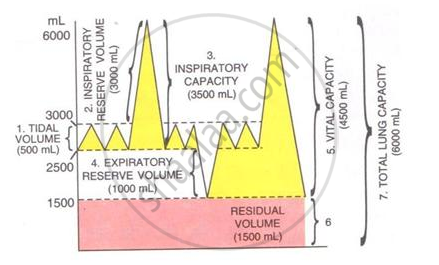
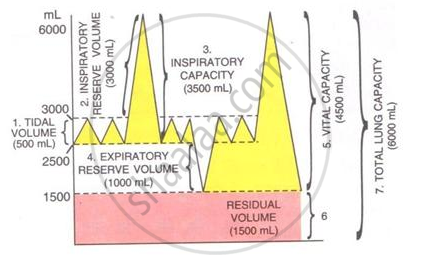
The volume of air in the lungs and the rate at which it is exchanged during inspiration and expiration was measured.
The following diagram shows a group of the lung volumes and capacities.

Study the diagram carefully and explain briefly the following :
Residual volume (RV)
Answer
Residual volume (RV):Air left in the lungs, even after forcible expirationis called residual volume. It is 1500 mL.
View full question & answer
Question 151 Mark
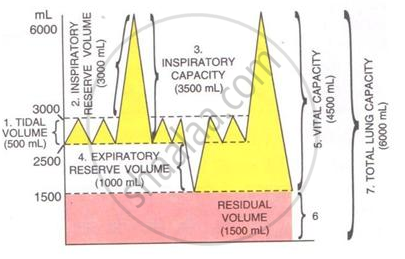
The volume of air in the lungs and the rate at which it is exchanged during inspiration and expiration was measured.
The following diagram shows a group of the lung volumes and capacities.

Study the diagram carefully and explain briefly the following :
Vital capacity (VC)
Answer
Vital capacity (VC):Volume of air that can be taken in and expelled out by maximum inspiration and expirationis called vital capacity. It is 4500 mL.
View full question & answer
Question 161 Mark
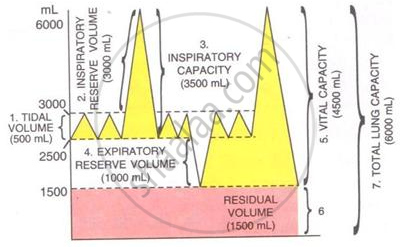
The volume of air in the lungs and the rate at which it is exchanged during inspiration and expiration was measured.
The following diagram shows a group of the lung volumes and capacities.

Study the diagram carefully and explain briefly the following :
Expiratory reserve volume (ERV)
Answer
Expiratory reserve volume (ERV): Air that can be forcibly expelled out after a normal expiration is called expiratory reserve volume. It is also called supplemental air. It is 1000 mL.
View full question & answer
Question 171 Mark
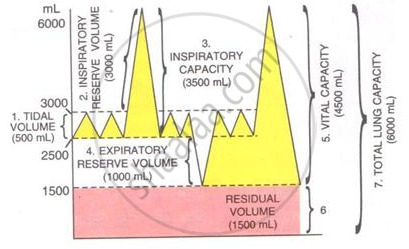
The volume of air in the lungs and the rate at which it is exchanged during inspiration and expiration was measured.
The following diagram shows a group of the lung volumes and capacities.

Study the diagram carefully and explain briefly the following :
Inspiratory reserve volume (IRV)
Answer
Inspiratory reserve volume (IRV):Air that can be drawn in forcibly over and above the tidal airis called inspiratory reserve volume. It is also known as complemental air. It is 3000 mL.
View full question & answer
Question 181 Mark
The volume of air in the lungs and the rate at which it is exchanged during inspiration and expiration was measured.
The following diagram shows a group of lung volumes and capacities.

Study the diagram carefully and explain briefly the following :
Tidal volume (TV)
Answer
Tidal volume (TV):Air breathed in and out, in a normal quiet breathing is called tidal volume. It is 500mL.
View full question & answer
Question 191 Mark
Given below is an overall chemical reaction of a certain process:
$C_6H_{12}O_6$→LacticAcid+2ATP+Heat enengy
Name one tissue in which this reaction occur.
Answer
This reaction may occur in muscular tissues (skeletal muscles).
View full question & answer
Question 201 Mark
Given below is an overall chemical reaction of a certain process:
$C_6H_{12}O_6$​​​​​​​→LacticAcid+2ATP+Heat energy
Is this reaction applicable to animals or to plants or to both animals and plants?
Answer
This reaction is applicable to animals only.
View full question & answer
Question 211 Mark
Given below is an overall chemical reaction of a certain process:
$C_6H_{12}O_6$ →LacticAcid+2ATP+Heat energy
Name the process.
Answer
Anaerobic respiration
View full question & answer
Question 221 Mark
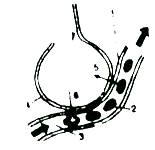
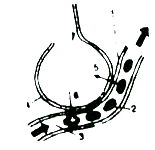
Given alongside is a diagrammatic sketch of a kind of part in human lungs.
What do the arrows 5 and 6 indicate?
Answer
5: $CO _2$ diffuses out; 6: $O _2$ diffuses in
View full question & answer
Question 231 Mark
Given alongside is a diagrammatic sketch of a kind of part in human lungs.
Name the parts numbered 1-4

Answer
1: Thin walls of capillary;
2: RBCs (Red blood corpuscles);
3: Plasma;
4: Thin wall of the alveolus
View full question & answer
Question 241 Mark
What is wrong in the statement "We breathe in oxygen and breathe out carbon dioxide".
Answer
We inhale air which contains more oxygen and less carbon dioxide. We exhale air which contains more carbon dioxide and less of oxygen. Therefore, the statement "We breathe in oxygen and breathe out carbon dioxide" is wrong.
View full question & answer
Question 251 Mark
How would you prove that air you breathe out is warmer?
Answer
During breathing, the air expelled out is always warmer or at body temperature. It can be felt by breathing out the air on our own hand. One can feel the warmth of the air expelled out during breathing.
View full question & answer
Question 261 Mark
Under what conditions would the breathing rate increase?
Answer
The breathing rate increases after a vigorous physical exercise. Also, accumulation of $CO_2$ in the blood increases the rate of breathing.
View full question & answer
Question 271 Mark
State one function of the following:
Pleural fluid
Answer
It provides lubrication for free movement of the expanding and contracting lungs.
View full question & answer
Question 281 Mark
State one function of the following:
Intercostal muscles
Answer
The muscles help the inward and outward movement of ribs enlarging the chest cavity all around.
View full question & answer
Question 291 Mark
State one function of the following:
Diaphragm
Answer
Diaphragm contributes to the enlargement of the chest cavity lengthwise.
View full question & answer
Question 301 Mark
State one function of the following:
Mitochondria
Answer
In mitochondria, pyruvic acid is further broken down step by step in a cyclic manner in the presence of oxygen.
View full question & answer
Question 311 Mark
State one function of the following:
Ciliated epithelium lining the respiratory tract
Answer
It is the protective inner lining of the respiratory passage. It helps in motion, driving any fluid that is on them.
View full question & answer
Question 321 Mark
What are the functions of the following in breathing?
Abdominal muscles
Answer
Abdominal muscles: Abdominal muscles help to increase the size of the thoracic cavity by the movement of diaphragm and therefore, aids in inspiration.
View full question & answer
Question 331 Mark
What are the functions of the following in breathing?
Diaphragm
Answer
Diaphragm: On contraction, the diaphragm falls or flattens from the dome-shaped outline to an almost horizontal plane and thus, contributes to the enlargement of the chest cavity lengthwise.
View full question & answer
Question 341 Mark
What are the functions of the following in breathing?
Ribs
Answer
Ribs: The ribs move inwards and outwards by the muscles stretched between them, thus enlarging the chest cavity all around.
View full question & answer
Question 351 Mark
Starting from the nostrils, trace the path in sequence which the inspired air takes until it reaches the air sacs.
Answer
Path taken by the inspired air:
Nose → Pharynx → Larynx → Trachea → Bronchi
View full question & answer
Question 361 Mark
With regard to the respiratory system and the process of respiration in man, answer the following question :
Give the overall chemical equation to represent the process of respiration in humans.
Answer
The overall chemical equation for the process of respiration in humans:
$\ce{C6H12O6 + 6O2 ->[Enzymes] 6CO2 + 6H2O + 38ATP + 420 kcal}$
View full question & answer
Question 371 Mark
With regard to the respiratory system and the process of respiration in man, answer the following questions:
Name the two muscles that help in breathing.
Answer
(i) Abdominal muscles
(ii)Intercostal muscles
View full question & answer
Question 381 Mark
Give suitable explanation for the following :
Why does a person feel breathlessness at higher altitudes?
Answer
At higher altitudes, the oxygen content of the air is low. So, a person feels breathlessness at higher altitudes.
View full question & answer
Question 391 Mark
Give Suitable Explanation for the Following :
Breathing through the nose is said to be healthier than through the mouth.
Answer
Breathing through the nose is said to be healthier than through the mouth because the hair present in the nostrils prevent large dust particles from entering inside the respiratory system.
View full question & answer
Question 401 Mark
Differentiate between the following pairs on the basis of the aspect given in the brackets.
Tidal volume and Residual volume (Quantity of air)
Answer
Residual volume :- 500 ml
Tidal volume :- 1500 ml
View full question & answer
Question 411 Mark
Differentiate between the following pairs on the basis of the aspect given in the brackets.
Respiration and Breathing (Organs involved)
Answer
Respiration :- lungs, bronchi, alveoli
Breathing :- nasal cavity, trachea, diaphragm
View full question & answer
Question 421 Mark
Differentiate between the following pairs on the basis of the aspect given in the brackets.
Inspired air and Alveolar air ($CO_2$ content)
Answer
Inspired air :-$ 004\%$
Alveolar air :-$ 4.00\%$
View full question & answer
Question 431 Mark
Differentiate between the following pairs on the basis of the aspect given in the brackets.
Photosynthesis and Respiration (Reactants)
Answer
Photosynthesis :- $CO_2$+ sunlight + $H_2O$
Respiration :- Glucose (with or without oxygen)
View full question & answer
Question 441 Mark
Differentiate between the following pairs on the basis of the aspect given in the brackets.
Respiration and Photosynthesis (Gas released)
Answer
Respiration:- $CO_2$
Photosynthesis :- $O_2$
View full question & answer
Question 451 Mark
Differentiate between the following pairs on the basis of the aspect given in the brackets.
Aerobic and Anaerobic respiration (End products of the process)
Answer
Aerobic respiration :- $CO_2, H_2O, ATP$, Heat energy
Anaerobic respiration :- Lactic acid, ATP, Heat energy
View full question & answer
[1 Mark Question Answer] - BIOLOGY STD 9 Questions - Vidyadip