Questions

[2 Mark Question Answer]

🎯

Test yourself on this topic

9 questions · timed · auto-graded

Question 12 Marks
Match the items in Column I with the ones most appropriate in Column $II$. Rewrite the matching pairs.
Column $I$ Column $II$
$(a)$ Alveoli $(i)$ where aerobic respiration takes place
$(b)$ Bronchioles $(ii)$ lined with hair
$(c)$ Nasal Chamber $(iii)$ diffusion of gases
$(d)$ Bronchi $(iv)$ small air tubes
  $(v)$ an inverted $Y$ shaped tube
  $(vi)$ a common passage for food and air
Answer
Column $I$ Column $II$
$(a)$ Alveoli $(iii)$ diffusion of gases
$(b)$ Bronchioles $(iv)$ small air tubes
$(c)$ Nasal Chamber $(ii)$ lined with hair
$(d)$ Bronchi $(v)$ an inverted $Y$ shaped tube
View full question & answer
Question 22 Marks
What is the normal percentage composition of gases in inspired and expired air respectively?
Answer
COMPONENT INSPIRED AIR EXPIRED AIR
$1$. Oxygen $20.96$$\%$ $16.40$$\%$
$2$. Carbon dioxide $0.04$$\%$ $4.00$$\%$
$3$. Nitrogen $79.00$$\%$ $79.60$$\%$
View full question & answer
Question 32 Marks
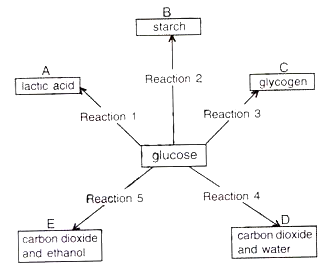
Given below are chemical reactions ($1$ to $5$) involving glucose and five other chemical products $(A-E)$.

Which reactions $(1-5)$ in the above correspond to the following (write the corresponding number of reaction next to them).
$(i)$ Aerobic respiration
$(ii)$ Change taking place in the liver
$(iii)$ Anaerobic respiration in yeast
$(iv)$ Change taking place in a plant
storage organ, e.g., potato
$(v)$ Anaerobic respiration in animals
Answer
$(i)$ Aerobic respiration: $4$
$(ii)$ Change taking place in the liver: $3$
$(iii)$ Anaerobic respiration in yeast: $5$
$(iv)$ Change taking place in a plant storage organ, e.g., potato: $2$
$(v)$ Anaerobic respiration in animals: $1$
View full question & answer
Question 42 Marks
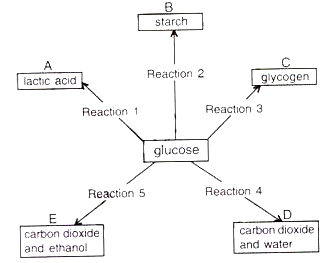
Given below are chemical reactions ($1$ to $5$) involving glucose and five other chemical products $(A-E)$.

Write the reaction number of the following:
$(i)$ Anaerobic respiration in plants __________
$(ii)$ End products in aerobic respiration ____________
$(iii)$ Reaction occurring in liver _________
$(iv)$ Anaerobic respiration in animals ________
$(v)$ Storage in the liver _________
Answer
$(i)$ Anaerobic respiration in plants: $5$
$(ii)$ End products in aerobic respiration: $4$
$(iii)$ Reaction occurring in liver: $2$
$(iv)$ Anaerobic respiration in animals: $1$
$(v)$ Storage in the liver: $3$
View full question & answer
Question 52 Marks
How is the respiratory passage kept free of dust particles?
Answer
The nasal cavity is lined by ciliated epithelium and mucous glands. The mucous glands secrete mucous. The ciliated epithelium is present on the entire lining of larynx, trachea, bronchi and bronchioles. The constant motion of cilia and mucous trap dust, micro-organisms, pollen and other minute particles present in the air. In this way, the respiratory passage is kept free of dust particles.
View full question & answer
Question 62 Marks
With regard to the respiratory system and the process of respiration in man, answer the following question:
What is meant by :
  1. Residual air and
  2. Dead air space
Answer
$1$. Residual air: Some air is always left in the lungs even after forcibly breathing out. This is the leftover or residual air. This volume is $1500$ mL.
$2$. Dead air space: Some tidal air is left in the respiratory passages such as the trachea and bronchi, where no diffusion of gases can occur. This volume is called dead air space. It is $150$ mL.
View full question & answer
Question 72 Marks
With regard to the respiratory system and the process of respiration in man, answer the following question:
Briefly describe how the above mentioned muscles help in the inspiration of air.
Answer
$(i)$The ribs are moved inwards and outwards by the intercostal muscles stretched between them and thereby, enlarges the chest cavity.
$(ii)$ The diaphragm flattens and presses the organs inside the abdomen. When the abdominal muscles relax, the abdominal wall moves outwards.
View full question & answer
Question 82 Marks
Give Suitable Explanation for the Following :
Why do you shiver and why do your teeth chatter when it is very cold in winter?
Answer
In order to maintain the body temperature constant in very cold conditions in winter, heat production is increased by enhanced metabolic rate and increased muscular activity. Shivering and chattering of teeth involves a lot of muscular activity. That is why we shiver and our teeth chatter in winter in order to increase heat production in the body.
View full question & answer
Question 92 Marks
Give suitable explanation for the following :
Why does gaseous exchange continue in the lungs even during expiration?
Answer
Gaseous exchange continues in the lungs even during expiration because expiration is the result of reverse movements of the ribs and diaphragm. As a consequence of the movements of the ribs and the diaphragm, the thoracic cavity is diminished and the lungs are compressed, forcing the air out into the atmosphere.
View full question & answer