Questions

[3 marks Question Answer]

🎯

Test yourself on this topic

13 questions · timed · auto-graded

Question 13 Marks
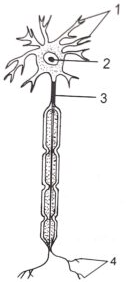
Observe the figure given below and answer the following:
Image
(i) Name the cell shown in the figure.
(ii) Label the parts numbered 1-4.
(iii) Give the function of the structure seen in the figure.
Answer
(i) neuron
(ii) 1. dendrite, 2nucleus, 3 axon,. 4.nerve ending
(iii) carry impulse
View full question & answer
Question 23 Marks
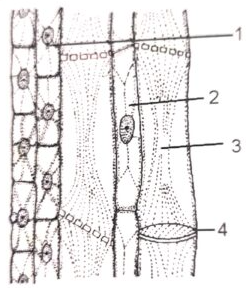
Observe the given figure and answer the following:
Image
(i) What does the figure show?
(ii) Label the parts numbered 1-4.
(iii) Give the function of part 3.
Answer
(i) phloem tissue
(ii) 1.plasmodesma, 2. companian, 3. cell sieve tube 4.sieve plate
(iii) conduct food
View full question & answer
Question 43 Marks
If you are provided with three slides, each containing one type of muscle fibre, how will you identify them?
Answer
SMOOTH MUSCLES : These muscle fibers are smooth in nature because they do not have any striations. They do contain any dark and light bands occurring repeatedly.
SKELETAL MUSCLE : These muscles have stripes in it. Unlike smooth muscles, in this skeletal muscle there occurs alternating dark and light bands occurring repeatedly.
CARDIAC MUSCLE : These muscle fibers are branched. Cardiac muscle fiber has a very distinct characteristics from the two other muscle fibers that is they have intercalated disc present in them.
So, by observing all these character on the slides through microscope, we can distinguish which slide contains what type of muscle fibers.
View full question & answer
Question 53 Marks
Mention the characteristic features of parenchyma, collenchyma and sclerenchyma
Answer
ParenchymaCollenchymaSclerenchyma
Comprises a thin cell wall and made up of cellulose.It comprises an uneven cell wall and is made up of pectin and hemicellulose.It comprises a hard and thick cell wall and is made up of lignin.
View full question & answer
Question 63 Marks
permanent tissues.
Answer
Characteristics of Permanent tissue:
• Cells of these tissues have no power of division.
• Cells are well developed and properly shaped.
• Cell wall is comparatively thick.
• Nucleus of the cells are bigger and cytoplasm is dense.
• Usually there are vacuoles in the cell.
• There may have intercellular spaces in between cells
The permanent tissue in plants mainly helps in providing support, protection as well as in photosynthesis and conduction of water, minerals, and nutrients. Permanent tissue cells may be living or dead
View full question & answer
Question 73 Marks
meristematic tissues
Answer
The characteristics of meristematic tissue are as follows:
• Cells are small and usually cubical.
• Cell walls are thin and Nuclei are large.
• Vacuoles are almost absent.
• Cells tightly packed with almost intercellular spaces.
• The new cell produced is transformed into mature permanent tissues.
Its main function is to begin growth of new cells in young seedlings at the tips of roots and shoots
View full question & answer
Question 83 Marks
Difference between
Striated and Unstriated muscles
Answer
Striated muscles are the cylindrical, non-branched, multinucleated muscles with alternative light and dark bands while non-striated muscles are long, non-branched, uninucleated muscles without alternative light and dark bands
View full question & answer
Question 93 Marks
Difference between
Bone and Cartilage
Answer
Bones are the hard, inelastic and a tough organ that forms part of the vertebral skeleton. Cartilage is a soft, elastic and flexible connective tissue that protects the bone from rubbing against each other
View full question & answer
Question 103 Marks
Difference between
Blood and Lymph
Answer
Lymph consists of only white blood cells, proteins, salts, glucose, fats, and water whereas blood consists of RBC's, WBC's and platelets and other substances such as glucose, amino acids etc.
View full question & answer
Question 113 Marks
Difference between
Parenchyma and Sclerenchyma
Answer
ParenchymaSclerenchyma
Cells are usually loosely packed with large intercellular spaces.There are no intercellular spaces between the cells.
Stores nutrients and water in stems and rootsProvides strength to the parts of the plant.
View full question & answer
Question 123 Marks
Difference between
Simple and Complex tissues
Answer
Simple tissueComplex tissue
1. Simple tissues are made up of single type of cells.Complex tissues are made up of different type of cells.
2. Simple tissue consists of parenchyma, collenchyma and sclernchyma.Complex tissue consists of xylem and phloem.
3. It occurs in all parts of plant.It occurs only in vascular region.
View full question & answer
Question 133 Marks
Which kind of muscle is involved in the following process?
Movement of the arm
Contraction of blood vessels
Movement of food along the alimentary canal
Answer
Voluntary muscle is striated muscle
smooth muscle
Peristalsis Is the Contraction of Muscle Tissue That Helps Move and Break Down Foodstuffs
View full question & answer
[3 marks Question Answer] - BIOLOGY STD 9 Questions - Vidyadip