Questions

[3 marks Question Answer]

🎯

Test yourself on this topic

11 questions · timed · auto-graded

Question 13 Marks
Give the structure and function of the following:
Phloem
Answer
Phloem

Structure - Phloem is a complex plant tissue found in all parts of the plant like roots, stems, and leaves. It is made up of four components which are:

(a) Sieve tubes
(b) Companion cells
(c) Phloem parenchyma
(d) Phloem fibres

Function - Phloem carries out the conduction of organic food prepared by the plant.
View full question & answer
Question 23 Marks
Give the structure and function of the following:
Crystal
Answer
Crystal

Structure - Three common types of crystals are found in plants: druses (spherical crystal aggregates), raphides (long pointed needles found in bundles), and prisms. Despite the variety of crystal structures found throughout the plant cells, all crystals contain calcium oxalate.

Function - Crystals either protect plants from animals or they may provide extra support.

View full question & answer
Question 33 Marks
Give the structure and function of the following:
Bone
Answer
Bone
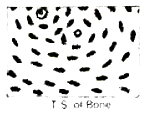
Structure - It is a hard, inflexible, and porous skeletal tissue well supplied with blood vessels and nerves. The bone matrix has a rigid mass of inorganic salts of calcium and magnesium. The bone cells called osteocytes are arranged in the form of thin circular layers around a central canal. Osteocytes are present in small spaces connected to one another by a system of canals.
Function - Bone gives shape, support, and protection to the body parts.
View full question & answer
Question 43 Marks
Give the structure and function of the following:
Collenchyma
Answer
CollenchymaStructure - It is a mechanical tissue cons1st1ng of living cells with usually no intercellular spaces. The cell wall is unevenly thickened and the walls are rich in hemicelluloses.

Function - Collenchyma provides mechanical support and elasticity to the plant body. Collenchyma may carry out photosynthesis if chloroplast is present.
View full question & answer
Question 53 Marks
Give the structure and function of the following:
Sclerenchyma
Answer
SclerenchymaStructure -
Cells of sclerenchyma are dead. These cells are elongated, narrow, pointed at both ends, thick-walled, and lignified. Their cell walls are thick due to the secondary deposition of lignin.

Function - Sclerenchyma gives strength, rigidity, and flexibility to the plant body, thereby enabling it to withstand various strains.
View full question & answer
Question 63 Marks
Differentiate between: Blood and Lymph
Answer
Blood Lymph
It is red in colour.It is a colourless fluid.
RBCs and WBCs are present.RBCs are absent, whereas WBCs are found in abundance.
Blood transports respiratory gases, food, hormones, etc. throughout the body.Lymph protects the body against infection.
View full question & answer
Question 73 Marks
Differentiate between: Nervous tissue and Nervous system
Answer
Nervous tissueNervous system
Several neurons group together to form nervous tissue.The nervous system is formed by the coordination of organs like the brain and spinal cord as well as nerves.
Nerve tissue transmits signals or impulses within the body.The nervous system makes the organism respond suitably to its environment.
View full question & answer
Question 83 Marks
Differentiate between: Collenchyma and Sclerenchyma
Answer
Collenchyma Sclerenchyma
Collenchyma cells are living.Sclerenchyma cells are dead.
Its cell walls show uneven thickening.Cell walls show uniform thickening.
Collenchyma provides mechanical support and elasticity to the plant body,Sclerenchyma gives strength and rigidity to the plant body.
Collenchyma may carry out photosynthesis if chloroplast IS Present.Sclerenchyma never carries out the function of photosynthesis.
View full question & answer
Question 103 Marks
Name the three kinds of muscles found in the human body. In each case, name one region in the body where they are found.
Answer

(1) Striated muscles: Provide the force for locomotion and all voluntary movements of the body. These muscles are found in the limbs.

(2) Unstriated muscles: Provide movements for the passage of food in the intestines. These muscles are found in iris of the eye, the lining of blood vessels, urinary bladder, etc.

(3) Cardiac muscles: Provide rhythmic contraction and relaxation movements. These muscles are found only in the heart.

View full question & answer
Question 113 Marks
Match the words of column A with the appropriate words of column B:
Column A Column B
(a) Adipose tissue (i) Cyton
(b) Neuron (ii) Unstriated muscles
(c) The dark and light band (iii) Columnar epithelium
(d) Dermis of skin (iv) Striated muscles
(e) Sieve pits (v) Fat cells
(f) Br ick like (vi) Phloem
Answer
Column A Column B
(a) Adipose tissue (v) Fat cells
(b) Neuron (i) Cyton
(c) The dark and light band (iv) Striated muscles
(d) Dermis of skin (ii) Unstriated muscles
(e) Sieve pits (vi) Phloem
(f) Br ick like (iii) Columnar epithelium
View full question & answer
[3 marks Question Answer] - BIOLOGY STD 9 Questions - Vidyadip