Questions

[5 Mark Question Answer]

🎯

Test yourself on this topic

8 questions · timed · auto-graded

Question 15 Marks
How many types of epithelial tissues have you studied? Write their functions.
Answer
There are two main types of epithelial tissues. These are:
(a) Simple and
(b) Compound

Simple epithelial tissue is further divided into six sub-groups which are:
(i) Columnar epithelium
(ii) Ciliated epithelium
(iii) Cuboidal epithelium
(iv) Squamous epithelium
(v) Glandular epithelium
(vi) Sensory epithelium

Compound epithelial tissue is of two types:
(i) Stratified epithelium
(ii) Transitional epithelium

Functions of epithelial tissue are:
(i) It forms a protective layer over the body and protects the underlying cells from drying up, injury, germs and harmful chemicals.
(ii) It absorbs water and other nutrients inside the body.
(iii) Some of these cells secrete ear wax, mucus, milk and digestive juices.
View full question & answer
Question 25 Marks
Differentiate between: Bone and Cartilage
Answer
Bone Cartilage
It is a hard and rigid tissue.It is a flexible tissue.
It is porous.It is non-porous.
It has a good supply of blood vessels and nerves. It has no blood vessels or nerves.
It is the main skeletal tissue of the body and is present throughout the It is found only in certain parts of the body like nose, ear, bronchial tubes, rings of the trachea, between vertebrae, and at the end of long bones.
It gives shape, support, and protection to the body.It provides flexibility and support to the body parts.
View full question & answer
Question 35 Marks
Explain the type and function of xylem tissues.
Answer
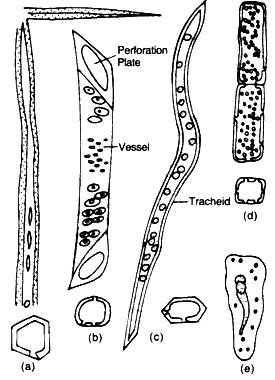
Xylem is a complex plant tissue composed of several types of cells which are
  1. Tracheids - These cells are long and tubular with thick, rigid, and lignified walls and pointed ends. Tracheids are present in all vascular plants. These conduct water and minerals from the root to stem.
  2. Vessels - These are long cylindrical cells with lignified walls, placed one above the other to form a pipe-like structure. They participate in the conduction of water and minerals.
  3. Xylem fibres - These are sclerenchymatous fibres found attached to the xylem. These provide strength to the plant organs.
  4. Xylem parenchyma - This is the living component of xylem. Xylem parenchyma is composed of simple parenchyma cells found in the xylem. These are connected with tracheids or vessels through simple or bordered pits. Their function is to store food material.

(a) - (e) Elements of xylem:

(a) Tracheids
(b) Vessels
(c) Fibres

(d) - (e) Parenchyma
View full question & answer
Question 45 Marks
How does cartilage differ from the bone?
Answer
Cartilage differs from the Bone in the following ways:
CartilageBone
It is a flexible tissue.It is a hard and rigid tissue.
It is non-porous.It is porous.
It has no blood vessels or nerves.It has a good supply of blood vessels and nerves.
It is found only in certain parts of the body like nose, ear, bronchial tubes, rings of the trachea, between vertebrae, and at the end of long bones.It is the main skeletal tissue of the body and is present throughout the body.
It provides flexibility and support to the body parts.It gives shape, support, and protection to the body.
View full question & answer
Question 55 Marks
Give structure, types and functions in brief of the following: Nervous tissue
Answer
Connective tissue
Structure - The cells of nervous tissue is called neuron. It is capable of transmitting signals or impulses within the body. Each neuron consists of a cell body or cyton with a nucleus and elongated hair like extensions called axons and dendrites. Axons bundle together to form the nerve
Types -
The following are the different types of connective tissue:
(a) neuron: The main cell type in nervous tissue.
(b) neuroglia: Supporting cells in nervous tissue.

Functions - Nervous tissue is found in brain, spinal cord and nerves. It carries out transmission of signals or impulses within the body.

View full question & answer
Question 65 Marks
Give structure, types and functions in brief of the following: Connective tissue
Answer
Connective tissue
Structure - This tissue has homogenous matrix which forms its main bulk. The connective tissue cells are living, separated from each other and are few in number. The matrix varies in size and shape and may be solid, gel like or liquid. The nature of the matrix decides the function of the connective tissue.
Types -
The following are the different types of connective tissue:
(a) Loose areolar connective tissue
(b) Fibrous connective tissue
(c) Cartilage connective tissue
(d) Bone
(e) Fluid connective tissue
Functions -
(i) Connective tissue connects and binds various organs of our body.
(ii) It gives support to the body and forms the skeleton to provide a definite shape.
(iii) It transports nutrients, hormones, oxygen and waste material within the body.
View full question & answer
Question 75 Marks
Give structure, types and functions in brief of the following: Muscular tissue
Answer
Muscular tissue:
Structure - Muscle tissue consists of cells which are elongated and large-sized, hence they are also called muscle fibres. These fibres are of various sizes. Contractile proteins are present in the muscle cells which bring about their contraction and relaxation. The cytoplasm of muscle fibre is called sarcoplasm and is bounded by a membrane called sarcolemma.
Types: Muscle tissue is of three types:
(i) Striated muscle tissue
(ii) Unstriated muscle tissue
(iii) Cardiac muscle tissue
Functions -
(i) Muscles bring about all voluntary movements done by a person.
(ii) All the involuntary movements needed to keep the body alive are possible due to muscles.
View full question & answer
Question 85 Marks
Give structure, types and functions in brief of the following: Epithelial tissue
Answer
Epithelial tissue:
Structure: The cells of epithelium are compactly placed, tightly held together and form a continuous sheet. Epithelial cells are supported below on a basement membrane. These cells may be of different shapes and sizes.
Types:
There are two main types of epithelial tissues which are:
(a) Simple and
(b) Compound
Functions:
(i) It forms a protective layer over the body and protects the underlying cells from drying up, injury, germs and harmful chemicals.
(ii) It absorbs water and other nutrients inside the body.
(iii) Some of these cells secrete ear wax, mucus, milk and digestive juices.
View full question & answer
[5 Mark Question Answer] - BIOLOGY STD 9 Questions - Vidyadip