Questions

[2 Mark Question Answer]

🎯

Test yourself on this topic

32 questions · timed · auto-graded

Question 12 Marks
The number of protons and neutrons in species P to T are given in the table below:
SpeciesPQRST
Protons61817917
Neutrons622181018
From the above table, find the species which represent noble gas. Give one reason for your choice.
Answer
to get inert gases first write configuration with help of atomic number = number of proton
P 6= 2,4
Q18=2,8,8
R17= 2,8,7
S9=2,7
Hence Q is only inert due to octet rules
View full question & answer
Question 22 Marks
Amongst the chlorine atom and chlorine molecule, which has more energy and why?
Answer
Chlorine atom has more energy because it is unstable ! More unstable a molecuke or an atom is, the more energy it has . And so Cl2 has less energy than Cl as Cl2 is highly stable and can be found in a free state in the nature!
View full question & answer
Question 32 Marks
Name an inert gas having
(a) a duplet structure
(b) an octet structure.
Answer
(a) a duplet structure -Helium is the only noble gas which has only two electrons in its valence shell. Such an electronic configuration of a valence shell is called duplet structure
(b) an octet structure:- all noble gases, has a full valence shell. Noble gases have eight electrons in their outermost shell, except in the case of helium, which has two
View full question & answer
Question 42 Marks
(a)What is the other name of a noble gas?
(b) Why are the atoms of noble gases unreactive?
(c) Why are the atoms of elements other than noble gases reactive?
Answer
(a) inert gases
(b) The atoms of noble gases already have complete outer shells, so they have no tendency to lose, gain, or share electrons. This is why the noble gases are inert and do not take part in chemical reactions
(c) Their outermost shell is incomplete. They can lose, gain or share electrons. Thus they are chemically reactive.
View full question & answer
Question 52 Marks
$1 \mathrm{H}_1, \mathbf{2 \mathrm { H } _ { 1 }}$ and $3 \mathrm{H}_1$ are the isotopes of hydrogen.
(a) Why do these isotopes have similar chemical properties?
(b) Why are these isotopes electrically neutral?
Answer
(a) They have similar chemical properties because isotopes of an element have the same number of electrons as an atom of that element. The electron arrangement is the same owing to same chemical properties
(b) In every isotope the charged subatomic particles which are protons and electrons are in equal number. Thus, an isotope is electrically neutral. Note: In every isotope there will be an equal number of electrons and protons
View full question & answer
Question 72 Marks
An atom A has the mass number 40 and atomic number 18. An atom B has the mass number 40 and atomic number 20.
(a) What is the electronic configuration of A?
(b) What its the electronic configuration of B?
(c) Are A and B isotopes of the same clement?
(d) Which amongst A and B is a metal?
Answer
(a) electronic configuration of A is = 2,8,8
(b) electronic configuration of B is= 2,8,8,2
(c) No Isotope due to deferent atomic number
(d) B is metal
View full question & answer
Question 82 Marks
Why do all elements have fractional atomic mass?
Answer
The atomic masses of most elements are fractional because they exist as a mixture of isotopes of different masses. Since the atomic mass of isotopes are different, so average atomic mass is calculated for a single element.
View full question & answer
Question 92 Marks
Why do the isotopes of same elements have similar chemical properties?
Answer
They have similar chemical properties because isotopes of an element have the same number of electrons as an atom of that element. The electron arrangement is the same owing to same chemical properties. However they have different numbers of neutrons, which affects the mass number
View full question & answer
Question 102 Marks
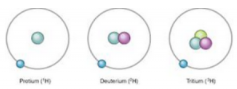
Name three isotopes of hydrogen, give their symbols, number of protons and number of neutrons.
Answer
They each have one single proton $(Z=1)$, but differ in the number of their neutrons. Hydrogen has no neutron, deuterium has one, and tritium has two neutrons. The isotopes of hydrogen have, respectively, mass numbers of one, two, and three. Their nuclear symbols are therefore ${ }^1 \mathrm{H},{ }^2 \mathrm{H}$, and ${ }^3 \mathrm{H}$
View full question & answer
Question 112 Marks
What is the main cause of existence of isotopes?
Answer
The reason for the existence of isotopes is a change in (c) neutron number. A given element can have different isotopes owing to the difference in the number of neutrons but the number of protons and electrons remains the same.
View full question & answer
Question 122 Marks
What do you understand by the term isotope?
Answer
An isotope is one of two or more species of atoms of a chemical element with the same atomic number and position in the periodic table and nearly identical chemical behavior but with different atomic masses and physical properties. Every chemical element has one or more isotopes.
View full question & answer
Question 132 Marks
Atomic numbers of elements A, B, C and D are 3, 9, 11 and 17 respectively. Identify two pairs amongst the elements which have similar chemical properties. Which pair is likely to be metallic in character?
Answer
we know that chemical properties depend upon number of valence electron hence first find out valence electron
A3=2,1,
B9=2,7
C11=2,8,1
D17 = 2,8,7
Therefore Element A, C and B, D are two pair
A,C pair is metallic
View full question & answer
Question 142 Marks
Three elements P, Q and R have atomic numbers 4, 12 and 20 respectively.
(a) State the number of valence electrons in each of the elements
(b) Are these elements going to have similar or different chemical properties?
(c) Are these elements metals or non-metals?
Answer
(a) number of valence electrons in P, Q and R is 2, 2, 2 respectively
(b) similar chemical properties?
(c) these elements metals
View full question & answer
Question 152 Marks
An element is represented by symbol X?
(a) What is the mass number and atomic number of element X?
(b) Name its valence shell and number of electrons in the valence shell.
(c) Is the clement a metal or a non-metal?
Answer
(a) Self
(b) Self
(c ) Self
View full question & answer
Question 162 Marks
An element is represented as 40X20. . Name the shell which has valence electrons and the number of valence electrons in it.
Answer
Atomic number =20
Electronic configuration = 2, 8, 8, 2
Name the shell which has valence electrons= N shell
and the number of valence electrons in it.= 2
View full question & answer
Question 172 Marks
(a) What do you understand by the term valence electrons?
(b) why are valence electrons named as such, rather than only electrons?
Answer
(a) The electrons present in the valence shell are called valence electrons
(b) Because these outer shell electrons are responsible in chemical bonding
View full question & answer
Question 222 Marks
Draw the atomic structure of the following elements geometrically, clearly showing the (a) number of protons (b) number of neutrons and (c) number of electrons in various shells around nucleus :

(a) ${ }^2 \mathrm{H}_1$
(b) ${ }^7 \mathrm{Li}_3$
(c) ${ }^{27} \mathrm{Al}_{13}$
(d) ${ }^{40} \mathrm{Ca}_{20}$
Answer

Image
(a) Self
(b) Self
(c) Self
(d) Self
View full question & answer
Question 232 Marks
What do you understand by the term electronic configuration? State Bohr-Bury’s scheme of electronic configuration.
Answer
Electronic configuration is the arrangement of electrons around the nucleus of a particular atom or molecule. An atom is made of tiny particles called protons, neutrons, and electrons. A neutral atom has the same number of protons and elections
The rule of the Bohr-Bury Scheme can be stated as follows: -The electrons in the atom are arranged around the nucleus in different shells and the electrons first occupy that shell which is closest to the nucleus as it has the lowest energy. -The second shell is called the L-shell which can take upto eight electrons.
View full question & answer
Question 242 Marks
What are neutrons? What experimental evidence led us to assume the existence of neutrons
Answer
A neutron is a subatomic particle found in the nucleus of every atom except that of simple hydrogen. The particle derives its name from the fact that it has no electrical charge; it is neutral. Neutrons are extremely dense.
View full question & answer
Question 252 Marks
What are shells around the nucleus? K,L M, N, O, P are the shells around the nucleus of an atom which shell is (a) nearest to nucleus and (b) farthest from nucleus?
Answer
The electrons in an atom are arranged in shells that surround the nucleus, with each successive shell being farther from the nucleus.
(a) nearest to nucleus called bound shell
(b) farthest from nucleus called valence shell
View full question & answer
Question 262 Marks
State Bohr’s model of the structure of atom.
Answer
According to Bohr Atomic model, a small positively charged nucleus is surrounded by revolving negatively charged electrons in fixed orbits. He concluded that electron will have more energy if it is located away from the nucleus whereas the electrons will have less energy if it located near the nucleus
View full question & answer
Question 272 Marks
State the main drawback n Rutherford’s structure of atom.
Answer
Rutherford’s atomic model failed to explain the stability of electrons in a circular path. He stated that electrons revolve around the nucleus in a circular path, but particles in motion would undergo acceleration and cause energy radiation.
View full question & answer
Question 282 Marks
(a) Who discovered nucleus within an atom?
(b) Briefly describe the experiment which led to the discovery of nucleus.
Answer
(a) Rutherford and the Discovery of the Atomic Nucleus. In 1909
(b) Rutherford’s gold foil experiment showed that the atom is mostly empty space with a tiny, dense, positively-charged nucleus. Based on these results, Rutherford proposed the nuclear model of the atom
View full question & answer
Question 292 Marks
Briefly describe Thomson’s atomic model. Why was this model not accepted?
Answer
an atom is made up of a positively charged sphere into which negatively charged electrons are implanted. Because electrons and protons have the same magnitude, an atom as a whole is electrically neutral
View full question & answer
Question 302 Marks
State three properties of positive rays.
Answer
three properties of positive rays

• (i) They travel in straight lines and cast shadows of objects placed in their path. …
• (ii) They are deflected by electric and magnetic fields but the deflections are small as compared to that of cathode rays.
• (iii) They are the streams of positive ions of the gas enclosed in the discharge tube.
View full question & answer
Question 312 Marks
What is a proton? State the charge on a proton in coulombs and mass in grams.
Answer
Proton is the positively charged particle present in the nucleus of the atom. Magnitude of charge: Charge of proton is 1.6022 $\times 10^{-19}$ coulomb. Mass of proton: Mass of proton is 1.0072766 a.m.u. or $1.6726 \times 10^{-27} \mathrm{~kg}$.
View full question & answer
[2 Mark Question Answer] - CHEMISTRY STD 9 Questions - Vidyadip