Questions

[2 Mark Question Answer]

🎯

Test yourself on this topic

41 questions · timed · auto-graded

Question 12 Marks
Potassium chloride is an electrovalent compound, while hydrogen chloride is a covalent compound, But, both conduct electricity in their aqueous solutions. Explain.
Answer
Potassium chloride is an electrovalent compound and conducts electricity in the molten or aqueous state because the electrostatic forces of attraction weaken in the fused state or in aqueous solution.
Polar covalent compounds like hydrogen chloride ionise in their solutions and can act as an electrolyte. So, both can conduct electricity in their aqueous solutions.
View full question & answer
Question 22 Marks
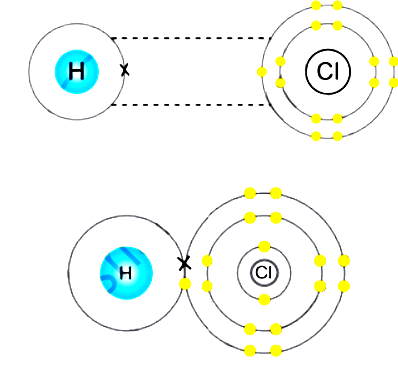
An element A has 1 electron in its first shell. It combines with element B having 7 electrons in its third shell. What type of bond is formed?
Answer
Element A with 1 electron in its first shell is hydrogen, and element B with 7 electrons in its third shell is chlorine.
So, a single covalent bond is formed between hydrogen and chlorine by sharing one pair of electrons.
View full question & answer
Question 32 Marks
Covalent bonds can be single, double or triple covalent bonds. How many electrons are shared in each? Give an example of each type.
Answer
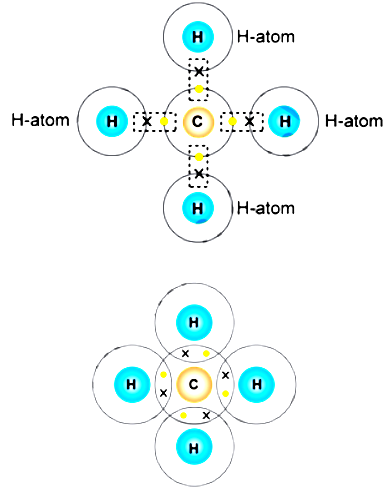
A single covalent bond is formed by sharing one pair of electrons between atoms, each atom contributes one electron.
A double bond is formed by the sharing of two pairs of electrons between two atoms.
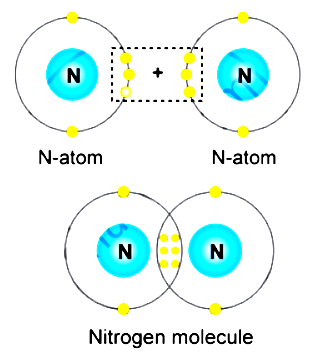
A triple bond is formed by the sharing of three pairs of electrons between two atoms.
View full question & answer
Question 42 Marks
Name the charged particles which attract one another to form electrovalent compound?
Answer
The charged particles which attract one another to form electrovalent compounds are called ions. Those having positive charge are called cations a those having negative charge are called anions.
View full question & answer
Question 52 Marks
Explain the following:
Carbon-12 and carbon-14 both show similar chemical properties.
Answer
Carbon-12 and carbon-14 are isotopes of carbon. They have the same atomic number (6) and hence the same electronic configuration. Chemical properties are determined by the electronic configuration of an atom. So, carbon-12 and carbon-14 show similar chemical properties.
View full question & answer
Question 62 Marks
Explain the following:
An element has atoms with different mass numbers.
Answer
Mass of an atom is contributed by mass of protons and mass of neutrons present inside the nucleus of an atom. Atoms of the same element contain the same number of protons but may differ in their number of neutrons. Therefore, an element has atoms with different mass numbers.
View full question & answer
Question 72 Marks
Explain the following:
Atoms combine by transfer and sharing of an electron(s).
Answer
Atoms combine because they have incomplete valence shells and tend to attain a stable electronic configuration. So, to attain a stable electronic configuration, atoms of elements gain or share their electrons with other atoms.
View full question & answer
Question 82 Marks
Explain the following:
Mass of an atom is concentrated inside the nucleus of the atom.
Answer
Mass of an atom is contributed by mass of protons and mass of neutrons present inside the nucleus of an atom. Electrons present outside the nucleus are of negligible mass. Therefore, the mass of an atom is concentrated inside the nucleus of an atom.
View full question & answer
Question 92 Marks
Element M forms a chloride with the formula $MCl _2$ which is solid with a high melting point. What type of bond is in $MCl _2$. Write the formula of the compound when M combines with sulphur, oxygen, and nitrogen.
Answer
The bond formed between metal and nonmetal is an ionic bond.
The bond formed between metal M and chlorine is an ionic bond.
When metal M combines with sulphur - MgS
When metal M combines with oxygen - MgO
When metal M combines with nitrogen - $Mg _3 N_2$.
View full question & answer
Question 132 Marks
Give the orbital diagram of the following:
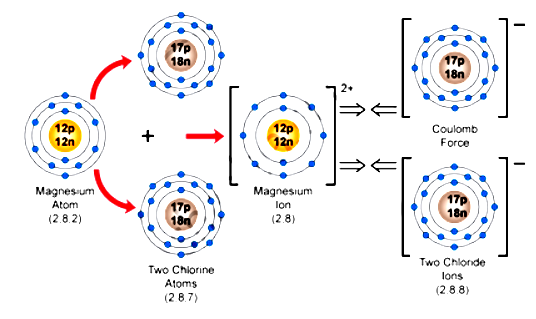
Magnesium chloride
Answer
Orbital Diagram:
Magnesium chloride
View full question & answer
Question 162 Marks
What type of compounds are usually formed between metals and non-metals and why?
Answer
Electrovalent compounds are usually formed between metals and non-metals.
Atoms of metallic elements that have 1, 2 or 3 valence electrons can lose an electron(s) to atoms of non-metallic elements that have 5, 6 or 7 valence electrons and thereby form an electrovalent bond.
View full question & answer
Question 172 Marks
Mention the basic tendency of an atom which makes it combine with other atoms
Answer
Besides chaos, everything in this world wants stability. The same is the case with atoms. For atoms, stability means having the electron arrangement of inert gas, i.e. octet in the outermost shell. Helium has two electrons (duplet), while all other inert gases, i.e. neon, argon, krypton, xenon, and radon have eight electrons (octet) in the outermost shell.
View full question & answer
Question 182 Marks
Write the formula of its (X)
sulphate
nitrate
phosphate
carbonate
hydroxide.
Answer
The formulae are
$X(SO_4)_3$
$X(NO_3)_3$
$XPO_4$
$X_2(CO_3)_3$
$X(OH)_3$
View full question & answer
Question 192 Marks
Elements are classified as metals, non-metal, metalloids, and inert gases. Which of them form an electrovalent bond?
Answer
Metals have a tendency to lose their valence electrons (1, 2 or 3). So, they combine with non-metals which have 7, 6 or 5 electrons in their valence shell to form an electrovalent bond.
View full question & answer
Question 202 Marks
Potassium (at No.19) and chlorine (at No.17) react to form a compound. Explain the formation of the compound on the basis of:
Reducing agent
Answer
$2K + Cl_2 \rightarrow 2KCl$​​​​​​​
Reducing agent
A reducing agent reduces other substances either by providing electrons or by providing hydrogen or an electropositive ion, or by removing oxygen or an electronegative ion.
$K \rightarrow K^++ e^-​​​​​​​$​​​​​​​
View full question & answer
Question 212 Marks
Potassium (at No.$19$) and chlorine (at No.$17$) react to form a compound. Explain the formation of the compound on the basis of:
Oxidizing agent
Answer
$2K + Cl_2 \rightarrow 2KCl$​​​​​​​
Oxidizing agent
An oxidizing agent oxidizes other substances either by accepting electrons or by providing oxygen or an electronegative ion, or by removing hydrogen or an electropositive ion. $Cl_2 + 2e^-\rightarrow 2Cl^-​​​​​​​$​​​​​​​
View full question & answer
Question 222 Marks
Potassium (at No.$19$) and chlorine (at No.$17$) react to form a compound. Explain the formation of the compound on the basis of:
Reduction
Answer
$2K + Cl_2 \rightarrow 2KCl$​​​​​​​
Reduction: In the electronic concept, a reduction is a process in which an atom or ion accepts electron(s).
$Cl_2 + 2e^-\rightarrow 2Cl^-​​​​​​​$​​​​​​​
View full question & answer
Question 232 Marks
Potassium (at No.$19$) and chlorine (at No.$17$) react to form a compound. Explain the formation of the compound on the basis of:
Oxidation
Answer
$2K + Cl_2 \rightarrow 2KCl$
Oxidation: In the electronic concept, oxidation is a process in which an atom or ion loses an electron(s).
$K \rightarrow K^++ e^-​​​​​​​$​​​​​​​
View full question & answer
Question 242 Marks
Explain oxidation and reduction in terms of loss or gain of electrons.
Answer
Oxidation: In the electronic concept, oxidation is a process in which an atom or ion loses an electron(s).
$Zn \rightarrow Zn^{2+}+ 2e^-$​​​​​​​
Reduction: In the electronic concept, a reduction is a process in which an atom or ion accepts electron(s).
$Cu^{2+} + 2e^- \rightarrow Cu$
View full question & answer
Question 252 Marks
What do you understand by redox reactions?
Answer
Transfer of electron(s) is involved in the formation of an electrovalent bond. The electropositive atom undergoes oxidation, while the electronegative atom undergoes reduction. This is known as a redox reaction.
View full question & answer
Question 262 Marks
The electronic configuration of fluoride ion is the same as that of the neon atom. What is the difference between the two?
Answer
Fluoride ion is a negatively charged ion with 9 protons and 10 electrons.
Neon atom is electrically neutral with 10 protons and 10 electrons.
View full question & answer
Question 272 Marks
Element $X$ has electronic configurations $2, 8, 18, 8, 1$. Without identifying $X,$
  1. Predict the sign and charge on a simple ion of $X.$
  2. Write if $X$ will be an oxidizing agent or a reducing agent. Why?
Answer
a. $X^+$
Reason - Since the element X has 1 electron in its valence shell. So, it will lose an electron and gain noble gas configuration. Therefore it forms a cation ($X^+​​​​​​​$​​​​​​​​​​​​​​). The sign is positive and the charge is 1 proton.
b. X will be a strong reducing agent as it has the tendency to donate its valence electron.
View full question & answer
Question 282 Marks
Elements X, Y and Z have atomic numbers 6,9 and 12 respectively. Which one:
Forms an onion
Forms a cation
Has four electrons in its valence shell?
View full question & answer
Question 292 Marks
Explain
Duplet rule for the formation of hydrogen
Answer
Elements tend to combine with one another to attain the stable electronic configuration of the nearest inert gas.
Hydrogen
A hydrogen atom has one electron in the valence shell which shares with another hydrogen atom having one electron to complete its duplet state, i.e. two electrons in the valence shell and resulting in the formation of hydrogen.
View full question & answer
Question 302 Marks
Give reason
${ }_{17}^{35} \mathrm{CI}$ and ${ }_{17}^{37} \mathrm{CI}$ do not differ in their chemical reactions.
Answer
${ }_{17}^{35} \mathrm{CI}$ and ${ }_{17}^{37} \mathrm{CI}$ are isotopes of chlorine element which differ in the number of neutrons, whereas chemical properties are determined by the electronic configuration of an atom. Isotopes of an element are chemically alike.
View full question & answer
Question 312 Marks
Give reason
Actual atomic mass is greater than mass number.
Answer
Actual atomic mass is greater than the mass number because the mass number is a whole number approximation of atomic mass unit. In fact, neutrons are slightly heavier than protons, and an atom has over 200 sub-atomic particles.
View full question & answer
Question 322 Marks
Give reason
Argon does not react.
Answer
Argon does not react as it has the outermost orbit complete, i.e. 8 electrons in the outermost shell.
View full question & answer
Question 332 Marks
Give a reason
Physical properties of isotopes are different.
Answer
Physical properties depend on atomic mass, and isotopes have different mass number, i.e. they have different number of neutrons. So, isotopes have different physical properties.
View full question & answer
Question 342 Marks
Complete the table given below
  No. of protons No. of electrons No. of Neutrons Atomic Number Mass numbe
`""_17^35"CI"`          
`""_17^37"CI"`          
Answer
  No. of protons No. of electrons No. of Neutrons Atomic Number Mass numbe
${ }_{17}^{37} Cl$ 17 17 18 17 35
${ }_{17}^{37} Cl$ 17 17 20 17 37
View full question & answer
Question 352 Marks
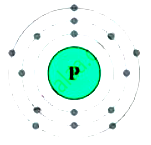
What are nucleons? How many nucleons are present in phosphorus? Draw its structure.
Answer
Nucleons: Particles which constitute the nucleus are called nucleons.
Protons and neutrons are the nucleons.
Atomic mass of phosphorus = 31
Atomic number = 15
View full question & answer
Question 362 Marks
An atom of an element has two electrons in the M shell.
What is the (a) atomic number (b) number of protons in this element?
Answer
Number of electrons in the M shell = 2
So, the number of electrons in the K and L shells will be = 2, 8
Hence, atomic number = 2 + 8 + 2 = 12
Number of protons = 12
View full question & answer
Question 372 Marks
From the symbol ${ }_{12}^{24} \mathrm{Mg}$
,state the mass number, the atomic number and electronic configuration of magnesium.
Answer
Mass number = 24
Atomic number = 12
No. of electrons = 24 - 12 = 12
Electronic configuration = 2, 8, 2
View full question & answer
Question 382 Marks
Write down the names of the particles represented by the following symbols and explain the meaning of superscript and subscript numbers attached ${ }_1 \mathrm{p}^1,{ }_0 \mathrm{n}^1,{ }_{-1} \mathrm{e}^0$
Answer
p = proton
n = neutron
e = electron
Superscript number : These superscript number show their mass number
Subscript number : These numbers show their atomic number
View full question & answer
Question 392 Marks
Write down the electronic configuration of the following:
(a) ${ }_{13}^{27} \mathrm{Y}$
(b) ${ }_{17}^{35} \mathrm{Y}$
Answer
Electronic configuration: ${ }^{27} X _{13}=2,8,3$
Number of electrons in $X =13$
Number of neutrons in $X=27-13=14$
Electronic configuration of ${ }^{35} Y _{17}=2,8,7$
Number of electrons in $Y =17$
Number of neutrons in $Y =35-17=18$
View full question & answer
Question 402 Marks
State one observation which shows that atom is not indivisible.
Answer
Chadwick discovered neutral particles present in an atom by bombarding light nuclei like beryllium with alpha particles, i.e. helium nuclei.
$_4Be^9 + _2He^4 \rightarrow _6C^{12} + _0n^1$
Discovery of the neutron also showed that an atom is divisible.
View full question & answer
Question 412 Marks
What do you think would be the observation of `alpha` particle scattering experiment if carried out on (i) heavy nucleus like platinum (ii) light nuclei like litheum.
Answer
(i) If the foil of a heavy metal like platinum (having a very heavy nucleus) is used, then the observations in the aa-particle scattering experiment would be the same as that in the gold foil experiment
(ii) If, however, the foil of a right metal like lithium (having a very light nucleus) is used, then the fast moving heavy aa-particles may even push the light nucleus aside and may not be deflected back.
View full question & answer
[2 Mark Question Answer] - CHEMISTRY STD 9 Questions - Vidyadip