Questions

[3 Mark Question Answer]

🎯

Test yourself on this topic

16 questions · timed · auto-graded

Question 13 Marks
Compare:
Chlorine atom and chloride ion, with respect to
Atomic structure
Electrical state
Answer
In the chlorine atom, the number of protons (17) is equal to the number of electrons (17).
In chloride ion, there are 17 protons but 18 electrons.
Chlorine atom is electrically neutral. Chloride ion is negatively charged.
The chlorine atom is reactive. It reacts with sodium vigorously forming sodium chloride. Chloride ion is unreactive. It does not react with sodium.
Chlorine ($Cl_2$​​​​​​​) is a poisonous, toxic, corrosive gas that is used in the manufacture of bleaching agents and disinfectants. It is non-toxic and readily absorbed by plants.
View full question & answer
Question 23 Marks
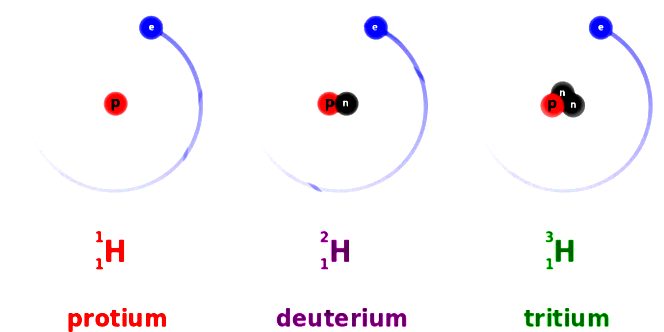
In what respects do the three isotopes of hydrogen differ? Give their structures.
Answer
The three isotopes differ only due to their mass number which is respectively 1, 2 and 3 and named protium, deuterium and tritium.
View full question & answer
Question 33 Marks
Complete the following table relating to the atomic structure of some elements.

Element Symbol

Atomic
Number

Mass
Number

Numbers of neutrons

Number of Electrons

Number of Protons

Li

3

6

Cl

17

20

Na

12

11

Al

27

13

S

32

16

Answer

Element Symbol

Atomic
Number

Mass
Number

Numbers of Neutrons

Number of Electrons

Number of Protons

Li

3

6

4

3

3

Cl

17

37

20

17

17

Na

11

23

12

11

11

Al

13

27

14

13

13

S

16

32

16

16

16

View full question & answer
Question 43 Marks
Explain
Octet rule for the formation of sodium chloride
Answer
Elements tend to combine with one another to attain the stable electronic configuration of the nearest inert gas.
Sodium chloride
The sodium atom has 1 electron in the valence shell which it donates to the chlorine atom with 7 electrons in the valence shell to attain the stable electronic configuration of the nearest inert gas, i.e. 8 electrons in the valence shell. This is known as the octet rule. These elements combine to form sodium chloride.
View full question & answer
Question 53 Marks
Explain fractional atomic mass. What is the fractional mass of chlorine?
Answer
Atomic masses of the isotopes of chlorine are 35 and 37 . However, in any given sample of chlorine gas, the isotopes occur in the approximate ratio $3: 1,75 \%$ of $\mathrm{Cl}^{35}$ and $25 \%$ of $\mathrm{Cl}^{37}$. So, the relative atomic mass or atomic weight of chlorine is 35.5 .
Fractional atomic mass of chlorine At.
Mass $=\frac{3(35)+1(37)}{2}=\frac{105+37}{2}$
View full question & answer
Question 63 Marks
Why do ${ }_{17}^{35} \mathrm{CI}$ and ${ }_{17}^{37} \mathrm{CI}$ have the same chemical properties? In what respect do these atoms differ?
Answer
Only electrons take part in chemical reactions. Chemical properties depend on the electronic configuration. Isotopes of the element $\mathrm{Cl}{ }_{17}^{35} \mathrm{CI}$ and ${ }_{17}^{37} \mathrm{CI}$ have the same atomic number, and hence, the same configuration. So, they have the same chemical properties. These differ only in physical contents and weights because neutrons contribute to the mass of an atom. ${ }_{17}^{35} \mathrm{CI}$ and ${ }_{17}^{37} \mathrm{CI}$ have different number of neutrons 18 and 20 , respectively.
View full question & answer
Question 73 Marks
What are isotopes? With reference to which fundamental particle do isotopes differ? Give two uses of isotopes.
Answer
Isotopes: Atoms of the same element having the same atomic number but different mass numbers.
Isotopes differ with reference to neutrons.
Uses of isotopes:
Some isotopes are radioactive, i.e. isotopes of cobalt are used for treating cancer and other diseases.
An isotope of $^{235}U$ is used as a fuel in a nuclear reactor
View full question & answer
Question 83 Marks
Five atoms are labeled $A$ to $E$
Atoms Mass No Atomic No.
$A$ $40$ $20$
$B$ $19$ $9$
$C$ $7$ $3$
$D$ $16$ $8$
$E$ $14$ $7$
(a) Which one of these atoms:
(i) contains 7 protons
(ii) has electronic configuration 2,7
(b) Write down the formula in the compound formed between C and D
(c) Predict : (i) metals (ii) non-metals
Answer
(a)
Atom E contains 7 protons.
Atom $B$ has an electronic configuration 2, 7 .
(b) Atom C stands for $Li ^3$, Atom D stands for ${ }_8 O ^{16}$.
Hence, compound formula is $Li _2 O$.
(c) Metals: A and C, Non-metals: B, D, E
View full question & answer
Question 93 Marks
Explain the rule according to which electrons are filled in various energy levels.
Answer
1. The maximum capacity of a shell to accommodate electrons is given by the general formula $2 n^2$, where $n$ is the serial number of a shell.
2. The maximum number of electrons possible in the outermost shell is $8$ and that in the penultimate shell is $18$ .
3. It is not necessary for an orbit to be completed before another is formed. In fact, a new orbit is formed when the outermost shell attains 8 electrons.
View full question & answer
Question 103 Marks
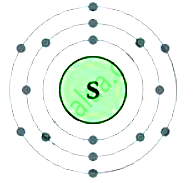
Sulphur has an atomic number 16 and a mass of 32. State the number of protons and neutrons in the nucleus of sulphur. Give a simple diagram to show the arrangement of electrons in an atom of sulphur.
Answer
Atomic number = 16 Atomic mass = 32 Number of protons = 16 Number of electrons = 16 Number of neutrons = 32 - 16 = 16 Electronic configuration = 2, 8, 6 
View full question & answer
Question 113 Marks
Element Symbol No. of Protons No. of Neutrons No. of Electrons
Sodium ${ }_{11}^{23} NA$ $11$ $P$ $11$
Chlorine ${ }_{17}^{35} Cl$ $Q$ $18$ $17$
Uranium $R$ $92$ $146$ $92$
$S$ ${ }_9^{19} F$ $9$ $10$ $9$
Answer
Element Symbol No. of Protons No. of Neutrons No. of Electrons
Sodium ${ }_{11}^{23} NA$ $11$ $12$ $11$
Chlorine ${ }_{17}^{35} Cl$ $17$ $18$ $17$
Uranium $^{238}U_{92}$ $92$ $146$ $92$
Fluorine ${ }_9^{19} F$ $9$ $10$ $9$
View full question & answer
Question 123 Marks
Give the symbol and charge of each particle.
Answer

Particle

Symbol

Charge

Electron

e

-1

Proton

p

+1

Neutron

n

No charge

View full question & answer
Question 133 Marks
How does cathode ray differ from as anode rays?
Answer

Cathode rays

Anode rays

These rays travel from the cathode to the anode.

These rays travel from the anode to the cathode.

They are made of negatively charged particles.

They are made of positively charged particles.

They produce a greenish-yellow fluorescence on a soda-glass screen.

They produce fluorescence on a zinc sulphide screen.

They are affected by an electric field, i.e. they are inflected towards a positive field and deflected towards a negative field.

They are deflected by electric and magnetic fields but in a direction opposite to that of cathode rays.

View full question & answer
Question 143 Marks
State Dalton's atomic theory.
Answer
Main postulates of Dalton's atomic theory:
  1. Matter consists of very small and indivisible particles called atoms.
  2. Atoms can neither be created nor be destroyed.
  3. The atoms of an element are alike in all respects, but they differ from the atoms of other elements.
  4. Atoms of an element combine in small numbers to form molecules.
  5. Atoms of one element combine with atoms of another element in a simple ratio to form molecules of compounds.
  6. Atoms are the smallest units of matter which can take part in a chemical reaction.
View full question & answer
Question 153 Marks
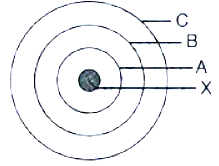
In the figure given alongside
(a) Name the shells denoted by A,B, and C. Which shell has least energy
(b) Name X and state the charge on it
(c) The above sketch is of …………. Model of an atom
Answer
(a) A is for K shell or I shell.
B is for L shell or II shell.
C is for M shell or III shell.
Shell K has the minimum amount of energy.
(b) X is a nucleus; it is positively charged.
(c) The above sketch is of Bohr model of an atom.
View full question & answer
Question 163 Marks
State one major drawback of Rutherford's model.
Answer
One major drawback of Rutherford's model was the comparison of electrons with the planets in the solar system.
Thus, when an electron moved around the nucleus continually, it should radiate energy, i.e. lose energy. As a result it should be gradually pulled towards the nucleus and end up colliding with it. This should result in the total collapse of the atom.
However, we know that the atom is structurally stable. Thus, Rutherford's model could not explain this stability.
View full question & answer
[3 Mark Question Answer] - CHEMISTRY STD 9 Questions - Vidyadip