Questions · Page 1 of 2

[1 Mark Question Answer]

🎯

Test yourself on this topic

50 questions · timed · auto-graded

Question 11 Mark
An element A has 2 electrons in its fourth shell. State:
is it anoxidisingor reducing agent
Answer
It is a Reducing agent.
View full question & answer
Question 31 Mark
An element A has 2 electrons in its fourth shell. State:
position in the periodic table
Answer
Position in the periodic table is group 2 period 4
View full question & answer
Question 51 Mark
An element $A$ has $2$ electrons in its fourth shell. State:
its electronic configuration
Answer
Its electronic configuration is $1s^22s^22p^63s^23p^64s^2.$
View full question & answer
Question 71 Mark
What is the colour of the flame of sodium and potassium?
Answer
The colour of the flame of sodium is golden yellow, and the colour of the flame of potassium is pale violet.
View full question & answer
Question 81 Mark
Name the method by which alkali metals can be extracted.
Answer
Alkali metals can be extracted by the electrolysis of their molten salts.
View full question & answer
Question 91 Mark
Name the alkali metals, How many electron(s) they have in their outermost orbit.
Answer
Name of the alkali metals: Lithium, sodium, potassium, rubidium, cesium, and francium
Electrons in the outermost orbit: 1
View full question & answer
Question 101 Mark
Name and state the following with reference to the elements of the first three periods of the periodic table.
Alkali metal in period 3 dissolves in the water giving a strong alkali.
Answer
Sodium (NaOH)
View full question & answer
Question 111 Mark
Name and state the following with reference to the elements of the first three periods of the periodic table.
Alkaline earth metal in period 3.
Answer
Magnesium
View full question & answer
Question 121 Mark
Name and state the following with reference to the elements of the first three periods of the periodic table.
Typical elements of Groups 14 and 15.
Answer
Typical elements of Period 2 belonging to Group 14 and 15 are carbon and nitrogen.
Typical elements of Period 3 belonging to Group 14 to 15 are silicon and phosphorus.
View full question & answer
Question 131 Mark
Name and state the following with reference to the elements of the first three periods of the periodic table.
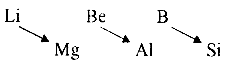
Bridge elements of Period 3 of Group 1,2and 3.
Answer
Li and Mg; Be and Al; B and Si which form bridge relationship i.e. diagonal relationship.
View full question & answer
Question 141 Mark
Name and state the following with reference to the elements of the first three periods of the periodic table.
An electrovalent compound formed by an alkaline earth metal and a halogen.
Answer
Sodium chloride (NaCl)
View full question & answer
Question 151 Mark
Name and state the following with reference to the elements of the first three periods of the periodic table.
Non-metallic elements present in Period 3 of Groups 15 and 16.
Answer
Non-metallic elements present in Period 3 of Groups 15 and 16 -Phosphorus and sulphur
View full question & answer
Question 161 Mark
Name and state the following with reference to the elements of the first three periods of the periodic table.
A covalent compound formed by an element in period $2$ and a halogen.
Answer
Carbon tetrachloride $(CCl_4)$
View full question & answer
Question 171 Mark
Name and state the following with reference to the elements of the first three periods of the periodic table.
Group whose elements have zero valencies.
Answer
Noble gases
View full question & answer
Question 181 Mark
Name and state the following with reference to the elements of the first three periods of the periodic table.
Noble gas having electronic configuration : 2, 8, 8.
Answer
Argon
View full question & answer
Question 191 Mark
Name and state the following with reference to the elements of the first three periods of the periodic table.
Valency of elements in Group 14 and 15.
Answer
4, 3
View full question & answer
Question 201 Mark
Name and state the following with reference to the elements of the first three periods of the periodic table.
Metalloid in Period 3.
Answer
Silicon
View full question & answer
Question 211 Mark
Name and state the following with reference to the elements of the first three periods of the periodic table.
Noble gas with duplet arrangement of electrons.
Answer
Element is Helium
View full question & answer
Question 221 Mark
An element belongs to the third period and Group IIIA (13) of the periodic table. State: the name of the element.
Answer
The name of the element is Aluminium.
View full question & answer
Question 231 Mark
An element belongs to the third period and Group IIIA (13) of the periodic table. State: if it is a metal or non-metal?
Answer
It's a Metal.
View full question & answer
Question 241 Mark
An element belongs to the third period and Group IIIA (13) of the periodic table. State: thevalency,
Answer
The valency is +3.
View full question & answer
Question 251 Mark
An element belongs to the third period and Group IIIA (13) of the periodic table. State: the number of valence electrons,
Answer
The number of valence electrons is 3
View full question & answer
Question 261 Mark
What is the name given to group 17 elements? Why are they called so?
Answer
Group 17 elements are called halogens. The name halogens are from Greek halo(sea salt) andgens(producing, forming) and thus means 'sea salt former'.
View full question & answer
Question 301 Mark
Name an element of group 18 which can form compounds.
Answer
Xenon or krypton from Group 18 can form compounds.
View full question & answer
Question 311 Mark
How many electrons do inert gases have in their valence shells?
Answer
All the noble or inert gases have 8 electrons in their valence shell except helium which has two electrons in its valence shell.
View full question & answer
Question 321 Mark
Why group 17 elements are highly reactive?
Answer
Group 17 elements are highly reactive because of their closeness to the noble or stable gas configuration. They can easily achieve a noble gas electron structure.
View full question & answer
Question 331 Mark
State the nature of compounds formed when group 17 elements combine with (i) metals (ii) non-metals.
Answer
  1. Group 17 elements react with metals to form metal halides which are neutral in nature.
  2. Group 17 elements react with non-metals to form acidic compounds such as hydrogen halides.
View full question & answer
Question 371 Mark
Arrange the following:
Elements of group 1, in increasing order of reactivity
Answer
$Li < Na < K < Rb < Cs$
View full question & answer
Question 381 Mark
Give reason:
Inert gases do not form compounds.
Answer
Inert gases have 2 or 8 electrons (duplet/octet) in their outermost orbit. That is their electronic arrangement is very stable, so they are unreactive and do not form compounds.
View full question & answer
Question 391 Mark
Give reason:
Alkali and alkaline earth metal compounds usually form electrovalent compounds.
Answer
Alkali metals and alkaline earth metals have 1 and 2 valence electrons, respectively, in their outermost shell.
They can lose electrons to atoms of non-metals to form an electrovalent compound.
View full question & answer
Question 401 Mark
Give reason:
Alkali metals and halogens do not occur free in nature.
Answer
Alkali metals and halogens are very reactive; hence, they do not occur in the free state in nature.
View full question & answer
Question 411 Mark
Give reason:
Alkali metals are kept in an inert solvent.
Answer
Due to the reactive nature of alkali metals, they are kept in inert solvents.
View full question & answer
Question 421 Mark
How do alkaline earth metals occur in nature?
Answer
Alkaline earth metals occur in nature in the combined state and not in the free state as they are very reactive.
View full question & answer
Question 431 Mark
Name the first three alkaline earth metals.
Answer
The first three alkaline earth metals are Beryllium, Magnesium, and Calcium.
View full question & answer
Question 441 Mark
This question refers to elements of the periodic table with atomic numbers from 3 to 18. In the table below, some elements are shown by letters, even though the letters are not the usual symbols of the elements.

3

4

5

6

7

8

9

10

A

B

C

D

E

F

G

H

11

12

13

14

15

16

17

18

I

J

K

L

M

N

O

P

What is the electronic configuration of G?
Answer
G has atomic number 9; therefore, its electronic arrangement is 2, 7.
View full question & answer
Question 451 Mark
This question refers to elements of the periodic table with atomic numbers from $3$ to $18.$ In the table below, some elements are shown by letters, even though the letters are not the usual symbols of the elements.
$3$ $4$ $5$ $6$ $7$ $8$ $9$ $10$
$A$ $B$ $C$ $D$ $E$ $F$ $G$ $H$
$11$ $12$ $13$ $14$ $15$ $16$ $17$ $18$
$I$ $J$ $K$ $L$ $M$ $N$ $O$ $P$
If $A$ combines with $F$, what would be the formula of the resulting compound?
Answer
$Li_2O$. A stands for lithium and F stands for oxygen. The valence of lithium is $+1$ and the valence of $O$ is $-2$, i.e. $A_2F.$
View full question & answer
Question 461 Mark
This question refers to elements of the periodic table with atomic numbers from 3 to 18. In the table below, some elements are shown by letters, even though the letters are not the usual symbols of the elements.

3

4

5

6

7

8

9

10

A

B

C

D

E

F

G

H

11

12

13

14

15

16

17

18

I

J

K

L

M

N

O

P

Which of these is:

  1. a noble gas?
  2. a halogen?
  3. an alkali metal?
  4. an element with valency4?
Answer
  1. H and P are noble gases.
  2. G and O are halogens.
  3. A andI are alkali metals.
  4. D and L have valency4.
View full question & answer
Question 471 Mark
What is the number of elements in the $3^{rd}$ period, of the modern periodic table?
Answer
There are eight elements in the third period.
View full question & answer
Question 481 Mark
What is the number of elements in the $1^{st}$ period$?$
Answer
There are two elements in the first period.
View full question & answer
Question 491 Mark
Name two elements of each group.
Answer
  1. Group 1: Lithium (Li), Sodium (Na)
  2. Group 17: Chlorine (Cl), Iodine (I)
  3. Group 18: Helium (He), Neon (Ne)
View full question & answer
Question 501 Mark
What are the following group known as?
Group 18
Answer
Group 18 is known as Noble gases or Inert gases or Zero group elements.
View full question & answer
[1 Mark Question Answer] - CHEMISTRY STD 9 Questions - Vidyadip