Questions

[2 Mark Question Answer]

🎯

Test yourself on this topic

31 questions · timed · auto-graded

Question 12 Marks
State two ways by which a saturated solution can be changed to unsaturated solution.
Answer
  • On heating, a saturated solution becomes unsaturated and more solute can be dissolved in the solution.
  • By adding more solvent, a saturated solution can be made unsaturated.
View full question & answer
Question 22 Marks
What is the importance of dissolved impurities in water?
Answer
The dissolved impurities in water are salts and minerals.
Dissolved salts provide specific taste to water.
Salts and minerals are essential for growth and development.
They supply the essential minerals needed by our body.
View full question & answer
Question 32 Marks
Name three methods by which hydrous substances can be made anhydrous.
Answer
Methods by which hydrous substances can be made anhydrous:
  • By heating
  • Exposure to dry air
View full question & answer
Question 42 Marks
What are hydrous substances? Explain with examples.
Answer
Substances which contain water molecules along with salt are hydrated substances.
Examples: Sodium carbonate decahydrate: $Na_2CO_3.10H_2O$
Copper sulphate pentahydrate: $CuSO_4.5H_2O$
View full question & answer
Question 52 Marks
What is soap? For what is it used?
Answer
Soap is chemically a sodium salt of stearic acid (an organic acid with the formula $C_{17}H_{35}COOH$) and has the formula $C_{17}H_{35}COONa$.
Soap is used for washing purposes.
View full question & answer
Question 62 Marks
State the disadvantages of using hard water.
Answer
  • It is more difficult to form lather with soap.
  • Scum may form in a reaction with soap, wasting the soap.
  • Carbonates of calcium and magnesium form inside kettles. This wastes energy whenever you boil a kettle.
  • Hot water pipes 'fur up'. Carbonates of calcium and magnesium start to coat the inside of pipes which can eventually get blocked.
View full question & answer
Question 72 Marks
Give equations to show what happens when temporary hard water is
Treated with slaked lime
Answer
$\mathrm{Ca}\left(\mathrm{HCO}_3\right)_2+\mathrm{Ca}(\mathrm{OH})_2 \xrightarrow{\text { Boil }} 2 \mathrm{CaCO}_3+2 \mathrm{H}_2 \mathrm{O}$
$\mathrm{Mg}\left(\mathrm{HCO}_3\right)_2{ }^{+} \mathrm{Ca}(\mathrm{OH})_2 \xrightarrow{\text { Boil }} \mathrm{MgCO}_3+2 \mathrm{H}_2 \mathrm{O}$
View full question & answer
Question 82 Marks
Give equations to show what happens when temporary hard water is
Boiled
Answer
$\begin{gathered}\mathrm{Ca}\left(\mathrm{HCO}_3\right)_2 \xrightarrow{\text { Boil }} \mathrm{CaCO}_3+\mathrm{H}_2 \mathrm{O}+\mathrm{CO}_2 \uparrow \\ \mathrm{Mg}\left(\mathrm{HCO}_3\right)_2 \xrightarrow{\text { Boil }} \mathrm{MgCO}_3+\mathrm{H}_2 \mathrm{O}+\mathrm{CO}_2 \uparrow\end{gathered}$
View full question & answer
Question 92 Marks
What is the effect of temperature on solubility of $KNO _3$ and $CaSO _4$ in water?
Answer
Solubility of potassium nitrate $\left( KNO _3\right)$ in water increases with an increase in temperature. Solubility of calcium sulphate $\left( CaSO _4\right)$ in water decreases with an increase in temperature.
View full question & answer
Question 102 Marks
Give the names and formulae of two substances
Anhydrous substance
Answer
Table salt: $NaCl$
Nitre: $KNO_3$​​​​​​​
View full question & answer
Question 112 Marks
Give the names and formulae of two substances.
Hydrated substance
Answer
Washing soda crystals: $Na_2CO_3.10H_2O$
Blue vitriol: $CuSO_4.5 H_2O$
View full question & answer
Question 122 Marks
State any three methods of crystallisation.
Answer
In the laboratory, crystals may be obtained by the following methods:
By cooling a hot saturated solution gently
By cooling a fused mass
By sublimation
By slowly evaporating a saturated solution
View full question & answer
Question 132 Marks
How can you show that your solution is really saturated?
Answer
Stir this mixture with the help of a glass rod and dissolve the copper sulphate crystals. Similarly, go on dissolving more copper sulphate (1 gram at a time) with constant and vigorous stirring. A stage is reached when no more copper sulphate dissolves. It is called a saturated solution at this temperature.
View full question & answer
Question 142 Marks
Give three factors which affect the solubility of a solid solute in a solvent.
Answer
Three factors on which the solubility of a solid depend:
  1. Temperature
  2. Nature of the solid
  3. Nature of the solvent
View full question & answer
Question 152 Marks
What are drying or desiccating agents? Give examples.
Answer
These are substances which can readily absorb moisture from other substances without chemically reacting with them.
Examples:
Phosphorous pentoxide ($P_2O_5$​​​​​​​), quick lime (CaO)
View full question & answer
Question 162 Marks
Explain why:
Table salts become sticky on exposure to humid air during the rainy season.
Answer
Table salt becomes sticky on exposure during the rainy season, because it generally contains a small percentage of magnesium chloride and calcium chloride as impurities. These impurities absorb moisture from the monsoon air due to their deliquescent nature, and thus, table salt become sticky.
View full question & answer
Question 172 Marks
Explain why:
Effervescence is seen on opening a bottle of soda water.
Answer
Carbon dioxide is dissolved in soda water under pressure. On opening the bottle, the pressure on the surface of water suddenly decreases; therefore, the solubility of $CO_2$ in water decreases and the gas rapidly bubbles out.
View full question & answer
Question 182 Marks
What is the effect of pressure on solubility of gases? Explain with an example.
Answer
With an increase in pressure, the solubility of a gas in water increases.
With an increase in temperature, the solubility of a gas in water decreases.
For example, the solubility of carbon dioxide in water under normal atmospheric pressure is low, but when the water surface is subjected to higher pressure, a lot more of $CO_2$ gas gets dissolved in it.
Similarly, in case of soda water, on opening the bottle, the dissolved gas rapidly bubbles out because the pressure on the surface of the water suddenly decreases.
View full question & answer
Question 192 Marks
Density of water varies with temperature. What are its consequences?
Answer
The property of anomalous expansion of water enables marine life to exist in the colder regions of the world, because even when water freezes on the top, it is still liquid below the ice layer, as the density of water is greater than that of ice.
View full question & answer
Question 202 Marks
'Water is the universal solvent'. Comment.
Answer
Water dissolves many substances forming an aqueous solution. It can dissolve solids, liquids and gases. When a solid dissolves in water, the solid is the solute, the water is the solvent and the resultant liquid is the solution. So, it is said that water is a universal solvent. In other words, water can dissolve nearly every substance.
View full question & answer
Question 212 Marks
Give the properties of water responsible for controlling the temperature of our body.
Answer
Our body is almost 65% of water, and it has the property of specific heat. Due to high specific heat capacity, the presence of a large amount of water is able to modify the climate of the body and control the temperature of our body, which is warm in winter and cool in summer.
View full question & answer
Question 222 Marks
Why does temperature in Mumbai and Chennai not fall as low as it does in Delhi?
Answer
The temperature in Mumbai and Chennai do not fall as low as in Delhi because these cities are situated in the coastal areas. Due to high specific heat capacity, the presence of a large amount of water is able to modify the climate of the nearby land areas making them warmer in winter and cooler in summer. So, the temperature does not fall as low as it does in Delhi.
View full question & answer
Question 232 Marks
Why is water considered a compound?
Answer
Water is considered a compound because it is made of two elements hydrogen and oxygen combined in the ratio 1:8 by mass.
Mass ratio of elements $H_2O$
$H : O, 2 \times 1 : 16 \times 1 = 1 : 8$
(Atomic mass of $H = 1, O = 16)$
Components of water cannot be separated by physical methods but can be separated by electrolysis of water.
View full question & answer
Question 242 Marks
Water exists in all three states. Discuss.
Answer
In the free state, water occurs in the solid, liquid and gaseous states.
Solid state: A large amount of fresh water is found in the form of snow or ice.
Liquid state: Most of the water present in oceans and found in streams, rivers, lakes, ponds and springs on land is water in the liquid state.
Gaseous state: Water vapour present in the air is in the gaseous state. Water vapour condenses in the sky to form clouds. Mist and fog are also examples of water in the gaseous form.
View full question & answer
Question 252 Marks
Explain why:
Rivers and lakes do not freeze easily?
Answer
Large rivers do not freeze "through out" because, Water, ice, and snow are good insulators and poor conductors of heat. The portions of a lake or river that are exposed to the cold winter air will freeze into ice and this ice insulates the water below from further rapid freezing.
View full question & answer
Question 262 Marks
Explain why:
Burns caused by steam are more severe than burns caused by boiling water.
Answer
Burns caused by steam are more severe than burns caused by boiling water because of high specific latent heat of condensation. 2268 J/g of heat is released when 1 g of steam condenses to form 1 gm of water.
Due to the high specific latent heat of solidification of water, rivers and lakes do not freeze easily.
View full question & answer
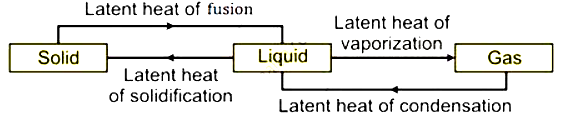
Question 272 Marks
Explain what you understand from the following diagram:
Answer
When a solid changes into a liquid, it absorbs heat equal to the latent heat of fusion. When a liquid changes into a solid, it loses heat equal to the latent heat of solidification.
When a liquid changes into a gas, it absorbs heat equal to the latent heat of vaporisation. When a gas condenses into a liquid, it loses heat equal to the latent heat of condensation.
View full question & answer
Question 282 Marks
How is air dissolved in water different from ordinary air?
Answer
Oxygen is more soluble in water than nitrogen. Air dissolved in water contains a higher percentage of oxygen (30-35%). Oxygen is only 21% in ordinary air. In this way, air dissolved in water is different from ordinary air.
View full question & answer
Question 292 Marks
State the importance of the solubility of $CO_2$ and $O_2$ in water.
Answer
1. Fish extracts the oxygen from the water and expels water through the gills. Fish can survive in water only through the dissolved oxygen present in water.
2. Aquatic plants make use of dissolved carbon dioxide for photosynthesis.
3. Carbon dioxide dissolved in water reacts with limestone to form calcium bicarbonate.
4. Marine organisms such as snails, oysters, etc., extract calcium carbonate from calcium bicarbonate to build their shells.
View full question & answer
Question 302 Marks
What is the importance of dissolved salts in water?
Answer
Importance of dissolved salts in water:
  • Dissolved salts provide specific taste to water.
  • Dissolved salts act as micronutrients for the growth and development of living beings.
View full question & answer
Question 312 Marks
What are the observations and conclusions when tap water is boiled and evaporated in watch glass?
Answer
When tap water is boiled and evaporated:
Observations:
  • A number of concentric rings of solid matter are seen on the watch glass after evaporation of tap water.
Conclusion:
  • Tap water contains dissolved salts, minerals and impurities.
View full question & answer
[2 Mark Question Answer] - CHEMISTRY STD 9 Questions - Vidyadip