Questions

[5 Mark Question Answer]

🎯

Test yourself on this topic

4 questions · timed · auto-graded

Question 15 Marks
Explain the permutit method for softening hard water.
Answer
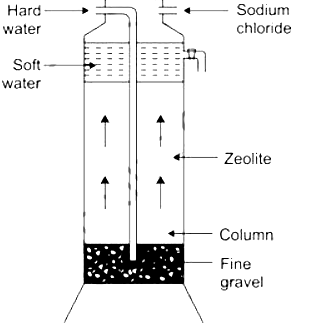
Permutit is an artificial zeolite. Chemically, it is hydrated sodium aluminium orthosilicate with the formula $Na_2Al_2Si_2O_8.XH_2O.$ For the sake of convenience, let us give it the formula $Na_2P.$​​​​​​​

A tall cylinder is loosely filled with lumps of permutit. When hard water containing calcium and magnesium ions percolates through these lumps, ions exchange. Sodium permutit is slowly changed into calcium and magnesium permutit, and the water becomes soft with the removal of calcium and magnesium ions.
When no longer active, permutit is regenerated by running a concentrated solution of brine over it and removing calcium chloride formed by repeated washing.
$CaP + 2NaCl → Na_2P + CaI_2​​​​​​​$​​​​​​​
View full question & answer
Question 25 Marks
What are stalgmites and stalactites? How are they formed?
Answer
In some limestone caves, conical pillar-like objects hang from the roof and some rise from the floor. These are formed by water containing dissolved calcium hydrogen carbonate continuously dropping from the cracks in the rocks. Release of pressure results in the conversion of some hydrogen carbonate to calcium carbonate.
$Ca(HCO_3)_2 → CaCO_3 + CO_2 + H_2O$
This calcium carbonate little by little and slowly deposit on both roof and floor of the cave.
The conical pillar which grows downwards from the roof is called stalactite and the one which grows upward from the floor of the cave is called stalagmite.
These meet after a time. In a year, some grow less than even a centimetre, but some may be as tall as $100 cm.$
$CaCO_3 + CO_2 + H_2O → Ca(HCO_3)_2$
$MgCO_3 + CO_2 + H_2O → Mg(HCO_3)_2$
If the water flows over beds of gypsum ($CaSO_4.2H_2O$), a little bit of gypsum gets dissolved in water and makes it hard.
View full question & answer
Question 35 Marks
What would you observe when crystals of copper (II) sulphate and iron (II) sulphate are separately heated in two test tubes?
Answer
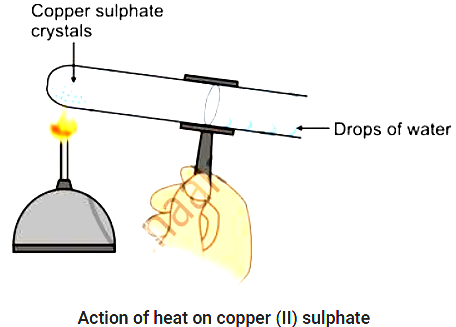
Action of heat on copper (II) sulphate crystals
When copper (II) sulphate crystals are heated in a hard glass test tube, the following observations are observed:

The crystals are converted to a powdery substance.The crystals lose their blue coloration on further heating.
Steaming vapours are produced inside the tube which condense near the mouth of the tube to form a colourless liquid.
On further heating, steam escapes from the mouth of the tube and water gets collected in a beaker placed under the mouth of the tube.
On further heating, the residue changes to a white powder and steam stops coming out.
$\mathrm{CuSO}_4 \cdot 5 \mathrm{H}_2 \mathrm{O} \xrightarrow{\Delta} \mathrm{CuSO}_4+5 \mathrm{H}_2 \mathrm{O}$
Action of heat on iron (II) sulphateWhen iron (II) sulphate is heated in a test tube, the following is observed:
The crystals crumble to a white powder and a large amount of steam and gas are given out.
On strong heating, a brown residue of ferric oxide $\left(\mathrm{Fe}_2 \mathrm{O}_3\right)$ is produced and a mixture of $\mathrm{SO}_2$ and $\mathrm{SO}_3$ is given off.
$\begin{gathered}\mathrm{FeSO}_4 \cdot 7 \mathrm{H}_2 \mathrm{O} \xrightarrow{\text { Heat }} \mathrm{FeSO}_4+7 \mathrm{H}_2 \mathrm{O} \\ 2 \mathrm{FeSO}_4 \xrightarrow{\text { Ferric oxide }} \mathrm{Fe}_2 \mathrm{O}_3+\mathrm{SO}_2+\mathrm{SO}_3\end{gathered}$
View full question & answer
Question 45 Marks
Complete the following table:
Common Name Chemical Name Formula Acid, base or salt Efflorescent,
hygroscopic or deliquescent substance
Solid caustic potash        
Quick lime        
Oil of vitriol        
Washing soda        
Solid caustic soda        
Blue vitriol        
Answer
Common Name Chemical Name Formula Acid, base or salt Efflorescent,
hygroscopic or deliquescent substance
Solid caustic potash Potassium hydroxide $KOH$ Base Deliquescent substance
Quick lime Calcium oxide $CaO$ Base Hygroscopic substance
Oil of vitriol Sulphuric acid $H_2SO_4$ Acid Hygroscopic substance
Washing soda Hydrated sodium carbonate $Na_2CO_3.10H_2O$ Salt Efflorescent substance
Solid caustic soda Sodium hydroxide $NaOH$ Base Deliquescent substance
Blue vitriol Copper sulphate $CuSO_4$ Salt Efflorescent substance
View full question & answer
[5 Mark Question Answer] - CHEMISTRY STD 9 Questions - Vidyadip