Questions

[4 Mark Question Answer]

🎯

Test yourself on this topic

7 questions · timed · auto-graded

Question 14 Marks
What are the local winds? Name any two local winds.
Answer
The local winds blow in certain places and these are warm and cold according to the area from which they blow, e.g. Foehn winds blow descending on the slopes of the Alps and make the temperature ideal for grapes due to its warm effect. In the same way, Chinook winds blowing, and coming down from the Rockies mountains in North America helps to increase the temperature and is beneficial to keep grasslands ice-free and warms the ranches, so good for animal rearing.
View full question & answer
Question 24 Marks
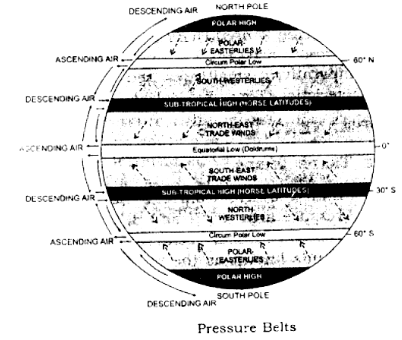
Describe the world distribution of pressure.
Answer
The distribution of atmospheric pressure across the latitudes is termed as global horizontal distribution of pressure and represented as pressure belts, e.g. Equatorial low, Sub-Tropical High, Circum-polar low and Polar High-pressure belts. It is correlated with the rising up and descending down of the air along with low and high-pressure belts respectively. Due to the spherical shape of the earth, the higher latitudes receive less insolation than the lower latitudes, and this difference in temperature different pressure belts are created. Due to extremely low-pressure equatorial ‘Doldrums’ (still air) are created.
View full question & answer
Question 34 Marks
What are the Jet Streams? What is the significance of Jet Streams?
Answer
Jet streams are the concentrated bands of rapid air movement found in the troposphere and stratosphere. The meeting front of warm and cold winds along the sub-tropical zone near 30° latitude and polar front along 60° latitude. Jet streams transport moisture and help in the formation of cyclonic winds. Jet streams are used to forecast the weather, especially for air travel so that the flying should be done according to the jet-streams. Mostly, these jet-streams blow from west to east with the Westerlies.
View full question & answer
Question 44 Marks
Explain the weather conditions associated with tropical and temperate cyclones.
Answer
Tropical cyclones: These are associated with turbulent weather conditions and cause heavy damage to property and human life, e.g. Tornado in North America, Hurricanes in the Caribbean region, typhoons in China, and Japan. These blow from south to north.
Temperate cyclones: These are active along the mid-latitude regions from west to east direction and cover a long region. These are pushed with Westerlies and also called the Western Disturbances. These affect from the Mediterranean to Pacific ocean covering South European countries, Middle East, Iran, Iraq, etc., Pakistan, India, China from west to east. These are associated with rainfall, snowfall, hailstones, etc, followed by clear weather due to coming back anticyclones.
View full question & answer
Question 64 Marks
Explain briefly the factors that affect Atmospheric Pressure.
Answer
Factors affecting Atmospheric Pressure are as below :
  • Altitude: The atmospheric pressure decreases with height or altitude. The decrease in pressure is about 1 cm of mercury for every 110 m of ascent. The atmospheric pressure is highest at sea level. This is because at higher altitudes the air is thinner or less dense than the air at the sea level. The maximum air density is at the earth’s surface; air density decreases with height because the pull of the earth’s gravity is less. The fewer number of gas molecules at higher altitudes means fewer molecular collisions and a decrease in air pressure.
  • Temperature: Atmospheric pressure decreases with increase in temperature. This is because when the temperature rises, air expands. The molecules of air move far apart (become less dense) and hence exert less pressure. On the contrary, with a decrease in temperature, the air gets compressed and the space between molecules decreases (becomes denser) and exerts more pressure on the region.
  • Water Vapour: Water vapour concentration affects atmospheric pressure because the molecular weight of water (18 g/mol) is less than the average molecular weight of air (about 29 g/mol). When water evaporates and enters the atmosphere as a gas, the water vapour molecules take the place of other gas molecules in the air. So, a volume of wet (or humid) air weighs less than an equal volume of dry air. Therefore, humid air is less dense and exerts less pressure than dry air.
  • Rotation of the Earth: Due to the rotation of the earth, the bulk of the air at the Poles is thrown away towards the Equator. Since the Equatorial region receives a great amount of heat throughout the year, the air becomes warm and light and therefore, it rises and creates low pressure. At the Poles, the cold heavy air sinks down and creates high pressure. In fact, temperature and rotation of the earth together contribute to the formation of world pressure belts.
View full question & answer
Question 74 Marks
Cyclones and Anticyclones.
Answer
Cyclones :
  1. These are the circular winds with low pressure in the centre.
  2. The winds blow anticlockwise from outside to the centre in Northern Hemisphere.
  3. These bring rainfall, clouds thunder lightening.
Anticyclones :
  1. These are circular winds with high pressure in the centre.
  2. The winds blow clockwise from the centre towards all sides in Northern Hemisphere.
  3. These bring clear weather and cold winds.
View full question & answer
[4 Mark Question Answer] - Geography STD 9 Questions - Vidyadip