Questions

[4 Mark Question Answer]

🎯

Test yourself on this topic

9 questions · timed · auto-graded

Question 14 Marks
What are the properties of Troposphere?
Answer
Properties of Troposphere :
  1. It extends to a height of 18 km at the equator and declines gradually to a height of 8 km at the poles.
  2. Most of the weather phenomena take place in this layer.
  3. It contains almost all the water vapour and most of the dust particles. It is a turbulent zone.
  4. The upper limit of troposphere is called tropopause.
  5. In the troposphere, the temperature of air decreases at an average rate of 1°C for every 166 metres.
View full question & answer
Question 24 Marks
Why does the atmosphere thin out at higher levels?
Answer
The atmosphere is held by the gravitational force of the Earth and is densest near the Earth’s surface where gravity is maximum. There are concentric layers of air in the atmosphere. Each layer has a different density. The upper layers are continually pressing down on the lower ones. Therefore, the air of the lower layer is always much heavier or denser, while the upper layers are thinner or less dense. Thus atmosphere thins out at higher levels and about 90 percent of the mass of air lies within a height of about 20 km. from the surface of the earth.
View full question & answer
Question 34 Marks
What is the significance of Ozone and what are the effects of its depletion?
Answer
Ozone in the atmosphere acts as a protective umbrella for us by absorbing harmful ultraviolet radiation coming from the sun.
Effects of Ozone depletion :
  1. The ozone layer screens out more than 99 percent of the incoming solar energy. Ultraviolet radiation of these wavelengths is harmful to most forms of terrestrial life, causing eye irritation, skin cancer, and many other diseases, depending on the amount of radiation.
  2. It impairs the growth of certain crop plants and adversely affects a wide variety of organisms from bacteria to vertebrates.
  3. Microorganisms may undergo a high rate of mutation because of the high sensitivity of the DNA to ultraviolet light.
  4. The increased ultraviolet radiation may lead to faster deterioration of plants, fabrics, plastics, and other materials.
Effects of Global Warming: Global warming can cause changes in rainfall patterns leading to flooding in some areas and drought in others. Monsoon flooding is expected to cause great loss of life in India, Bangladesh, and South-East Asian countries. Over the last 100 years, because of Global Warming, the ice reserves have melted and the sea level has risen by about 10 to 25 cm. If this trend continues, areas will be submerged under seawater.
View full question & answer
Question 44 Marks
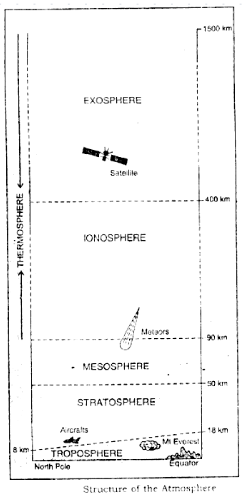
Name different layers of atmosphere. Describe the important characteristics of each layer.
Answer

The atmosphere is composed of the following belts (layer):

1.Troposphere:
This atmospheric layer lies closed to the earth’s surface. It extends to a height from 8 km (Near the Poles) to 18 km (Near the Equator). Most of the weather phenomena occur in this layer of the atmosphere. It is a dusty zone containing much water vapour and clouds.

2. Stratosphere: The next layer lying above the troposphere is the stratosphere. The thickness of this layer varies about 62 km (at the Equator) and about 72 km (at the Poles.) Temperature is almost constant. There are no clouds, water vapour of dust in this layer due to the constant temperature in the vertical direction. Ozone gas is found in abundance which absorbed harmful ultra-violet radiation from the sun.

Image"

3. Mesosphere: This third layer is above the stratosphere. ‘Meso’ meaning the intermediate, this region is marked by a decrease in temperature with height. Temperature decrease from about 0°C at Stratopause to 100°C at Mesopause. This inversion of temperature is probably due to the absence of ozone molecules beyond the stratosphere. This layer extends to 80 km. above the earth.

4. Thermosphere:
It lies above the Mesosphere and is divided into two parts-the the Ionosphere and Exosphere.

  • Ionosphere: The air layer lying behind the stratosphere is known as the Ionosphere. This extends to a height of 80 km to 480 km. Radio waves used in long-distance radio communication are reflected back to earth by the Ionosphere. In this way, radio massages can be transmitted round the curve of the Earth. This is about 970 km thick.
  • Exosphere: The upper-most layer of the atmosphere is called Exosphere. It lies somewhere between 480 km. and above the Earth. It is known only to aerospace ships.


View full question & answer
Question 54 Marks
Explain the composition of the Atmosphere
Answer
The most important gases composing the atmosphere are nitrogen 78% and oxygen (21%). Therefore, 99% of the atmosphere consists of nitrogen and oxygen. Of the remaining gases, argon accounts for 0.9%. The other gases are carbon dioxide, helium, hydrogen, methane, etc. These gases are called the fixed components of the atmosphere because their relative proportion is constant in the lower layers of the atmosphere. In addition to fixed components, there are a number of variable components of the atmosphere. The quantity of these components varies from place to place.
View full question & answer
Question 64 Marks
Give a description of the recent studies about Global Warming.
Answer
The Global mean temperature has increased by 0.6°C in the 20th century. It is estimated to increase by 1.4° to 5.8°C by the year 2100 from 1990. This has affected abnormal weather conditions in various parts e.g. less rainfall in Africa and Gulf Coast of the U.S.A., more rainfall in the Asian tropical region and some areas may get no rainfall. Increasing melting of ice and glaciers resulted in rise of oceanic water level by 10 to 25 cm. Warming of the atmosphere will considerably increase its moisture carrying capacity. While the troposphere warms up, the stratosphere will cool down.
It is the balance between radiation coming into the atmosphere and radiation going out. Any change in this balance can have a rapid impact on life forms on earth because it will have an impact on the sensitivity, adaptability, and vulnerability of the whole biospheric system. Climate change will bring about substantial changes in cereal production specially in the Tropics. Global freshwater conditions may worsen by 2025.
View full question & answer
Question 74 Marks
Describe the structure of the atmosphere. ### Write a paragraph about the structure of the atmosphere.
Answer
In the atmosphere, there are concentric layers of air. Each layer has a different density. The upper layers press down the lower one. So, the air of the lower layer is always heavier or denser, while the upper layers are thinner or less dense. In this way, about 90 percent of the mass of air lies within a height of about 20 km from the surface of the earth. On the basis of the characteristics of temperature and air pressure there exist four thermal layers of the atmosphere. They are Troposphere, Stratosphere, Mesosphere, and Thermosphere. The Thermosphere is divided into Ionosphere and Exosphere.
View full question & answer
Question 84 Marks
Greenhouse Effect
Answer
Greenhouse Effect: Greenhouse is built-in cold areas to grow the plants within it in warm temperatures. But, due to Global Warming, the whole earth is becoming a Greenhouse due to an increase in temperature, which indirectly disturbs the normal life on earth by challenging nature and nature will originate many unwanted problems of change in climate, radiation imbalance, diseases, etc.
The rate of absorption of solar radiation by earth and its emission back into space as infra-red waves balance the heat on earth. This phenomenon plays a very important role in maintaining the surface temperature of the earth. The carbon dioxide and other gases form a blanket around the globe which prevents the passage of infra-red waves from the earth back into space. Concentration of solar radiation produces much heat, making the earth a very warm place. This phenomenon is similar to that of the greenhouse in which the glass-enclosed area gets heated up due to its insulation from the rest of the environment. Hence, warming of the atmosphere is due to the greenhouse effect. Hence, Global Warming is also known as the Greenhouse Effect.
View full question & answer
Question 94 Marks
Explain : Global Warming
Answer
  • Global Warming: The temperature on the earth is rising. This phenomenon known as Global Warming is the result of enhanced concentration of Greenhouse gases in the atmosphere caused mainly by human activities. Consequences of Global Warming:
  1. Global temperature is likely rise by 2 to 5°C during the next century. Due to rise in temperature by 2 to 5°C, there is a chance of melting of ice caps on Earth’s poles. This melting of ice will result in the rise of the sea level. Large stretches of low lying areas will submerge and many island countries will face deep encroachment by seawater. Some may disappear altogether.
  2. As the increase in temperature will be uniform all over the surface of the world, there will be serious climatic changes. This will bring various changes in wind and rain patterns.
  3. Higher temperature will cause rise in transpiration, which in turn, will affect the groundwater table.
  4. As the climatic belts shift from equator towards pole, the vegetation would also shift away from the equator.
  5. Insects and pests will increase in the warmer climatic conditions. Thus, pathogenic diseases will multiply.
View full question & answer